Acts 27 is famous for its storm — fourteen days of howling wind, a ship adrift under blackened skies, two hundred and seventy-six souls clinging to broken planks before they finally wash ashore on Malta. But the real question of discernment in Acts 27 doesn’t begin with the storm. It begins with a single, quiet sentence tucked into verse 11, where the entire chapter is silently decided.
“But the centurion paid more attention to the pilot and to the owner of the ship than to what Paul said.”
— Acts 27:11 (ESV)
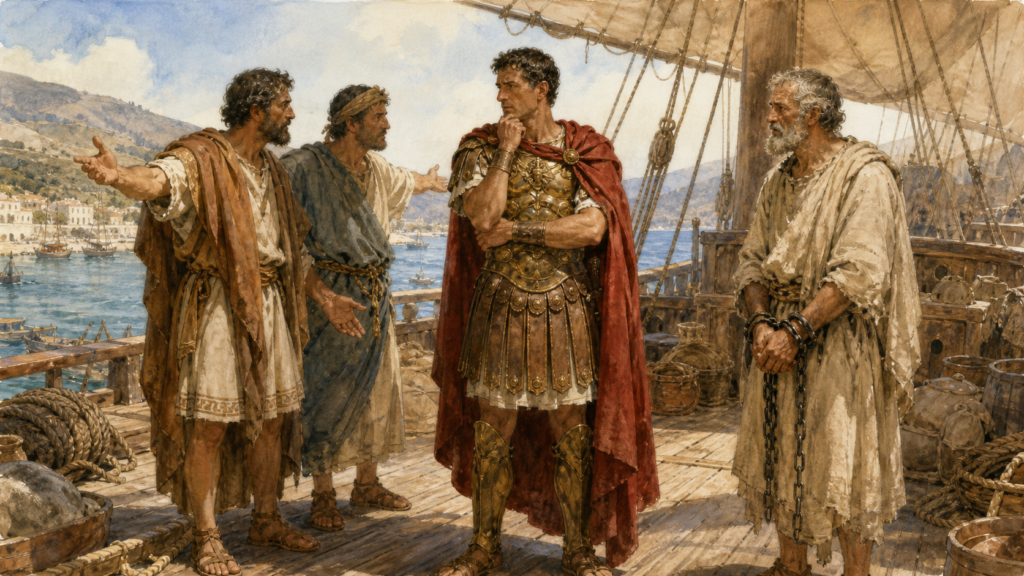
Acts 27 narrates Paul’s voyage from Caesarea to Rome under Roman guard. What begins as a routine prisoner transfer turns into the longest and most cinematic narrative in the entire book — wind, calculation, prayer, broken bread, shipwreck, and unexpected salvation. But the trajectory of the whole chapter pivots on this brief moment in verse 11. Julius the centurion, charged with delivering Paul to Caesar, has to decide whose counsel to trust. He chooses the experts. The storm begins there.
When the Reasonable Choice Looks So Right
Stand in Julius’s place for a moment.
Two voices are speaking. On one side: the ship’s pilot and its owner — seasoned mariners with decades of Mediterranean experience between them. They argue, quite reasonably, that Fair Havens isn’t a safe winter harbor and that pressing on to Phoenix would be wiser (Acts 27:12). On the other side: a chained prisoner with no maritime training, no rank, no public credibility. He warns that the voyage will end in injury and much loss (Acts 27:10).
By every visible measure, Julius isn’t being foolish. He’s being rational. He’s listening to the people who actually pilot ships for a living. If we had been there, most of us would have made the same call. So why did the centurion not listen to Paul? Not because he was being stubborn or impious. He was being sensible. The terrifying thing about Acts 27:11 is that the wrong choice came clothed in unimpeachable common sense.
What unsettles me about this verse, the more I sit with it, isn’t that the centurion was unreasonable. It’s that reason alone did not guarantee truth.
Most commentaries treat verse 11 as a quick narrative beat — the centurion misjudged, the storm followed. But Luke seems to be doing something subtler than just marking a mistake. He’s showing us how disasters tend to begin — not with foolishness, but with sensible decisions made in the absence of one quieter voice. Being convinced of our own judgment, it turns out, is no protection at all. (I sat with a similar tension in my Acts 23 devotional, where conviction itself can quietly run against God.)
The Quiet Verb Behind “Listened More”

I wanted to dig into the original Greek here, because something in the English softens easily.
The verb behind “paid more attention to” is ἐπείθετο (epeitheto), the imperfect passive form of πείθω (peithō, to persuade or to be persuaded). The ESV’s rendering sounds active — as though Julius weighed both sides and rendered a calm verdict. But the Greek passive voice carries a quieter, almost involuntary weight. He was being persuaded. The decision came to him like a tide coming in — slowly, naturally, almost without him choosing.
This is what catches me. I do this every day.
I imagine I’m discerning, but in reality my heart leans, almost on its own, toward whichever voice carries more obvious authority — the more successful person, the more confident expert, the larger consensus. I’m being persuaded long before I think I’m deciding. And the truth — that this drift was carrying me away from the smaller, harder voice of God — usually surfaces only after the storm hits.
The Voice That Comes from a Bound Mouth
A second question rises out of this verse. Where, in Scripture, does God’s voice tend to come from?
Paul, on this ship, was the smallest man aboard. He was in chains. He couldn’t even decide his own destination. And yet, out of his bound mouth came the only spiritual insight that could have spared the entire voyage from disaster.
This is a pattern that repeats throughout Scripture in ways that should slow us down.
In Pharaoh’s court, the truth was spoken by Joseph, a former slave (Genesis 41).
In King Ahab’s palace, the only true word came from Micaiah, the prophet everyone hated to hear (1 Kings 22).
Before Pilate, the One who said, “I have come into the world — to bear witness to the truth” stood there bound, beaten, and condemned (John 18:37).
God seems to speak, again and again, from outside the seats of credentialed authority — through the bound, the small, the dismissed. Which means the question Acts 27:11 leaves us with isn’t which voice sounds more authoritative. It’s which voice carries the truth. And in the moment, that’s a much harder question than retrospect makes it sound. (The same difficulty surfaces in my Acts 21 devotional, where even Spirit-given knowledge doesn’t always resolve into a single clear next step.)
A Storm Built One Small Inclination at a Time

Whose voice am I believing a little more these days?
The world is loud with plausible voices — the successful person’s confidence, the credentialed expert’s analysis, the crowd’s consensus. And in the middle of all that noise, the gospel often takes Paul’s seat: sounding bound, sounding small, sounding out of step. To stay tuned to that smaller voice requires a deliberate choice every single day. Left alone, my ear naturally turns toward the louder one.
So Acts 27:11 starts to read, over time, less like one centurion’s mistake and more like a description of how all of our storms are built. Storms rarely come from a single dramatic decision. They come from the accumulation of a little more trust here, a little more weight there, day after day, until we wake up in a wind we can no longer steer.
I want to say one more thing carefully here, because I don’t want to be heard wrong. The discernment in Acts 27 isn’t telling us to ignore expertise or distrust qualified counsel. The pilot and the owner weren’t lying — winter sailing was genuinely dangerous, and their professional judgment about Fair Havens may have been entirely sound on its own terms. The verse isn’t anti-expert. It’s anti-absolute. It warns us about the moment when one kind of voice — even a competent, sensible, credentialed one — becomes the only voice we’re willing to weigh. The centurion’s failure wasn’t that he listened to the experts. It was that he stopped listening to anyone else.
Frequently Asked Questions
Q: Why did the centurion not listen to Paul in Acts 27?
A: Julius the centurion deferred to the ship’s pilot and owner because, by every reasonable measure, they were the qualified experts. Acts 27:11 doesn’t show him being foolish — it shows him being sensible. His failure wasn’t ignoring expertise; it was treating expert counsel as the only voice worth weighing.
Q: What is the meaning of Acts 27:11?
A: The Acts 27:11 meaning centers on the difference between being convinced and being right. The Greek verb ἐπείθετο is passive — Julius was being persuaded, drifting toward the louder voice rather than actively discerning. The verse warns that reasonable decisions made without spiritual attentiveness can still lead into a storm.
Q: How does Acts 27 teach spiritual discernment?
A: Acts 27 frames discernment not as a one-time judgment but as a daily orientation. The chapter shows that God’s voice often comes through the bound, the small, the dismissed — not through credentialed authority. Discernment in Acts 27 is the willingness to weigh the smaller voice alongside the louder one, every single day.
A Prayer to Close — Discernment in Acts 27
Lord,
I see myself in the centurion. I am rational. I am sensible. And quietly, daily, I am being persuaded by voices louder than yours. The voice of the credentialed expert, the successful neighbor, the agreeing crowd — these reach me before your voice does, and my heart leans toward them almost without my noticing.
Give me ears to hear the smaller voice. Help me weigh the bound man’s words alongside the captain’s. Show me where I am drifting today, and where the storm is being built one small inclination at a time. Teach me to make your word — not the loudest voice in the room — the highest authority in my ordinary days.
In the name of our Lord Jesus Christ I pray. Amen.
About the Author
Each morning I read one chapter of Scripture and reflect on its resonance in daily life. Writing from the perspective of a layperson rather than a trained theologian, I trace how the ancient text still meets us today.
📖 Learn more: About the Author