This morning’s Acts 26 devotional reading kept circling back to one short exchange between Paul and King Agrippa—just two verses—but the more I sat with it, the more I felt those two verses might be the heart of the whole chapter.
“And Agrippa said to Paul, ‘In a short time would you persuade me to be a Christian?’ And Paul said, ‘Whether short or long, I would to God that not only you but also all who hear me this day might become such as I am—except for these chains.'”
— Acts 26:28-29 (ESV)
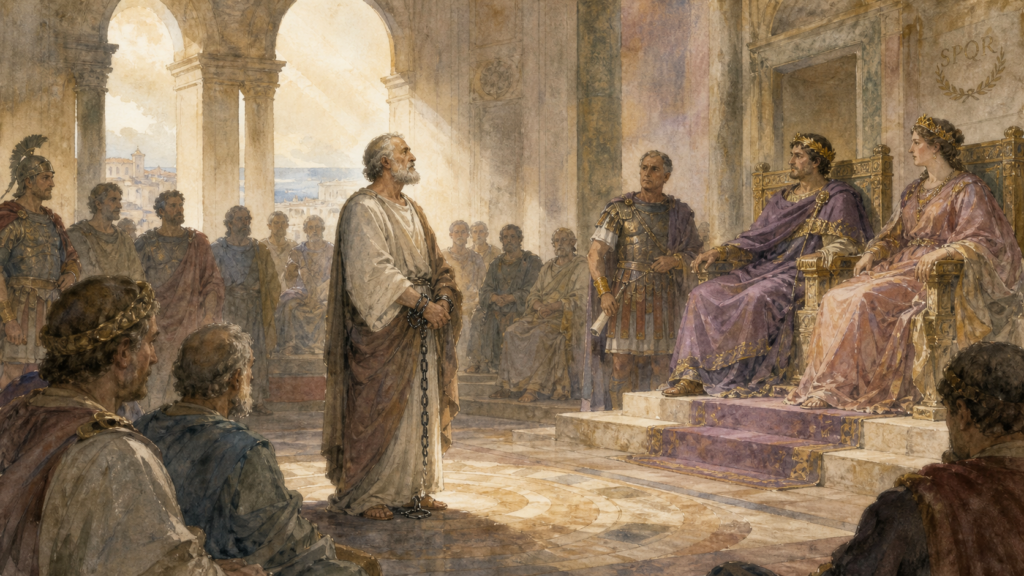
Acts 26 takes place in Caesarea, in front of the most decorated audience Paul has spoken to in the whole book. King Agrippa II is there with his sister Bernice. The new Roman governor Festus is presiding. Roman tribunes and leading citizens of the city fill the room. The technical purpose of the gathering is to help Festus draft a letter to Caesar, since Paul has appealed his case to Rome and Festus has no idea what charges to actually write down (25:26-27). What unfolds, however, is something much stranger than a legal hearing.
The Prisoner Who Forgot He Was on Trial
Paul is supposed to be defending himself. He is in chains. He has been in custody for over two years. The Jewish leadership in Jerusalem wants him dead. The whole structure of the moment is one in which the prisoner is small and the kings are large.
But as Paul tells the story of his Damascus encounter and his commission—really the whole gospel by way of his autobiography—something tilts. Around verse 27, he turns the frame upside down. He looks at Agrippa and asks, “Do you believe the prophets? I know that you believe.” The accused is now questioning the judge. The defendant is testing the king’s faith.
Then comes Agrippa’s response in verse 28. The Greek phrase ἐν ὀλίγῳ (en oligō) is genuinely ambiguous—translators are split on whether Agrippa is speaking with serious emotion (“almost you persuade me”) or with a kind of deflective wit (“are you trying to make a Christian of me this quickly?”). The text refuses to tell us. What it does tell us is what Paul says next, and that is where I had to stop and stay for a while.
“Except for These Chains”
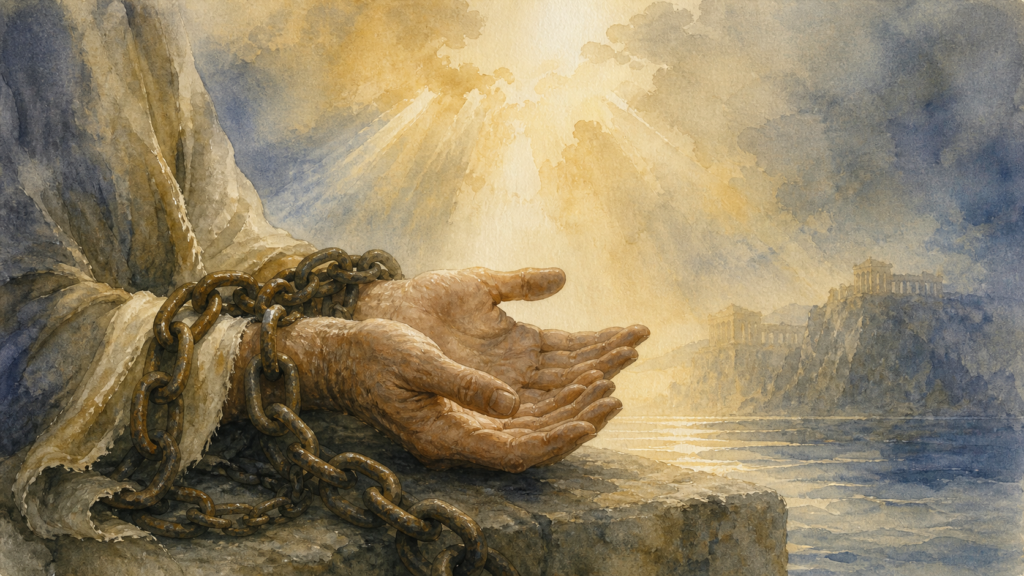
On the surface, Paul’s reply is witty. “I’d love for you—and everyone hearing me—to become exactly like me. Just minus these chains.” It is the kind of line you remember.
But sitting with those words longer, I noticed two things present at the same time, and the way they sit together is what struck me.
The first is that Paul finds what he has received so good that he wants the king who is holding him captive to have it too. He wants Bernice and Festus and the centurions and every nameless person in that room to have it. This is not the language of someone who has settled for something. You don’t recommend “good enough” to your jailer. You only say “become like me” about something you cannot stop being grateful for.
The second is that Paul tells the truth about his chains. He does not dress them up. He does not say “even my suffering is beautiful” or “these chains are an honor.” Chains are bad. So please take everything except those. The honesty is bracing. He does not romanticize his hardship to make his testimony sound nobler than it is.
What I find quietly remarkable is how those two things coexist in one sentence. The grace he has received is so abundant that even imprisonment cannot cancel it out—and yet imprisonment is still imprisonment. Freedom is freedom and chains are chains. The freedom just runs deeper than the chains, that is all.
Not Strategic Witness, but Overflow
I asked myself: was this evangelism, or was it self-defense?
Formally, the setting is a legal hearing. Paul is presenting his case. But the content of what he says—and the warmth of how he says it—is unmistakably an invitation. I don’t think Paul woke up that morning planning a rhetorical pivot to evangelism at exactly the right moment. I think his testimony was simply moving through him, and at one point it spilled over the edges of the courtroom and became something else.
That reframes the passage for me. The scene of Paul before Agrippa isn’t a manual for “how to share your faith strategically.” It is a picture of what it looks like when someone has received something so good that it cannot be contained, and other people happen to be standing nearby when it overflows.
When you have received enough, it leaks. You don’t have to push it. It shows up in the way you talk, the way you respond when something goes wrong, the way you treat the people who cannot help your career. Eventually someone asks, “Why do you live like that?”—and only then does your mouth open. They say the unrehearsed sentence that comes out at that moment carries more weight than a thousand polished evangelistic lines.
The contemporary picture I keep coming back to is Clayton Kershaw. The former Dodgers pitcher doesn’t preach from the mound. He doesn’t make a spectacle of his faith in interviews. But the way he treats his wife, the orphanage work in the Dominican Republic, his composure through losing seasons—the whole life is the message. When somebody asks him why, he tells them about what he has received. The answer doesn’t sound like a sales pitch. It sounds like overflow.
It struck me that what Paul said in chains and what Kershaw says in interviews come from the same place. Different centuries, different rooms, but the same source: a heart so full of received grace that the speech is almost involuntary.
The Question Underneath the Question
Reading this Acts 26 devotional today, my first instinctive question was: Am I living like that? Am I a witness like Paul, like Kershaw?
But sitting with it longer, I realized there is a question that has to come before that one.
Am I gathering what I have actually received? Am I storing it up where I can find it again?
Christian life can start to feel heavy in a particular way. There is a low-grade pressure to evangelize, a sense of obligation to “be a good example,” a discomfort about not doing enough. And we try to push out witness from a place that is running on empty. Words squeezed out by sheer effort don’t carry. They feel forced because they are forced. They didn’t overflow from anything—they were manufactured.
This is where I find Tim Keller’s framing of law versus gospel helpful. The law-mode of the Christian life says: you must perform in order to be accepted, including the performance of being a faithful witness. The gospel-mode says: you have already been accepted, fully and finally, and your life is a response to that—not a payment toward it. Paul’s words in 26:29 are response, not payment. He overflows because he has received, not because he is working off a debt.
I want to be careful here, because this insight can be misread. I wouldn’t want anyone to walk away thinking, “Great, I don’t need to share my faith intentionally—I’ll just live well and let it leak out passively.” That isn’t what the chapter shows. Paul did speak, openly and at length, in front of a hostile and powerful audience. He didn’t sit there silently being virtuous. The point isn’t passivity. The point is that his speaking came from a full place rather than a depleted one.
Gathering What We’ve Received
So before I ask, “How can I be a better witness?”, I want to ask, “Am I keeping track of what I’ve been given?”
That is the practical work, I think. Not strategy. Not technique. Just the slow, daily attention of noticing—mercies received, prayers answered, kindnesses extended, sins forgiven, moments when God showed up. Gathering them. Not letting them slip past. Letting yesterday’s grace still be alive in me today.
A full vessel doesn’t have to try to overflow. It just does, when it is full. The whole strategy is: keep filling.
If today’s Acts 26 devotional reading leaves me with anything, it is this: when I find I have nothing to spill, the right move isn’t to manufacture more witness. It is to go back to the place where I receive. Open the Bible in the morning not because I should, but because I am hungry. Pray not as a duty but as a homecoming. Remember what has been done for me. Then, when someone asks, my mouth will probably open on its own—and what comes out will sound like Paul’s “except for these chains,” not like a sales pitch.
That is what it means to learn how to share faith naturally—not as a technique we master, but as the side effect of a life kept close to the source. Paul’s witness in Acts 26 isn’t a model for performance. It is what happens when grace has been received deeply enough to spill.
Frequently Asked Questions
Q: What does “except for these chains” mean in Acts 26:29?
A: Paul wishes that everyone in the room would experience what he has received from Christ — but not the chains he himself wears. The line carries both witness and honesty: the grace he has received is so good he wants others to share it, yet he refuses to romanticize his suffering. Freedom is freedom and chains are chains, and Paul keeps them clearly distinguished.
Q: Was Paul evangelizing or defending himself before Agrippa?
A: Formally it was a legal hearing — Festus needed charges to send to Caesar (Acts 25:26-27). But the content of Paul’s testimony moves seamlessly into gospel invitation, suggesting his witness was not strategic but overflowing. The scene of Paul before Agrippa shows that when someone has received deeply, defense and witness become almost the same thing.
Q: How can Christians share faith naturally without forcing it?
A: This passage suggests the answer isn’t a better technique — it is a deeper receiving. When grace has filled us up, witness leaks out on its own through how we live, work, and respond to hardship. The practical work is gathering what we have received and letting it stay alive in us, not manufacturing words from a depleted place.
A Prayer to Close This Acts 26 Devotional
Lord,
This morning I saw Paul standing in chains and offering his freedom to the king who held him captive. I saw a man so full of what You had given him that even imprisonment couldn’t drain his joy, and that fullness spilled over into an invitation that reached every person in the room.
I confess I often forget what I have received. I forget the size of it, the cost of it, the steady faithfulness behind it. And from that forgetfulness I try to manufacture witness—words and gestures squeezed out of an empty place. I know those don’t carry the fragrance of Christ.
Help me to gather what You have given. Let each morning’s reading become a place where I receive again, and where what is stored up has room to grow. When the cup overflows, let the overflow be the witness—not strategy, not performance, but response. Let me live not as one performing for acceptance, but as one already accepted.
In the name of our Lord Jesus Christ I pray. Amen.
About the Author
Each morning I read one chapter of Scripture and reflect on its resonance in daily life. Writing from the perspective of a layperson rather than a trained theologian, I trace how the ancient text still meets us today.
📖 Learn more: About the Author