I sat down with Acts 21 this morning and didn’t quite know where to start the Acts 21 devotional. So much happens in a single chapter. Paul is on the final leg of his journey to Jerusalem; the disciples in Tyre warn him through the Spirit not to go; in Caesarea, a prophet named Agabus dramatically takes Paul’s belt and binds his own hands and feet with it; Paul makes his resolute confession; the companions, defeated, fall into a quiet prayer of surrender. And then, almost surprisingly, once Paul actually arrives in Jerusalem, he ends up in the temple performing a purification rite.
“And having sought out the disciples, we stayed there for seven days. And through the Spirit they were telling Paul not to go on to Jerusalem.” — Acts 21:4 (ESV)
“Then Paul answered, ‘What are you doing, weeping and breaking my heart? For I am ready not only to be imprisoned but even to die in Jerusalem for the name of the Lord Jesus.’ And since he would not be persuaded, we ceased and said, ‘Let the will of the Lord be done.'” — Acts 21:13-14 (ESV)
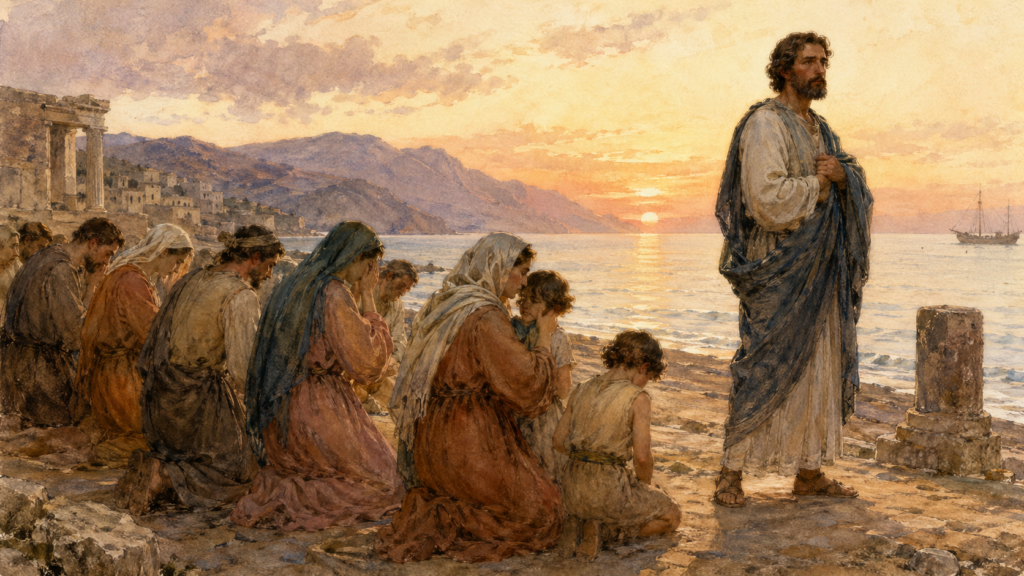
What hooked me on the first read was that little phrase in verse 4: “through the Spirit.” If the Spirit really told them, “Don’t let Paul go,” then what is Paul doing by going? Can the same Spirit be saying “go” to one person and “don’t go” to another, at the very same moment? I started pulling on the thread, and what unfolded turned this Acts 21 devotional into something more precise than I had assumed.
Even Those Who Tried to Stop Him Were Moved by the Spirit
The first thing worth being clear about is that the disciples at Tyre and the brothers and sisters in Caesarea weren’t operating out of mere human worry. The text plainly says they spoke “through the Spirit” (διὰ τοῦ πνεύματος, dia tou pneumatos). The Caesarean scene is even more vivid. Agabus, an actual prophet, walks up, takes Paul’s belt, binds his own hands and feet with it, and announces, “Thus says the Holy Spirit, ‘This is how the Jews at Jerusalem will bind the man who owns this belt'” (21:11). Real Spirit-given revelation. Real prophetic gesture. Real love standing behind the warning.
That’s exactly what makes the scene so heavy. Brothers and sisters under the same Spirit appear, on the surface, to be pointing in opposite directions.
What the Spirit Actually Showed, and What Was Concluded From It
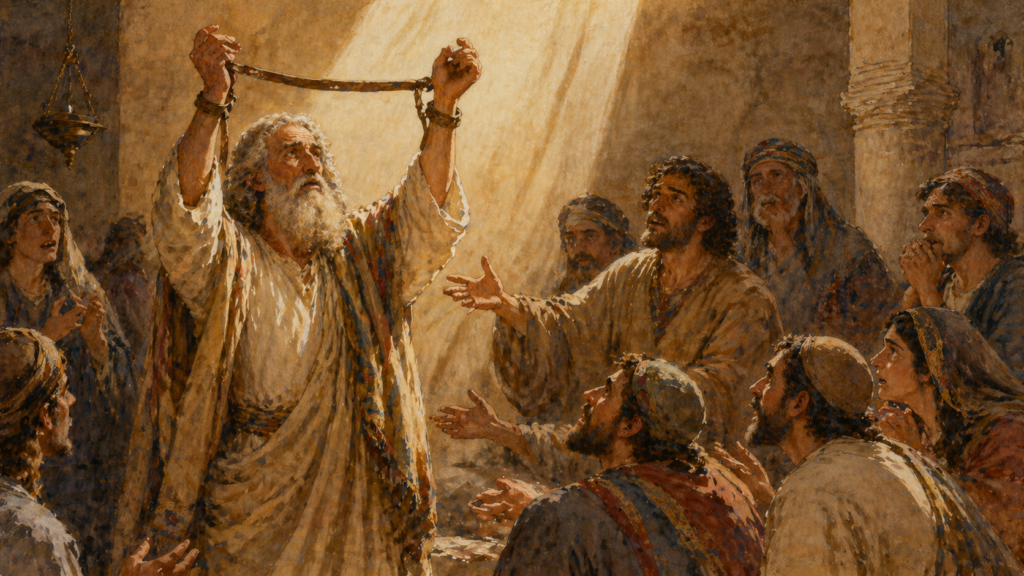
When I slowed down and read carefully, though, I noticed something. Trace Agabus’s prophecy word for word. The Spirit’s content in that prophecy is just one thing: that Paul will be bound and handed over. That’s it. There is no, “and therefore he must not go.”
The dissuasion appears in the very next verse: “When we heard this, we and the people there urged him not to go up to Jerusalem” (21:12). It is the hearers who add the conclusion. “Suffering awaits → therefore avoid it.” A perfectly natural inference, born of love, but not a word the Spirit Himself spoke.
The Tyre scene in 21:4 can be read in a similar way. The Greek uses an imperfect tense — “they were telling [Paul] through the Spirit, again and again, not to go.” A number of commentators understand this to mean: the Spirit revealed to them what was coming, and they, on the basis of that revelation, kept urging him not to go. If the Spirit had directly commanded “do not go,” then the Paul who proceeds to Jerusalem would be a Paul out of step with how the rest of Acts portrays him.
The clinching evidence sits one chapter earlier. In his farewell address to the Ephesian elders at Miletus, Paul himself says:
“And now, behold, I am going to Jerusalem, constrained by the Spirit, not knowing what will happen to me there, except that the Holy Spirit testifies to me in every city that imprisonment and afflictions await me.” — Acts 20:22-23 (ESV)
The same Spirit who keeps testifying that “imprisonment and afflictions await” is also the Spirit who has Paul constrained — bound — to go to Jerusalem. Two pieces of information sit, without contradiction, in one man. So the suffering the Spirit revealed wasn’t the basis for backing away. It was the basis for getting ready. “This is what’s coming. Walk into it with your eyes open.”
That landed on me with some weight. I realized how easily I throw around the phrase “the Spirit’s leading.” Whenever some inner stirring rises up, I tend to label it as the Lord’s guidance — without ever pausing to separate what the Lord actually showed me from the conclusion I tacked on. And the disciples at Tyre stand as a sober reminder that even sincere love can place itself across someone’s calling. This is the heart of what it means to discern the Spirit’s voice.
The Purification Vow — Another Layer of Obedience
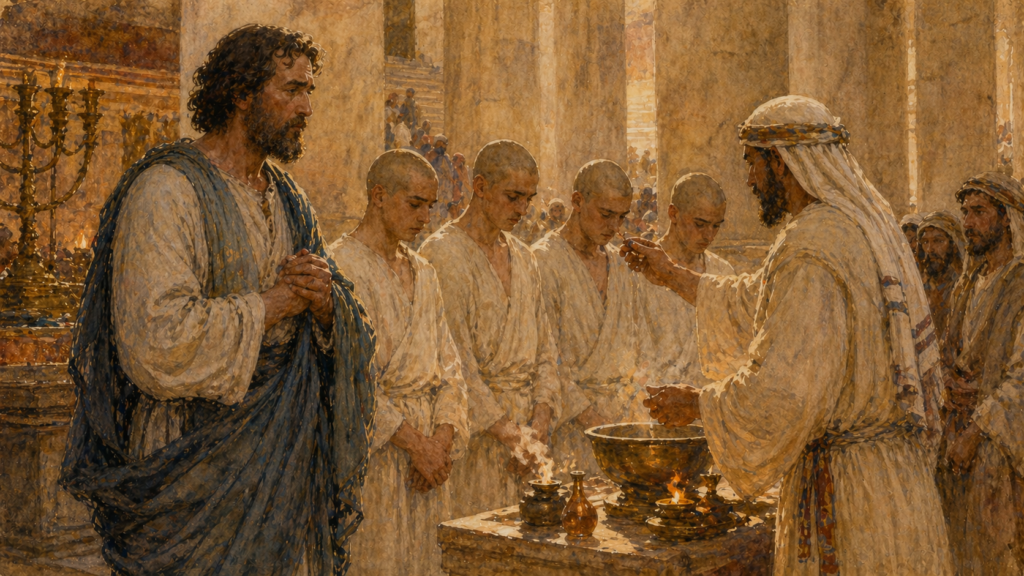
The other thing that surprised me was what Paul does once he actually arrives in Jerusalem. At James’s suggestion, he goes into the temple and takes part in a purification rite, even paying the expenses for four men under a Nazirite vow (21:26). The same Paul who spent his entire ministry insisting that no one is justified by works of the law is suddenly underwriting a ceremonial vow. On the surface, this looks like a contradiction.
But Paul actually answers this for us in 1 Corinthians 9. “To the Jews I became as a Jew, in order to win Jews… I have become all things to all people, that by all means I might save some” (1 Cor 9:20, 22). For Paul, the principle is sharp: making law-keeping a condition of salvation destroys the gospel, but observing the law for the sake of the gospel, out of love, is an exercise of freedom. The same logic explains why he had Timothy circumcised (Acts 16:3) and yet refused to let Titus be circumcised (Gal 2:3). The first was love; the second would have been a betrayal of the gospel itself. This is the same tension I traced earlier in the Acts 15 council over Gentile believers — the line between law as yoke and law as gracious response.
Paul wouldn’t yield an inch on the content of the gospel, but he was extraordinarily flexible in how he carried and applied it. To borrow a frame Tim Keller often uses, this isn’t law-keeping as performance (earning acceptance), but law-keeping as response (flowing from acceptance already received). Only those who are free from the law can use the law as an instrument of love.
So the purification rite turns out to be a smaller obedience laid on top of the larger one. Not for Paul’s own sake, but for the sake of his Jewish brothers in Christ. And in a quiet irony, that very rite becomes the direct trigger for his arrest (21:27 onward). An act of love walks straight into suffering, and Paul knew from the beginning that suffering was waiting.
Discernment Ends in Surrender
By the time I came back to verse 14 — “Let the will of the Lord be done” — it carried more weight than it had on the first read. That sentence is a near-exact echo of Jesus’ prayer in Gethsemane (Luke 22:42). It is where the people who had been resisting Paul’s plans finally lay down their own interpretation and arrive.
I think that arrival is what discernment ultimately is. However hard we work at discerning, we cannot finally hold in our own hands a guarantee that we got it right. The Paul who goes and the brothers who send him meet, in the end, in the same prayer. Both of them place even the accuracy of their discernment into the Lord’s hand.
So perhaps when we sense what we call the Spirit’s prompting, the question to put to ourselves takes a particular shape. What did the Lord actually show me? And from there, the conclusion I’m drawing — “therefore I should do this” — where does it begin? Is it rising from the deepest place of my calling, or from fear, or from comfort, or from how things will look to other people? That kind of self-questioning is the lifelong starting place of discerning the Spirit’s voice.
I want to be careful, though, not to let any of this be misread. I’d hate for someone to walk away thinking, “follow your heart, ignore the people who try to stop you.” Paul could press through the warnings only because he was, in his deepest place, constrained by the Spirit — not because he was simply confident. In most of ordinary life, the loving counsel of those around us is one of the channels through which the Lord protects us. It is only at decisive moments that even that counsel may need to be walked through. And even then, the destination is the same prayer: Let the will of the Lord be done.
Frequently Asked Questions
Q: Why did the disciples warn Paul “through the Spirit” if he was supposed to go to Jerusalem?
A: A close reading shows the Spirit revealed only a fact — that suffering and imprisonment awaited Paul. The conclusion “therefore do not go” was added by the loving disciples themselves. Paul received the same Spirit-given revelation in Acts 20:22-23 yet understood it as preparation rather than prohibition, which is why he went anyway while the brothers wept.
Q: Why did Paul perform a purification vow if he taught against works of the law?
A: For Paul, making law-keeping a condition of salvation destroys the gospel, but observing the law for the sake of the gospel, out of love, is an exercise of freedom. The Jerusalem purification rite (Acts 21:26) was an act of pastoral love toward Jewish believers, not a return to legalism — the same principle Paul lays out in 1 Corinthians 9:19-23.
Q: What does “Let the will of the Lord be done” in Acts 21:14 mean?
A: The sentence echoes Jesus’ Gethsemane prayer almost exactly (Luke 22:42). It marks the point where those who had warned Paul finally laid down their own interpretation and entrusted the outcome to God. It signals that discernment ultimately ends in surrender — even surrender of the need to be sure we discerned correctly.
A Prayer to Close This Acts 21 Devotional
Lord,
I have been quick to call all kinds of inner stirrings “the Spirit’s leading.” Whenever something rose up in me, I labeled it Your guidance, never quite stopping to ask what You actually showed me and what conclusion I added on my own. I have probably stood, in love’s name, in front of someone You were calling onward. I have probably also held back, in fear’s name, from a path You had set out for me.
In Acts 21 today I saw how heavy the work of discernment becomes when those under the same Spirit appear to point in different directions. And I saw that the going Paul and the staying brothers met, at the end, in one shared prayer.
Give me wisdom to discern. Teach me to separate the fact You have shown from the conclusion I have drawn. When the warnings of those who love me are Your way of protecting me, help me hear it. When the moment is decisive, help me hold fast to what You have called me to. And above all, when I cannot finally know whether I have discerned rightly, lead me to the place where I let go even of that need to be sure, and entrust it to You. As Paul did, and as those who sent him did, let me end at the same prayer: Let the will of the Lord be done.
In the name of our Lord Jesus Christ I pray. Amen.
About the Author
Each morning I read one chapter of Scripture and reflect on its resonance in daily life. Writing from the perspective of a layperson rather than a trained theologian, I trace how the ancient text still meets us today.
📖 Learn more: About the Author
Pingback: Acts 22 Devotional — Source of Paul's Boldness