This morning’s Acts 23 devotional pulled me into a scene I couldn’t shake all day: forty men binding themselves by an oath to neither eat nor drink until they had killed Paul. My first instinct was to ask, “Why such hatred?” But the more I sat with it, the more I realized this wasn’t a problem of hatred at all. It was a problem of conviction. And that single word ended up reshaping the whole devotional for me, opening into something I now think of as the twin axes of faith — religious conviction and humility, neither one whole without the other.
“When it was day, the Jews made a plot and bound themselves by an oath neither to eat nor drink till they had killed Paul. There were more than forty who made this conspiracy.” — Acts 23:12–13 (ESV)
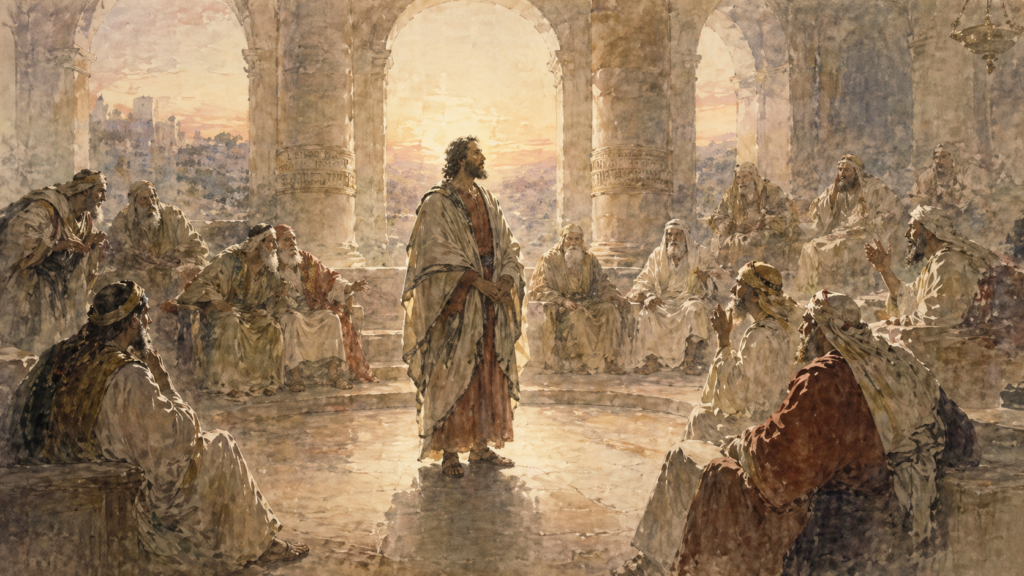
The Landscape of Acts 23 — The Sanhedrin, the Assassins, and the 470 Soldiers
The chapter opens with Paul standing before the Sanhedrin. The high priest Ananias orders him struck on the mouth, and Paul, with what looks like a mix of strategy and genuine identity, divides the council along the fault line of resurrection — Pharisees against Sadducees — until the meeting collapses into chaos. That very night, the Lord stands beside Paul and tells him to “take courage.” The next morning, more than forty men swear their lethal oath, but Paul’s nephew overhears the plot and reports it. The Roman tribune responds by assigning two hundred soldiers, seventy horsemen, and two hundred spearmen — four hundred and seventy armed men — to escort Paul safely to Caesarea.
The visual contrast of forty assassins overwhelmed by 470 soldiers is striking. But the question that held me longest in this Acts 23 devotional wasn’t about the rescue. It was about those forty men: why were they so willing to die for Paul’s death?
Where Did the Forty’s Religious Fury Come From?
I wanted to dig into the texture of this. Paul had been accused of bringing a Gentile into the temple courts (chapter 21) — a rumor, not a fact, but in their world it carried a death sentence. He was preaching a gospel that seemed to dissolve the boundary between Jew and Gentile, law and grace. When the Sanhedrin’s official channels failed to convict him (he was, after all, a Roman citizen), they turned to ḥērem — a self-cursing oath. “May we be cursed if we eat or drink before this man is dead.”
What strikes me is that none of these men would have called themselves wicked. They would have said they were defending God’s law, protecting Israel’s purity, doing the very thing faithfulness required. The engine of their fury was not hatred. It was religious conviction. And that, somehow, is more frightening than hatred ever could be.
The Mirror of Saul — Paul Looking at His Own Past
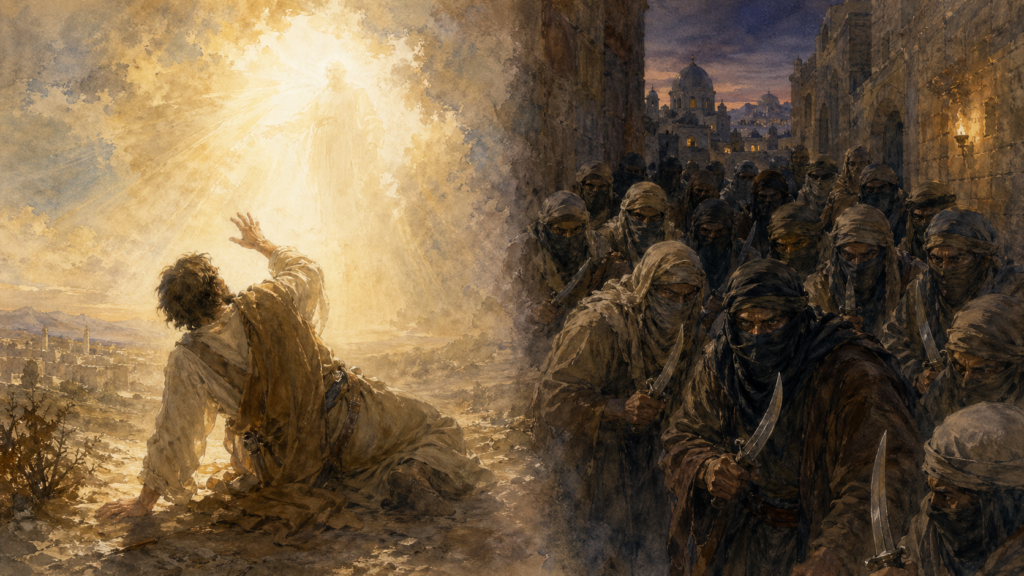
In Acts 23:1, Paul opens his defense with an arresting line:
“Brothers, I have lived my life before God in all good conscience up to this day.” — Acts 23:1 (ESV)
What’s haunting is that the pre-conversion Saul could have said the very same thing. He, too, had lived “in all good conscience” — and that conscience had led him to drag Christians from their homes. In Philippians 3 he describes his old self as “blameless” under the law. In 1 Timothy 1 he confesses he “acted ignorantly in unbelief,” not because he didn’t know Scripture but because his religious conviction had been pointed in exactly the wrong direction.
So when I look again at the forty men crouched in ambush, I don’t see strangers anymore. I see the face of young Saul — and that recognition reminded me of a similar moment I sat with in the Acts 19 devotional, where Demetrius the silversmith becomes an unsettling mirror for our own hidden interests. The mirror keeps showing up in Acts, and it usually shows me what I’d rather not see. I think Paul saw it too. The voice he heard on the road to Damascus — “Why are you persecuting me?” — was probably echoing somewhere down the alleys of Jerusalem in chapter 23. Once you’ve heard that voice yourself, you can no longer look at your enemies as merely enemies. You see something else in them. You see what you used to be.
Religious Conviction and Humility — The Twin Axes of Faith
The traditional readings of this Acts 23 devotional usually move along two lines. One emphasizes God’s providence — even the most violent plot cannot derail the divine plan to bring Paul to Rome. The other highlights the power of resurrection faith — Paul’s willingness to make the resurrection his single defense. Both are true and rich, and I don’t want to set them aside.
But my own reflection ended up somewhere a little different. The sharpest question this passage put to me wasn’t “How can I be bold like Paul?” but rather “How do I know I’m not standing where Saul once stood?”
Tim Keller’s framing of moralism versus the gospel kept surfacing in my mind. Moralism says, “I am accepted because I am right.” The gospel says, “Because I am accepted, I respond.” The forty assassins were, in the deepest sense, moralists with knives. Their conviction was not a pure trust in God; it was a defense of their own rightness. This is the same quiet pattern I found myself wrestling with in the Acts 15 devotional, where what we hold tightly out of religious carefulness can quietly become a yoke we lay on others. Religious conviction, when its real object is self-justification, can wear God’s name and still walk in the opposite direction from God.
What I came to was something like this: religious conviction and humility are the twin axes of any honest faith. Conviction without humility is not faith — it is idolatry wearing faith’s clothes. We need conviction to commit; we need humility to keep that commitment from becoming a weapon. People who only doubt never move. But people who only believe never stop, even when they should. The forty conspirators, the Sanhedrin, Saul — all of them were certain they stood with God. That certainty was precisely what kept them from seeing whom they were actually fighting.
I hope this isn’t misread as a quiet plea for skepticism. That would be its own trap. The point isn’t to abandon conviction; it’s to keep asking, honestly, where my conviction is pointing. Am I defending my own correctness, or following Christ? Am I protecting my image of God, or listening to God? They look almost the same from outside, but they go in opposite directions.
The Lord Standing By in the Darkest Night
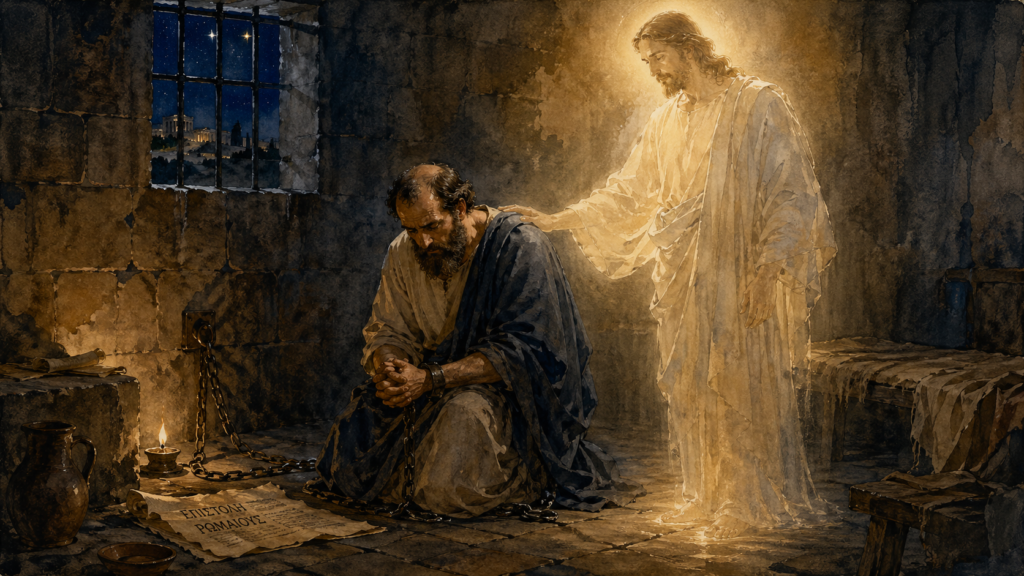
If I left this Acts 23 devotional only at the level of self-examination, it would feel too heavy. So I want to end where Acts 23 itself ends — with this verse:
“The following night the Lord stood by him and said, ‘Take courage, for as you have testified to the facts about me in Jerusalem, so you must testify also in Rome.'” — Acts 23:11 (ESV)
What’s striking is that the Lord doesn’t begin with comfort. He begins with mission. Not “everything will be fine,” but “you must testify also in Rome.” It is said that the way Christ often handles our fear is not by removing the threat but by reaffirming the calling. Fear shrinks when purpose enlarges.
And there’s one more layer I can’t get past. The same Saul who once acted out of religious conviction against Christ — now has Christ standing beside him in the dark. The persecutor has become the one who is attended. That image, I think, is the real consolation of this chapter. Our convictions can fail us. Our certainties can lead us astray. But the Lord who stopped Saul on the road to Damascus still stops us when we wander, and still stands beside us in the cell at midnight. That is why we can dare to examine our convictions at all — because we trust the One who corrects us is also the One who keeps us.
Frequently Asked Questions
Q: Why did forty men plot to kill Paul in Acts 23?
A: They believed Paul had violated the temple by bringing in a Gentile and that he was preaching a gospel that undermined the Mosaic law. When the Sanhedrin’s official channels failed to convict him (Paul was a Roman citizen), more than forty men bound themselves by a ḥērem — a self-cursing oath — to kill him. Their motive was not personal hatred but religious conviction defending what they understood as God’s law.
Q: What does Paul’s appearance before the Sanhedrin in Acts 23 reveal about religious conviction?
A: Acts 23 shows that sincere religious conviction can run in the opposite direction from God. The forty conspirators, the Sanhedrin, and even the pre-conversion Saul all believed they were defending the faith — yet they were resisting Christ. The chapter quietly teaches that conviction without humility can become a weapon, which is why Paul’s own confession in 23:1 (“in all good conscience”) carries such weight.
Q: What does Acts 23:11 mean for believers today?
A: When the Lord stood by Paul that night, He didn’t promise an easy path — He reaffirmed the mission (“you must testify also in Rome”). For us, this suggests that Christ’s primary response to our fear is often not the removal of the threat but the renewal of our calling. Our convictions may fail, but the Lord who corrects us is also the One who stands beside us.
A Prayer to Close This Acts 23 Devotional
Lord,
Standing in front of those forty conspirators today, I cannot honestly say I am different from them. I confess that I have wielded my certainty as a weapon, defended my own rightness in your name, and sometimes mistaken the protection of my convictions for the worship of you. The thought that religious conviction can quietly walk away from you while still calling itself faithful — that thought sobers me.
Keep my convictions tethered to you, not to my own self-image. Give me the humility to pause and ask where my certainty is pointing, and give me the courage not to collapse into mere doubt. As you stopped Saul on the road and stood by Paul in the barracks, stand by me too — examine what needs examining, and let me walk on with the kind of bold trust that only comes after honest self-knowledge.
In the name of our Lord Jesus Christ I pray. Amen.
About the Author
Each morning I read one chapter of Scripture and reflect on its resonance in daily life. Writing from the perspective of a layperson rather than a trained theologian, I trace how the ancient text still meets us today.
📖 Learn more: About the Author
Each morning I read one chapter of Scripture and reflect. I hope today’s devotional leaves a quiet resonance in your day as well.
Pingback: Discernment in Acts 27 — Whose Voice Do You Believe?
Pingback: Hearing But Never Understanding — Acts 28 Mirror