This morning’s Acts 15 devotional took me somewhere I wasn’t expecting. As I read through the chapter, the more I sat with it, the clearer it became that this isn’t really a story about a church making a decision. It’s about a question — where does salvation come from? — and about people having to look honestly at what they had been holding onto for a very long time. The Acts 15 devotional turned that same question back on me before I was finished reading.
“And he made no distinction between us and them, having cleansed their hearts by faith. Now, therefore, why are you putting God to the test by placing a yoke on the neck of the disciples that neither our fathers nor we have been able to bear? But we believe that we will be saved through the grace of the Lord Jesus, just as they will.” — Acts 15:9–11 (ESV)
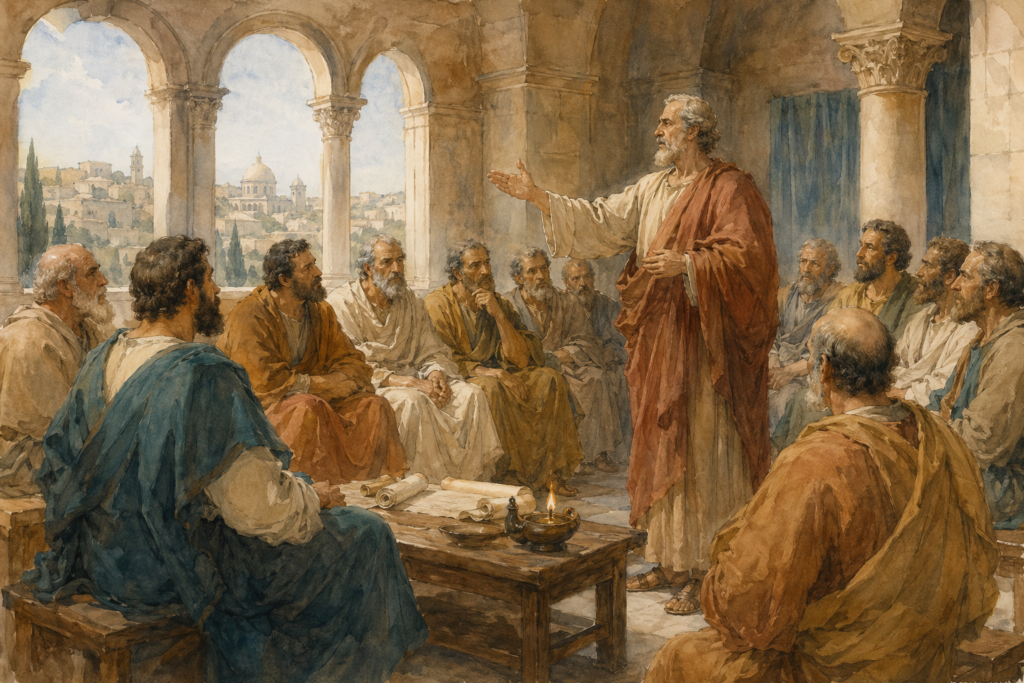
Acts 15 is often described as one of the most important turning points in the early church, and the Jerusalem council that unfolds in this chapter is the first major doctrinal gathering recorded in the New Testament. After Paul and Barnabas returned from their first missionary journey to Antioch, some men came down from Judea and started teaching that “Unless you are circumcised according to the custom of Moses, you cannot be saved” (15:1). That single sentence shook the Antioch church so badly that a delegation went up to Jerusalem to settle the matter. The chapter unfolds in four movements: the conflict erupts in verses 1–5, Peter and James speak and a resolution emerges in verses 6–21, the decision goes out in a letter in verses 22–35, and then in verses 36–41 Paul and Barnabas have a sharp disagreement that splits them and launches the second missionary journey.
I underlined verses 9–11, 24, and 28 this morning. I didn’t underline verse 38, but I couldn’t shake it either. As I sat with each of these, the threads kept braiding into one question — what am I holding right now, with full confidence that it’s right, that has quietly become a burden in front of God’s grace?
Where Does Salvation Come From? — Between Verse 1 and Verse 11
When I went back to verse 1 with fresh eyes, the verb stood out. The men from Judea didn’t say “you cannot be a good Christian” — they said “you cannot be saved.” This wasn’t a debate about customs or culture. It was a debate about the most foundational question there is: what saves us?
Then in verse 11, Peter lands somewhere completely different. “But we believe that we will be saved through the grace of the Lord Jesus, just as they will.” Not by circumcision plus grace. Not by obedience added to grace. Through grace, full stop. The distance between verse 1 and verse 11 turned out to be the distance the whole chapter travels.
Tim Keller has a frame I keep coming back to. Moralism says, “Because I obey, God accepts me.” The gospel says, “Because God accepts me, I obey.” The men from Judea were standing in the moralist position, and Peter was standing in the gospel position. The gap between those two postures looks small from the outside, but it’s actually unbridgeable. The moment obedience becomes a condition of acceptance, the gospel stops being good news.
I want to be careful here, because I don’t want this to be read as “so obedience doesn’t matter.” Honestly, I think it’s the opposite. Only a person who has already been received by grace can obey freely, without the constant background anxiety of trying to earn what they have. Obedience isn’t the entrance fee — it’s the response of someone who has already been welcomed in. The order matters enormously. When that order gets reversed, faith starts to feel heavier and heavier without anyone being able to say exactly why.
“He Made No Distinction” — Peter’s Witness from Cornelius’s Doorstep
The Greek word in verse 9 for “made no distinction” is διακρίνω (diakrinō) — to separate, to discriminate, to judge between. What I find striking is that the same verb appears in Acts 10:20, when the Spirit tells Peter to go to Cornelius’s house “without hesitation” (literally, “making no distinction”). And this isn’t even the first time Peter has had to defend that crossing — he was already called to account for it once before in Acts 11, where his eyes had to learn to recognize grace in a Gentile household. So when Peter stands up here at the Jerusalem council and says God “made no distinction,” he isn’t arguing from theory. He’s testifying from the threshold he himself once stood at and crossed under direct command of the Spirit. This isn’t an opinion — it’s a witness statement.
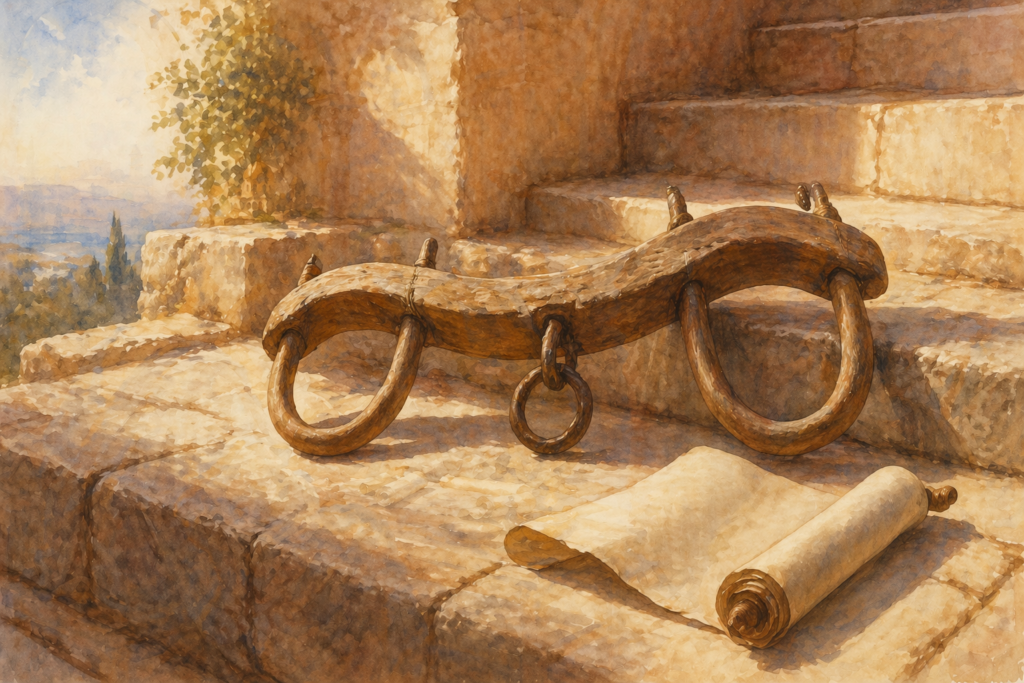
The word for “yoke” in verse 10 is ζυγόν (zygon), the same word Jesus uses in Matthew 11:30 when he says, “For my yoke is easy, and my burden is light.” So Peter is essentially asking, Why are you trying to put back on people’s necks the heavy yoke that even our ancestors couldn’t carry, when Jesus has just given us a light one? The Pharisees had built a culture of multiplying obligations on top of the Mosaic law; Peter is naming what that whole project actually felt like to live under. He had been there. He knew.
This is where I had to stop walking through the text and just sit. What yoke am I carrying? What part of what I call my faith might actually be a weight I’ve put on myself — heavy enough to crush someone else if I were to hand it to them, but invisible to me because I assume it’s just “what serious Christians do”? I don’t have a clear answer yet, but the fact that no answer comes immediately is itself telling me something. The burdens we don’t notice are usually the heaviest ones.
This whole movement of Peter’s heart — from the rooftop vision in Joppa to Cornelius’s house to his testimony at the Jerusalem council — is the same arc traced in Acts 10, where God declared clean what Peter had long held to be unclean. The vision wasn’t really about food. It was preparing him to say, years later, exactly what he says here in chapter 15.
Words Spread Without Authority vs. Words Discerned in Unity
The letter from the Jerusalem council brings out a contrast that I hadn’t seen so cleanly before. In verse 24, James says of the troublemakers in Antioch: “some persons have gone out from us and troubled you with words, unsettling your minds, although we gave them no instructions.” Whoever those men were, they had no commission. They were carrying private convictions across the empire and pressing them on a vulnerable young church.
Now look at the other side. Verse 22: “Then it seemed good to the apostles and the elders, with the whole church, to choose men from among them and send them to Antioch.” Not just the apostles. Not just the leaders. The whole church. And then verse 28 goes one level deeper: “For it has seemed good to the Holy Spirit and to us to lay on you no greater burden than these requirements.” “To the Holy Spirit and to us” — the apostles refuse to claim the decision as their own private authority. They tie it to the Spirit and to the discerning community together.
The contrast crystallized into one sentence for me: the false teaching spread privately, without authority; the true teaching was discerned by an empowered community in unity with the Spirit. As a quick filter for life today, this isn’t a bad question to carry: When something is being pressed on me as truth, is it the considered discernment of a faithful community walking with the Spirit, or is it the personal certainty of one charismatic voice? That isn’t a complete test, but it’s enough to slow me down.
I should add a balancing word, though. I don’t want this read as “individual conviction is always wrong and only committee decisions are reliable.” That swings the pendulum into a different kind of yoke. Personal conviction matters. Prophets in Scripture often stood alone. The point isn’t that one person can never be right — the point is that when I hold a strong conviction, I have to ask whether it’s been examined under the Spirit’s light alongside the wisdom of the body, or whether it’s running on my own conviction alone. That distinction is what I want to keep close.
There’s one more thing I noticed about how the council wrote that letter. They apologized (“we gave them no instructions”), they told the truth about what had happened, and they gave clear, minimal guidance going forward. They didn’t cover for the troublemakers, but they also didn’t pile on extra burdens to make a point. That balance — accountability without overreach, honesty without harshness — is the kind of leadership I’d like to grow into.
The Weight of One Line — Mark, and the Story That Doesn’t End
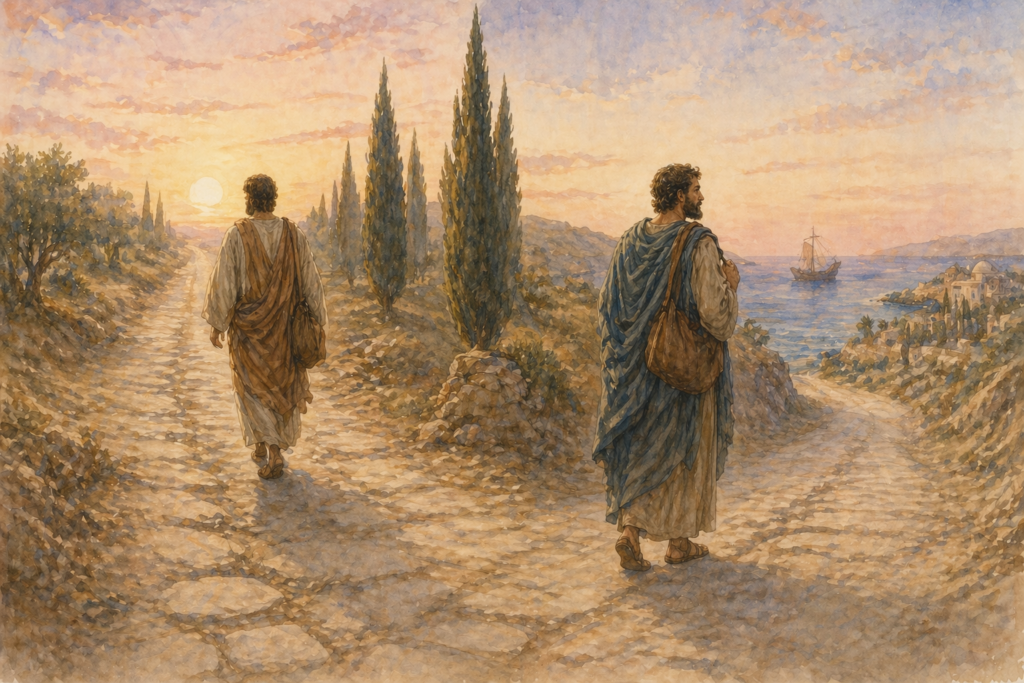
Verse 38 looked, on first reading, like a footnote. “But Paul thought best not to take with them one who had withdrawn from them in Pamphylia and had not gone with them to the work.” But once I dug into the background, the weight in this single line became clear.
Acts 13:13 tells us that Mark (John Mark) had left Paul and Barnabas mid-journey on the first missionary trip and gone back to Jerusalem. The text doesn’t tell us why. For Paul, it apparently registered as a question of reliability for the work ahead. For Barnabas — who, I’m told, was Mark’s cousin (Colossians 4:10) — it was a question of whether someone who had stumbled once should be given a second chance.
Verse 39 caught my attention even more. “And there arose a sharp disagreement, so that they separated from each other.” The Greek behind “sharp disagreement” is παροξυσμός (paroxysmos) — a violent, sharp irritation. The only other place this word appears in the New Testament is Hebrews 10:24, where it’s used positively to mean stirring one another up to love and good works. Luke isn’t softening anything here. He’s using a strong, deliberate word. He’s recording what actually happened.
But the story doesn’t stop in verse 39. Years later, Paul writes from prison: “Get Mark and bring him with you, for he is very useful to me for ministry” (2 Timothy 4:11). Peter calls Mark “my son” in 1 Peter 5:13. And tradition holds that this same Mark wrote the Gospel that bears his name.
In a book like Acts that compresses thirty years of early church history into twenty-eight chapters, every name that gets mentioned earns its place. Luke could have left this conflict out. He didn’t. And I think he’s writing as someone who already knows how it ends — Luke himself was with Paul years later when Mark was restored to the team (2 Timothy 4:11). So when Luke records this painful split without smoothing the edges, there’s something almost tender in his honesty. God doesn’t waste even our conflicts; he makes two missionary teams out of what was one. And he doesn’t give up on anyone, even when we have. The name Barnabas, I’m told, means “son of encouragement” — and to Mark, Barnabas lived up to that name all the way through.
Frequently Asked Questions
Q: What is the main message of the Acts 15 devotional? A: The chapter’s foundational claim is that salvation comes through the grace of the Lord Jesus alone, not through circumcision, law-keeping, or any added requirement (Acts 15:11). Peter’s declaration directly answers the false teaching of 15:1, and the deeper personal challenge is to notice what we may have quietly added to grace as a yoke without realizing it.
Q: What was the Jerusalem council in Acts 15 and what did it decide? A: The Jerusalem council was the early church’s first major doctrinal gathering, where apostles, elders, and “the whole church” (15:22) settled whether Gentile believers had to be circumcised and follow Mosaic law to be saved. The decision (15:22–29) confirmed salvation by grace alone and asked Gentile believers to observe only minimal practical guidelines that allowed Jewish and Gentile Christians to share table fellowship.
Q: Why did Paul and Barnabas separate in Acts 15? A: They had a sharp disagreement (παροξυσμός in Greek) over whether to bring John Mark on the second missionary journey, since Mark had previously left them mid-journey in Pamphylia (Acts 13:13). Paul thought it unwise; Barnabas, who was Mark’s cousin, wanted to give him another chance. Later Scripture (2 Timothy 4:11; 1 Peter 5:13) shows Mark was eventually restored to ministry, and the split actually doubled the missionary teams in circulation.
A Prayer to Close This Acts 15 Devotional
Lord,
This morning, sitting with Acts 15, I have to confess that some of what I carry as faithfulness might actually be weight I’ve added on top of your grace. The men from Judea were sure they were right. They believed they were defending the tradition you yourself had given. And it turned into a yoke on the necks of people you had already received. I might be doing the same thing, in places I haven’t seen yet. Lord, would you let me notice today, without flinching, the things I’m holding that have quietly slipped in front of you. Give me the courage to set them down.
Bring me back to where Peter was when he said “we will be saved through the grace of the Lord Jesus.” Help me not to forget what saved me, and to walk in obedience only on the foundation of that grace, never as a substitute for it. When I speak to anyone today, keep me from pressing my private convictions as though they were your voice. Teach me to speak from inside the discernment of your Spirit and your people, not from my own urgency.
And for the people I might be tempted to give up on, give me the eyes of Barnabas — the ones that saw past the failure in Mark and refused to write him off. Make me a son or daughter of encouragement to someone today who has stumbled.
In the name of our Lord Jesus Christ I pray. Amen.
About the Author
Each morning I read one chapter of Scripture and reflect on its resonance in daily life. Writing from the perspective of a layperson rather than a trained theologian, I trace how the ancient text still meets us today.
📖 Learn more: About the Author
Pingback: Romans 3 But Now — The Hinge That Changes Everything