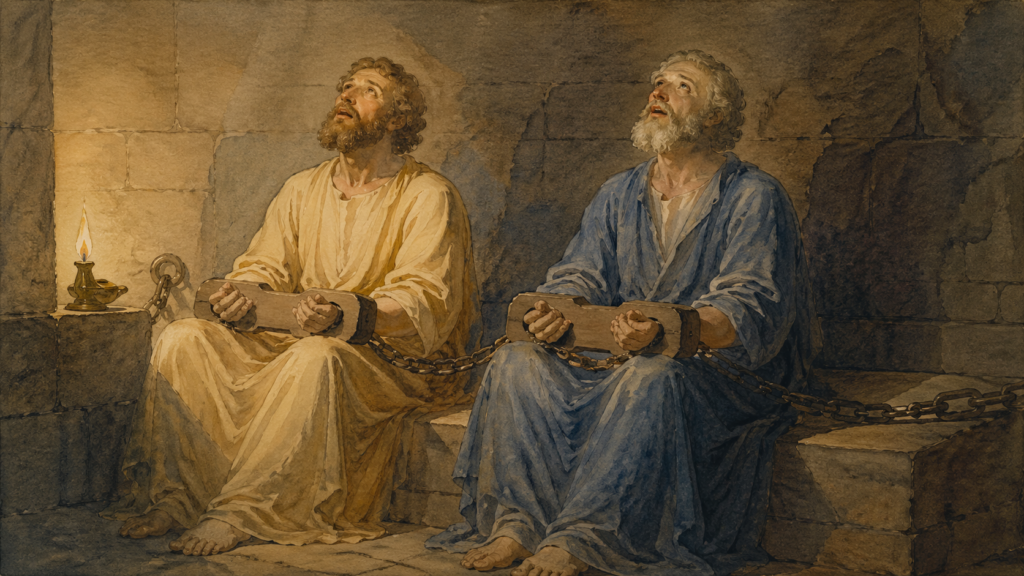
I kept returning to one moment while reading this Acts 16 devotional passage this morning. It’s the scene where the Philippian jailer falls trembling before Paul and Silas and asks, “Sirs, what must I do to be saved?” Paul’s answer is one of the most famous sentences in the book of Acts: “Believe in the Lord Jesus, and you will be saved, you and your household.” In this Acts 16 devotional, I want to sit with the strange mismatch between that question and that answer — and with how a quieter conversion earlier in the same chapter makes the very same point.
“Then he brought them out and said, ‘Sirs, what must I do to be saved?’ And they said, ‘Believe in the Lord Jesus, and you will be saved, you and your household.'” — Acts 16:30–31 (ESV)
This is the kind of verse that hangs framed on living-room walls. I’ve read it many times and memorized it. But reading verse 31 alongside verse 30 this morning, I noticed something I had somehow always walked past.
The Flow of Acts 16 — Two Conversions
Acts 16 belongs to Paul’s second missionary journey. He takes Timothy on as a new traveling companion (verses 1–3), finds every door into Asia quietly shut by the Spirit (verses 6–7), and only after a vision of a Macedonian man crosses into Europe (verses 9–10). In Philippi, two people come to faith. A wealthy seller of purple cloth named Lydia who meets Paul at a riverside prayer gathering (verse 14), and a Roman jailer at midnight after an earthquake shakes the prison open (verse 30).
Something struck me as I placed these two stories side by side. The converts could not be more different in background or circumstance, and yet the shape of their coming to faith is the same.
The Jailer’s Question — A Grammar of Works
I started with the Philippian jailer conversion scene in verse 30. “What must I do to be saved?” In Greek it’s τί με δεῖ ποιεῖν (ti me dei poiein), literally “what is necessary for me to do?” The verb at the center is ποιέω (poieō, to do, to perform). This is a question rising out of the world of works.
And it makes complete sense in context. The earthquake had opened the doors, the chains had fallen off, and under Roman law a jailer whose prisoners escaped would pay with his own life. He had already drawn his sword to kill himself. So when he cries out for salvation, his default grammar is the grammar of action — what must I do?
Paul’s reply changes the grammar itself. “Believe (πίστευσον, pisteuson, aorist imperative) in the Lord Jesus, and you will be saved (σωθήσῃ, sōthēsē, future passive).” The verb of doing is replaced with a verb of trust, πιστεύω (pisteuō, to believe, to trust). And the salvation is no longer something the jailer achieves; it’s something that happens to him. A passive future.
This isn’t the only time Luke lets the grammar of works come into view in Acts. Just a few chapters earlier, Simon the sorcerer tried to purchase the gift of God with money — another man asking, in effect, what must I do (or pay) to obtain this? The jailer asks in desperation, Simon asks in calculation, but the underlying grammar is the same. What struck me here is that Paul does not scold the jailer for asking the wrong question. He simply turns the answer in a different direction. It feels less like a correct reply to a mistaken question and more like a quiet replacement of one grammar with another.
Lydia — A Heart the Lord Opened

Then I went back to verse 14 and read it slowly. “The Lord opened her heart to pay attention to what was said by Paul.” In Greek, ὁ κύριος διήνοιξεν τὴν καρδίαν (ho kyrios diēnoixen tēn kardian). The verb διανοίγω (dianoigō) does not just mean to open a little; it carries the force of opening wide, opening fully. Luke uses the same verb in Luke 24:45, where the risen Jesus “opened their minds to understand the Scriptures.” Something closed being thrown open by a force from outside.
The subject of the sentence is unmistakable. The Lord opened her heart. Lydia’s part in the scene is simply that she was listening. She was listening, and the Lord opened.
And here’s the part that stayed with me. Lydia is already described as “a worshiper of God” (verse 14). She’s a devout Gentile woman who attends the Jewish prayer gathering by the river. She’s already religiously prepared. And yet even she could not open her own heart to the gospel; the Lord had to do it. The accumulation of devotion, it turns out, does not add up to faith on its own.
Two Very Different People, One Pattern
Lydia and the Philippian jailer conversion stand at opposite ends of the spectrum. One is a devout, prepared God-fearer; the other is a terrified, completely unprepared Roman official. One meets the gospel in the quiet of a riverside morning; the other in the chaos of a midnight earthquake.
But the call to believe in the Lord Jesus reaches them both through the same structure. Neither arrives at salvation through something they do. Lydia has her heart opened; the jailer hears “believe.” In both stories, the human being is not the active subject of salvation.
Tim Keller often frames this as the difference between moralism and the gospel. Moralism asks, “What must I do to be accepted?” The gospel says, “Receive by faith the acceptance that has already been given.” The two conversions in Philippi feel like these two grammars being exchanged in a single chapter — once quietly by a riverbank, once dramatically in a prison cell. The Jerusalem church reaches this same realization a few chapters later when they fall silent and glorify God that “God has granted even repentance” to the Gentiles (Acts 11:18). Even the turning itself, it turns out, is a gift.
What Comes After Belief
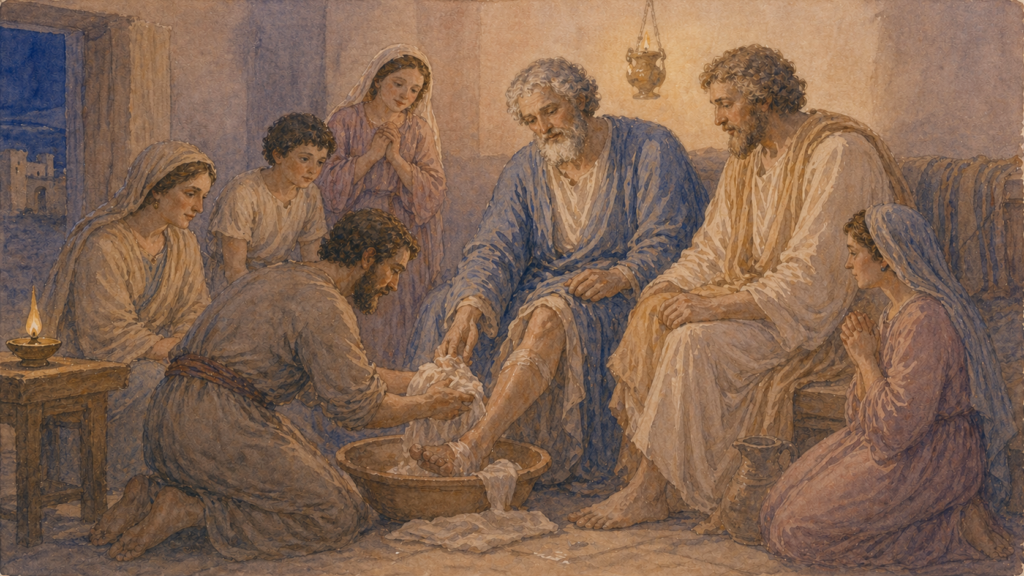
I don’t want “believe in the Lord Jesus” to be misheard as a message that treats obedience as optional. Reading a little further, verse 33 gives us this image: “he took them the same hour of the night and washed their wounds.” The jailer who has just heard “believe” does not stop acting. He immediately moves toward the prisoners he was guarding moments before, kneels down, and tends to their injuries.
That, I think, is the picture. Works done to earn acceptance are anxious labor. Works done out of acceptance already received are overflow. The same hands that might have signed a death warrant are now washing wounds. Nothing has been subtracted from his life — the engine has simply been swapped out.
A Mirror for Me
Closing the passage, one thing pressed on me. How often do I live in the jailer’s grammar? “What must I do to be acceptable to God today? How much more disciplined, devoted, faithful must I become before I can stand in this place?” These questions sit quietly underneath many of my days.
And Acts 16 seems to ask, gently: Are you asking what you must do, or are you trusting what has already been given? Are you sitting at the riverside like Lydia, simply listening, letting the Lord open what you cannot open for yourself?
Frequently Asked Questions
Q: What does “what must I do to be saved” mean in Acts 16:30–31?
A: The Philippian jailer’s question assumes salvation is something he must achieve through the right action. Paul’s reply, “believe in the Lord Jesus,” quietly replaces that grammar — salvation becomes something received by trust rather than earned by performance. The verb tense in Greek (a future passive) underscores this: the jailer will be saved, not save himself.
Q: Why did the Lord need to open Lydia’s heart in Acts 16:14?
A: Lydia was already a devout God-fearer who attended Jewish prayer gatherings, yet even her religious preparation could not open her own heart to the gospel. Luke uses the verb διανοίγω (dianoigō), “to open wide,” with the Lord as the explicit subject. The passage suggests that faith, even for the devout, is a gift received rather than an achievement produced.
Q: If salvation is by faith alone, what role do works play after believing?
A: Verse 33 shows the jailer, immediately after believing, washing the wounds of the very prisoners he was guarding moments before. Belief does not eliminate obedience — it changes its engine. Works done to earn acceptance are anxious labor; works done out of acceptance already received are the natural overflow of gratitude.
A Prayer to Close This Acts 16 Devotional
Lord,
I confess that I began this day the way the jailer began his question — asking what I must do to be acceptable to you. The grammar of performance runs deep in me, and I keep trying to earn a place that you have already given in Christ. Open my heart today the way you opened Lydia’s. Let the word “believe” reach me the way it reached the jailer at midnight. May my obedience not be the anxious labor of someone trying to be received, but the overflow of someone who has already been received. Among the people I meet today, let me be one who is not trying to prove but one who is letting the gift move through me.
In the name of our Lord Jesus Christ I pray. Amen.
About the Author
Each morning I read one chapter of Scripture and reflect on its resonance in daily life. Writing from the perspective of a layperson rather than a trained theologian, I trace how the ancient text still meets us today.
📖 Learn more: About the Author