There is a strange kind of frustration in the life of faith — the place where I know what is right but cannot do it. My heart wants one thing; my body drifts toward another. I resolve, and the resolve dissolves within three days. I repent, and somehow I find myself standing in the same place I left. Romans 8:3 names this exact gap and answers it in seven words: what the law could not do, God did.
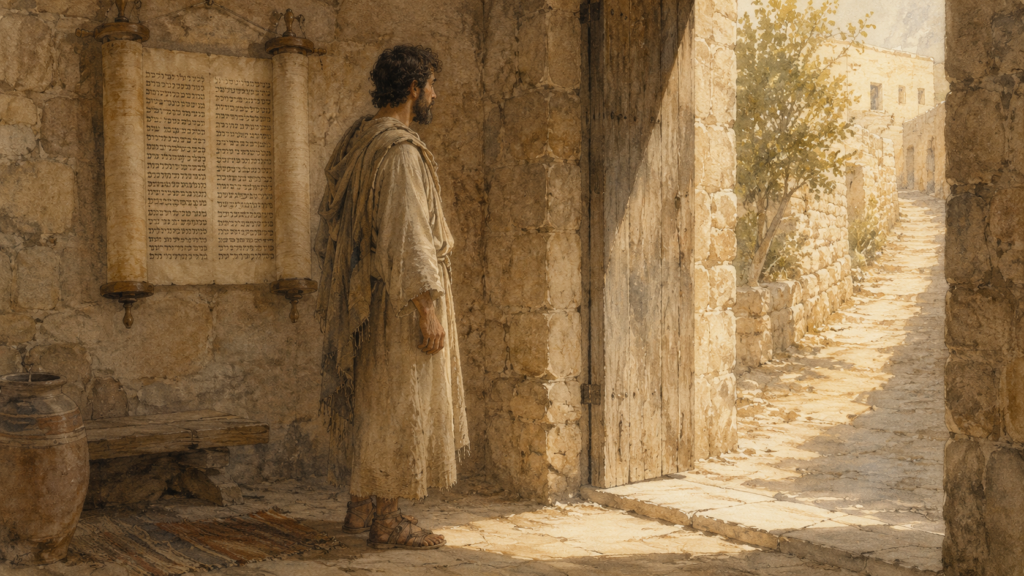
Paul’s cry at the end of Romans 7 — “Wretched man that I am!” — is, I have come to feel, simply the honest sound of that gap. (I sat with that cry more closely in yesterday’s reflection on Romans 7.) And Romans 8 begins precisely where that cry leaves off.
“There is therefore now no condemnation for those who are in Christ Jesus.” — Romans 8:1 (ESV)
Romans 8 is often called the high mountain of the New Testament, and for good reason. The chapter moves from no condemnation (v. 1) all the way to nothing can separate us from the love of God (v. 39). But before Paul climbs toward that summit, he pauses in verses 3–9 to explain why there is no condemnation — and his answer is not what I would have guessed. It is not, “because you tried harder.” It is, “because God did what the law could not do.”
The Law Is Not Weak — I Am
“For God has done what the law, weakened by the flesh, could not do.” — Romans 8:3a (ESV)
This phrase puzzled me at first. In Romans 7:12 Paul had just insisted that “the law is holy, and the commandment is holy and righteous and good.” And now, a chapter later, he says there is something the law cannot do. So which is it?
Reading it more slowly, I noticed that Paul does not say the law is weak. He says the law is weakened by the flesh. The weakness is not in the instrument but in the material it is asked to work on. The law points clearly to the path. It tells me what is right, what is wrong, what to pursue and what to flee. The trouble is not the map. The trouble is the traveler.
The image that came to mind was a diet book. I could read a hundred diet books and not lose a single kilogram. The books are not wrong. The problem is the gap between the reader and the page — between knowing and doing. The law, in that sense, is a diagnosis. A perfectly accurate diagnosis. But a diagnosis is not a cure. And what the law could not do — actually cure me — was never the law’s failure. It was mine.
What the Law Could Not Do, God Did
The hinge of the whole passage is three small words: God has done. What the law could not do, God did. And the way He did it is striking. He did not sharpen the commandments. He did not issue more demanding rules. He did not call for greater human resolve. He sent His Son.
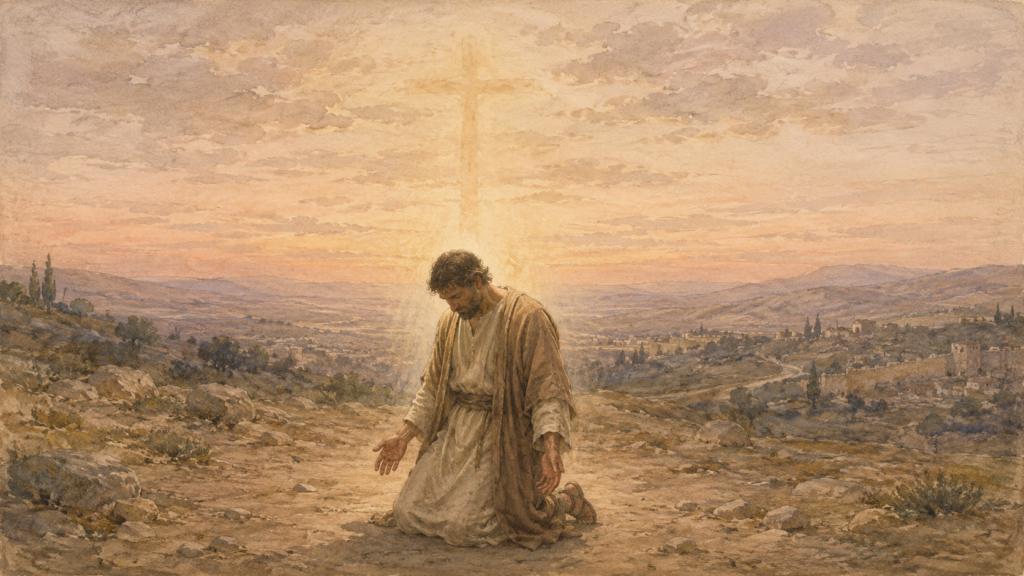
“By sending his own Son in the likeness of sinful flesh and for sin, he condemned sin in the flesh.” — Romans 8:3b (ESV)
I sat for a while with the phrase “the likeness of sinful flesh” (ἐν ὁμοιώματι σαρκὸς ἁμαρτίας, en homoiōmati sarkos hamartias). Paul is being very precise here. He does not say “sinful flesh,” which would compromise Christ’s holiness. He does not say merely “flesh,” which would blur Christ’s solidarity with us. He says the likeness of sinful flesh — Christ took on the same flesh as ours, stood in the same arena, but did not suffer the same defeat. And so, within that flesh, He could condemn sin. (Blue Letter Bible’s lexicon entry on ὁμοίωμα is helpful here for anyone who wants to dig further.)
That is the part I do not want to skip past. Sin was not dealt with somewhere outside of us, in some sterile heavenly courtroom detached from the body. It was dealt with in the very place where I keep losing. The arena of my defeat became the arena of His victory. And His victory is counted as mine — the same logic Romans 5 traced through when Paul wrote that Christ died for us while we were still sinners.
The Requirement of the Law — Fulfilled, Not Abolished
“In order that the righteous requirement of the law might be fulfilled in us, who walk not according to the flesh but according to the Spirit.” — Romans 8:4 (ESV)
This is where I want to slow down, because I think this verse is often misread in two opposite directions.
Paul does not say the law has been abolished. He says its requirement has been fulfilled. The law’s original aim — love of God, love of neighbor — is genuinely being accomplished in those who are in Christ. So this is not a passage that says, “the law doesn’t matter anymore, live however you like.” That reading flattens what Paul is actually doing.
But neither does Paul say the law’s requirement is fulfilled because I finally got my act together. The mechanism is named in the very next breath: “who walk not according to the flesh but according to the Spirit.” What the law could not do by command, the Spirit now does by indwelling. What could not be produced by effort is now produced by presence. That is the shift.
I want to be careful here, because I have seen this misread in a way that troubles me. Some hear “the Spirit will do it” and conclude that they should simply go limp and wait. That is not what Paul is describing. Walking — περιπατέω, peripateō — is an active verb. The Spirit does not move instead of me; the Spirit moves in me, so that my walking is no longer my desperate self-propulsion but something that flows from a source I did not generate. The opposite of self-effort is not passivity. It is dependence.
Two Mindsets, Not Two Effort Levels
“For those who live according to the flesh set their minds on the things of the flesh, but those who live according to the Spirit, on the things of the Spirit.” — Romans 8:5 (ESV)
In verses 5–8 Paul draws a contrast between two kinds of people, and I think it is easy to misread this as a contrast in moral intensity — as though the “flesh” people are slacking and the “Spirit” people are trying harder. That is not it at all.
The key verb is φρονέω (phroneō), which the ESV renders “set the mind on.” But it is wider than thinking. It means to lean toward, to give one’s attention to, to orient the heart’s center of gravity. It is less about what is in my head and more about what I am tilted toward.
The one who lives according to the flesh leans toward the self — my capacity, my righteousness, my effort, my record. The world rotates around me. And Paul says that road ends in death (v. 6), not because God is angry at people who try, but because the self cannot save the self. Whatever is rooted in me collapses when I collapse.
The one who walks according to the Spirit leans toward what Christ has already accomplished — His righteousness, His power, His finished work. And there, Paul says, is “life and peace.” Not because the Spirit-led person is morally superior, but because they are rooted in something that does not give way.
Verse 7 takes this even further, and it is the verse I find most exposing:
“For the mind that is set on the flesh is hostile to God, for it does not submit to God’s law; indeed, it cannot.” — Romans 8:7 (ESV)
I used to read “hostile to God” and picture the obvious villains — the deliberate rebels, the openly godless. But Paul’s logic is broader. Every attempt to stand before God on the basis of my own righteousness — even when it wears religious clothing, even when it looks like piety — is, at its root, hostile to God. Because it quietly nullifies what Christ has done and tries to redo it myself. The most religious version of me can be the most hostile, precisely because the hostility is the best-disguised.
And then the verse turns the knife: “it does not submit to God’s law; indeed, it cannot.” Not will not. Cannot. This is not a problem of willpower. It is a problem of capacity.
A Place I Have Already Been Moved To
“You, however, are not in the flesh but in the Spirit, if in fact the Spirit of God dwells in you.” — Romans 8:9 (ESV)
So what am I supposed to do? I need to move from the flesh to the Spirit, but the flesh cannot make that move. The very faculty I would use to escape is the faculty that is broken. This is where I would be stuck — except verse 9 unties the knot.
Paul does not say, “you must move.” He says, “you have been moved.” If the Spirit of God dwells in you, you are already in the Spirit. What the law could not do — relocate me from one realm to another — God has already done in Christ. It is not a destination to reach by effort. It is a position already given.
This is where the chapter quietly opened into something I keep returning to in John — Jesus’ word μένω (menō), “abide” or “remain.” “Abide in me, and I in you” (John 15:4). Faith, I am learning slowly, is not the labor of getting to the place. It is the practice of remaining in the place I have already been put. Less climbing, more rooting.
And the practical mirror, for me, is this: I notice that I run an unconscious calculation almost every day — if I do well today, God is closer; if I fail, God pulls back. That calculation is the flesh-mind dressed in Sunday clothes. Romans 8:3 is the verse that breaks it. Because I could not, He did. And what He did is the ground I stand on, on the days I do well and the days I do not.

Frequently Asked Questions
Q: What does Romans 8:3 mean when it says the law was “weakened by the flesh”? A: Paul is not saying the law itself is flawed — he just called it holy in Romans 7:12. He is saying the law’s effectiveness is limited by the material it works on: human flesh that cannot keep it. The law diagnoses accurately, but a diagnosis is not a cure. That is why what the law could not do had to be done by God Himself.
Q: What did God do that the law could not do? A: According to Romans 8:3, God sent His own Son “in the likeness of sinful flesh” and condemned sin in the flesh. He did not strengthen the law or demand more effort from us. What the law could not do from outside, God did from within the flesh itself, so that Christ’s victory in that arena is counted as ours.
Q: What does it mean to walk according to the Spirit in Romans 8? A: It does not mean passive waiting, and it does not mean trying harder. The Greek verb peripateō is active — actual walking — but the source of the walking has changed. Instead of self-propulsion by willpower, the walking flows from the Spirit who dwells within. The opposite of self-effort is not passivity; it is dependence.
A Prayer to Close This Romans 8 Devotional
Lord,
I confess that I keep drifting back to the place of self-righteousness. I keep running the quiet calculation — that I am accepted when I do well and distanced when I fail. I cannot seem to stop it on my own. But this passage says the opposite: precisely because I could not do it, You did. And what You did is the ground of my righteousness.
Let that truth settle into the deep places of me — the places resolution cannot reach.
The law commands me; the gospel announces over me. The law says, live like this. The gospel says, Christ has lived like this, and you are in Him. The law drives me toward the cliff. The gospel sets me on the Rock. Today, keep me on the Rock.
Help me to step back from the place of self-effort, not into passivity, but into dependence. Move my instinct — the one that always wants to stand up and try again on my own — into the place of remaining on the righteousness Christ has already accomplished. By the Spirit who dwells in me, let me walk today not by resolve but by abiding, not by striving but by trust.
In the name of our Lord Jesus Christ I pray. Amen.
About the Author
Each morning I read one chapter of Scripture and reflect on its resonance in daily life. Writing from the perspective of a layperson rather than a trained theologian, I trace how the ancient text still meets us today.
📖 Learn more: About the Author
Pingback: All Things Work Together for Good — Romans 8 Devotional