Today’s reflection rests on three verses near the end of Romans 7, where Paul declares that evil lies close at hand the very moment we want to do good — verses 21, 24, and 25. They are the place where Paul, after walking through the entire chapter’s tangle of inner conflict, finally arrives. They are also the doorstep of chapter 8, the great answer that begins almost immediately afterward. Taken individually, these verses can feel ordinary. But threaded together, they paint what may be the most honest picture of the Christian life I know.
“So I find it to be a law that when I want to do right, evil lies close at hand.” — Romans 7:21 (ESV)
“Wretched man that I am! Who will deliver me from this body of death?” — Romans 7:24 (ESV)
“Thanks be to God through Jesus Christ our Lord! So then, I myself serve the law of God with my mind, but with my flesh I serve the law of sin.” — Romans 7:25 (ESV)
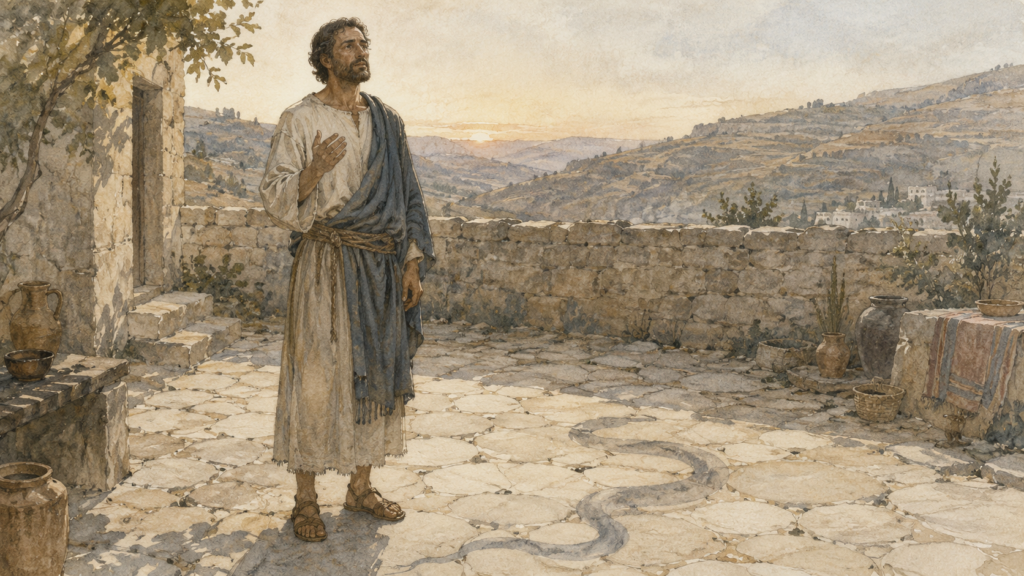
Romans 7 as a whole is Paul’s careful defense of the law’s goodness, paired with an equally careful insistence that the law cannot rescue. After the marriage analogy in verses 1–6 and the long account of inner struggle in verses 7–20, Paul reaches the chapter’s summit in these final verses — and then opens a door into chapter 8.
What Lies Close at Hand
When I first read verse 21, it felt like a routine summary of everything Paul had just said. But I stopped at one Greek verb in the original. The phrase translated “evil lies close at hand” uses παράκειμαι (parakeimai), which carries the picture of something lying down right next to you. Not nearby. Not somewhere in the room. Right beside you, waiting.
What unsettled me was not that evil is close. It was that evil is closest at the very place where I want to do good. Paul calls this a “law” on purpose — a rule, a principle, something with no exceptions. The moment I rise to do good, the thing lying next to me rises too.
I think we have all experienced this. The morning I decide to wake early for prayer is the morning my exhaustion feels heaviest. The week I resolve to forgive someone is the week their old words come back sharpest. The Sunday I decide to give more generously is the week unexpected expenses appear out of nowhere. We could call this “spiritual warfare” — but Paul reaches for a quieter, more devastating word. He calls it a law. Not an occasional ambush. A pattern with no exceptions, much like the way the seat of the heart is never empty — something is always rising up where God should be.
The Word “Who” — Romans 7:24 Meaning
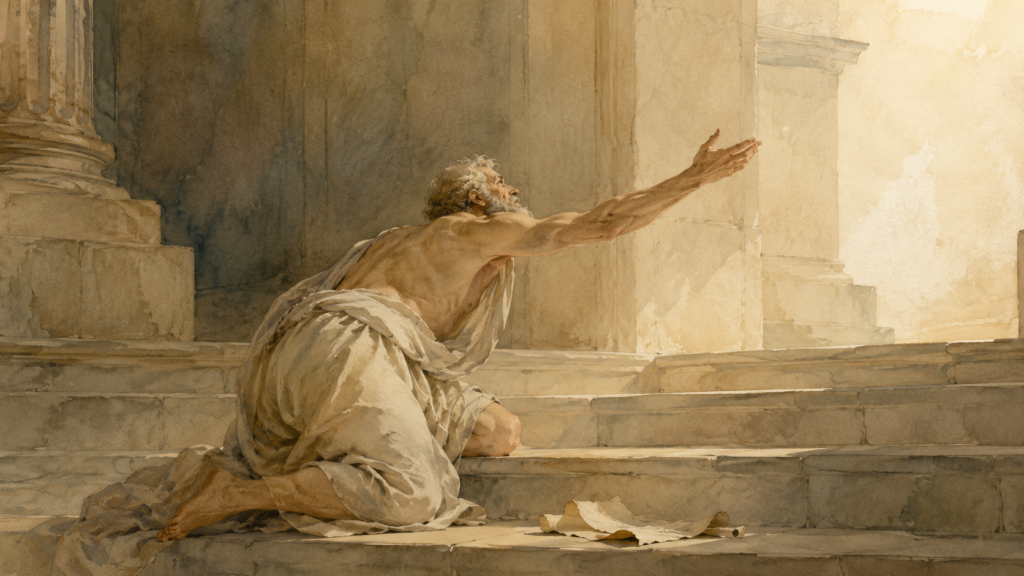
Verse 24 is probably the most quoted verse in Romans 7. “Wretched man that I am!” But I wonder if we sometimes miss the most important word in the sentence. It is the word that comes next.
“Who will deliver me from this body of death?”
In Greek, that “who” is the single word τίς (tis) — an interrogative pronoun. One small word that carries the whole weight of the chapter. Paul does not ask how he will be rescued. He does not ask for a method, a technique, a discipline. He asks for a person.
And the question already knows its own answer — that the answer is not inside him. If the answer had been inside him, he would not have asked “who.” He would have said, “I just need to try harder. I just need more resolve. I just need a better plan.” But Paul has walked through every aisle of self-effort in this chapter, and they are all empty. So he asks outward.
The verb “deliver” carries this same direction. The Greek ῥύομαι (rhyomai, to rescue from danger) pictures someone being pulled out of a swamp by a hand from outside. No one drowning in a swamp can lift themselves out by their own hair. Paul has stopped flailing. He is now reaching.
I think this is where many of us, including me, get stuck. We can admit the law of verse 21 — yes, evil really does lie close at hand. But we do not quite make it to the “who” of verse 24. We stay inside the question, “How do I fix this?” We do not yet ask, “Who can rescue me?”
Gratitude in the Middle of the Struggle
Verse 25 is strange when you read it carefully. After the anguish of verse 24, Paul suddenly breaks into thanksgiving: “Thanks be to God through Jesus Christ our Lord!” But what is stranger is what comes right after. He does not describe the struggle as resolved. He returns to it: “So then, I myself serve the law of God with my mind, but with my flesh I serve the law of sin.”
The first time I noticed this, I was confused. Paul is not thanking God because the conflict is over. The conflict is still there, right there in the same sentence as his gratitude. Then I realized — that is exactly the point.
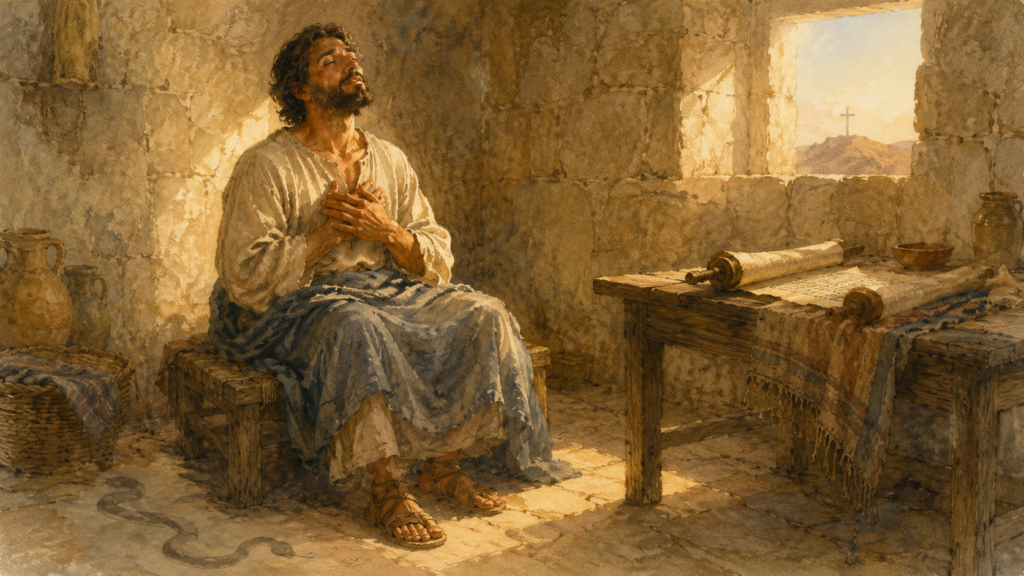
Gratitude does not begin when the struggle ends. It begins when the name of the Rescuer is known.
The name is what changes everything. Where verse 24 asked “who,” verse 25 supplies a name — Jesus Christ our Lord. Paul is not painting a portrait of victory over sin in this moment. He is not claiming that what lies close at hand has gone away. He is saying that he now knows who will deliver him, and that knowledge alone is reason enough to give thanks while the struggle is still ongoing.
I have come to think this is the most honest place a Christian can stand. We live inside the law of verse 21 — yes, evil still rises next to us when we want to do good — and we also live inside the gratitude of verse 25 at the same time. The Reformers called this simul justus et peccator, a Latin phrase meaning “at once righteous and a sinner.” One person, two realities, both true. The struggle of chapter 7 and the thanksgiving of verse 25 are not different stages of the Christian life. They are the same moment, held together.
This is why Romans 7 must come before Romans 8. A reader who skips chapter 7 cannot feel the weight of “There is therefore now no condemnation” in chapter 8 verse 1. The same hinge that turned condemnation into gospel in the “but now” of Romans 3 turns again here, after a long walk through the diagnosis. Only those who have followed self-effort to its dead end can call upon the name from outside. Only those who have seen what lies close at hand can give thanks for the One who delivers.
Frequently Asked Questions
Q: What does “evil lies close at hand” mean in Romans 7:21? A: The Greek verb παράκειμαι (parakeimai) literally pictures something lying down right beside you, waiting. Paul is not saying evil is somewhere in the world — he is saying it lies right next to the desire to do good. The two rise together.
Q: What is the Romans 7:24 meaning of “Who will deliver me from this body of death”? A: Paul does not ask “how” he will be rescued, but “who.” That single word, τίς (tis) in Greek, marks the moment he stops looking inside himself for a solution. The question already knows that deliverance must come from outside.
Q: Why does Paul give thanks in Romans 7:25 if the struggle is not over? A: Gratitude does not wait for the conflict to end. Paul thanks God the moment the name of the Rescuer is known — Jesus Christ our Lord. The same sentence that contains his thanksgiving also returns to the struggle, showing that Christian gratitude lives inside the ongoing tension.
A Prayer to Close This Romans 7 Reflection
Lord,
Thank you for bringing me to the place where Paul stood at the end of Romans 7. Looking at the honest diagnosis — that evil lies close beside me at the very place where I want to do good — I see how much of my striving has only circled the problem without ever reaching past it.
I have tried to lift this thing off me by my own strength. I thought if I resolved more firmly, woke up earlier, gripped my discipline tighter, it would finally release me. But wherever I have wanted to do good, the thing beside me has risen up with me.
Lord, do not let me call my own effort by the name of faith. Let me give thanks for Jesus Christ even while what lies close at hand has not yet gone away. Shape me into the kind of believer whose gratitude does not wait for the struggle to end — the kind who can give thanks in the middle of it because the name of the Rescuer is already known.
Today, every time the thing beside me rises, let me call upon that name.
In the name of our Lord Jesus Christ I pray. Amen.
About the Author
Each morning I read one chapter of Scripture and reflect on its resonance in daily life. Writing from the perspective of a layperson rather than a trained theologian, I trace how the ancient text still meets us today.
📖 Learn more: About the Author
Pingback: What the Law Could Not Do, God Has Done — Romans 8