If you read the New Testament straight through — the four Gospels, then Acts, then the letters of Paul — a single thread starts to come into view. The thing Jesus singled out for praise in the people who came to Him; the conclusion the early church fought to defend in its first major crisis; the gospel Paul finally set down on paper in Romans — they all point to the same truth. A person is counted righteous before God not by keeping the law well, but by faith in Christ. This morning, sitting with that whole sweep, I noticed it collapses into just three verses — Romans 3:20-22 — and pivots on what I’d call the famous Romans 3 but now: two small Greek words at the start of v. 21, νυνὶ δέ (nyni de), rendered in English as “but now.” I haven’t been able to shake the Romans 3 but now all morning.
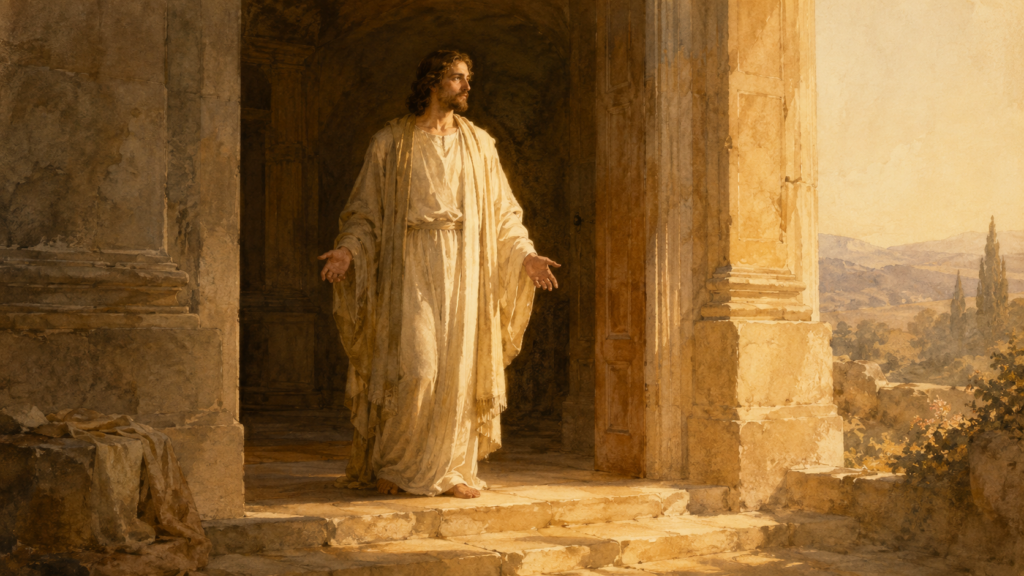
“For by works of the law no human being will be justified in his sight, since through the law comes knowledge of sin. But now the righteousness of God has been manifested apart from the law, although the Law and the Prophets bear witness to it— the righteousness of God through faith in Jesus Christ for all who believe. For there is no distinction” — Romans 3:20-22 (ESV)
Romans 3 sits at the climax of Paul’s opening argument. Chapters 1 and 2 build the case relentlessly: the moral failure of pagan idolatry in chapter 1, then the religious failure of those who keep Torah outwardly but quietly violate it in chapter 2. By 3:9 Paul has the verdict ready — “all, both Jews and Greeks, are under sin” — and a long string of Old Testament quotations drives the point home: “none is righteous, no, not one.” Verses 20 through 22 are where Paul stops indicting and starts announcing. The diagnosis is sealed in v. 20; the verdict is reversed in v. 21; the way it reaches us is named in v. 22.
Verse 20 — The Law as a Diagnosis, Not a Ladder
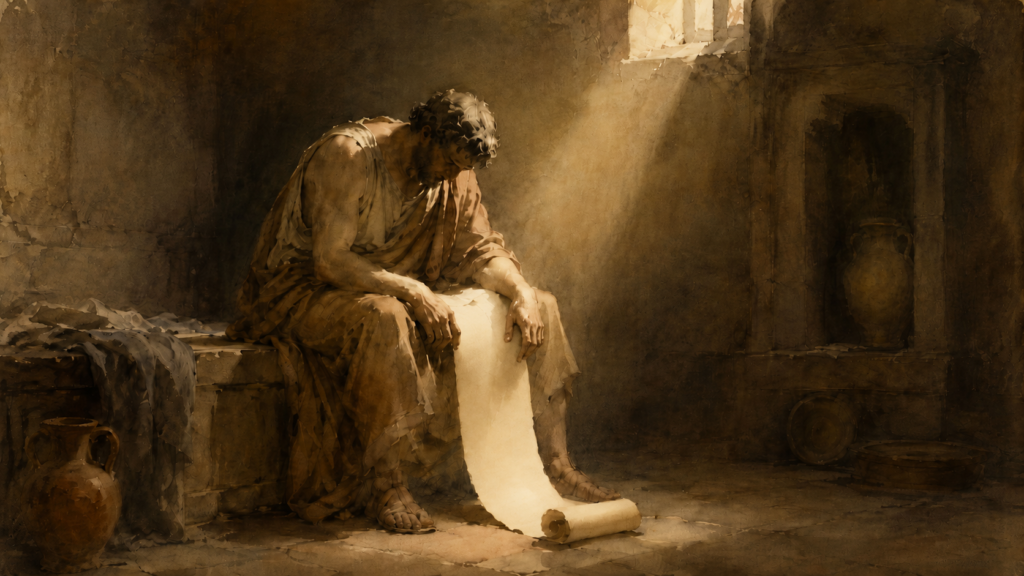
“For by works of the law no human being will be justified in his sight, since through the law comes knowledge of sin.” That second clause is doing a lot of work. Paul isn’t saying the law is broken. He’s saying the law is doing exactly the job it was designed for — only that job isn’t the one we wanted it to do. We wanted the law to be a ladder we could climb to reach God’s approval. It turns out to be more like a mirror of sin — showing us how far below that approval we actually live.
I had to sit with what that actually means in practice. The law tells us, in plain words, what God is like and what a life worthy of Him would look like: do not murder, do not bear false witness, do not covet, love your neighbor as yourself. These aren’t arbitrary rules; they’re God’s holy character translated into the grammar of our daily lives. So at first it seems like, if we just tried hard enough, we could line up.
Then something strange happens the moment you take any one of those commands seriously. The line “you shall not covet” sits there quietly until you actually let it speak — and suddenly the small jealousies you’d been ignoring start surfacing one by one. Why your friend’s new car kept coming to mind. Why something sank inside you when a colleague got the promotion. “Love your neighbor as yourself” sits there harmlessly until you try to apply it to a real, irritating neighbor — and then you see how much of your daily kindness is conditional on convenience. The law didn’t create the covetousness or the self-centeredness. It just shone a light on what was already there in the dark. The illness was already present; the diagnosis simply gave it a name.
So the law isn’t an instruction manual that says “do all this and you can earn righteousness.” It’s a diagnostic tool that says “see how far you are from righteousness.” Verse 20 says it plainly: through the law comes knowledge of sin. The law neither creates sin nor cures it. It exposes it. And that exposure is what gets us off the ladder and looking for another way home.
That’s where I had to ask myself an honest question: in my own walk, am I treating the law as a ladder or as a diagnosis? When I miss a few mornings of prayer and feel weighed down — when I hit a “good week” and feel a little smug — those feelings are the fingerprints of ladder-climbing. Verse 20 in Romans 3 says the ladder was never there. It’s only when I stop trying to climb that the next verse becomes audible.
Verse 21 — Romans 3 But Now and the Hinge of the Gospel
Right where the weight of v. 20 lands, v. 21 begins: “But now.” In Greek that’s νυνὶ δέ (nyni de) — said to be one of the most charged transitions in the whole New Testament. The Romans 3 but now isn’t a casual “now, at last.” It’s closer to an announcement that one age has ended and another has begun, with the cross and resurrection of Jesus as the hinge.
What follows is even more striking: “the righteousness of God has been manifested apart from the law, although the Law and the Prophets bear witness to it.” Apart from the law — and yet the Law and the Prophets had been pointing toward it the whole time. That sounds like a contradiction until you realize it’s the whole shape of the New Testament. A new road, but not a road that came out of nowhere; a road the older Scriptures had been gesturing toward all along.
That’s where the Gospels rushed back to me. Every time Jesus encountered someone, the thing He singled out for praise was almost never their Torah-keeping. It was their faith. Not the Pharisee with the airtight observance record, but the centurion with his unexpected trust, the Canaanite woman with her stubborn pleading, the bleeding woman reaching out at the edge of the crowd, the criminal on the next cross. To these people Jesus said, again and again, some version of “your faith has saved you.” It wasn’t the level of compliance that mattered; it was the direction of trust.
In Acts the same current breaks into the life of the community. In Acts 15, when the early church faced its first major crisis — whether Gentile believers had to take on the yoke of the law in order to be saved — Peter stood up and said:
“But we believe that we will be saved through the grace of the Lord Jesus, just as they will.” — Acts 15:11 (ESV)
That single sentence stopped the argument. (I sat with this same scene in an earlier reflection on Acts 15 and the quiet yoke we keep picking up, and the resonance with Romans 3 has only grown sharper since.) Peter’s confession lands in exactly the same place Romans 3:22 will land: there is no distinction. So Paul’s “but now” isn’t a new theology he invented one day at his writing desk. It’s the gospel that was already embodied in Jesus’ encounters with people, already defended by the early church under pressure, and finally set down with the precision of a courtroom argument by the apostle’s pen.
Verse 22 — A Righteousness Without Distinction
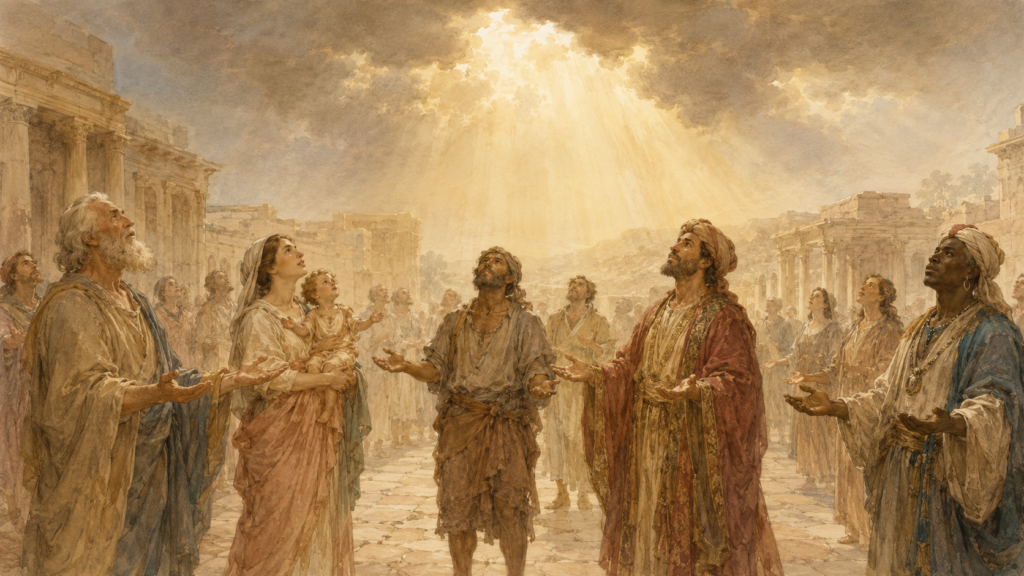
Verse 22 names what this righteousness actually is, in a single breath: “the righteousness of God through faith in Jesus Christ for all who believe. For there is no distinction.” Three things in one line. The source is God. The channel is faith in Christ. The recipients are all who believe.
The phrase that stayed with me longest was no distinction. A new believer doesn’t get less of this righteousness because they’re new. A short walk of faith, an unfinished read-through of the Bible, a thin prayer life — none of these become grounds for receiving a smaller portion. And the same phrase cuts the other way: a long-time believer can’t use the depth of their walk as grounds for receiving a fuller portion. “No distinction” runs in both directions. No one can use anything they bring as leverage, because the righteousness on offer doesn’t respond to leverage.
In a way, all those Gospel encounter scenes had been previewing this very verse. The people highest on the law-ladder — the religious experts, the rule-keepers — often missed the righteousness entirely. The people farthest from that ladder — the disreputable, the desperate, the outsiders — came with empty hands and received it without distinction. Verse 22 of Romans 3 is the theological summary of every one of those scenes.
But What About Works? Faith and James, Together
Here a fair question shows up. If righteousness comes by faith alone, do works no longer matter? Doesn’t James say almost the opposite?
“So also faith by itself, if it does not have works, is dead.” — James 2:17 (ESV)
The tension is real, but Paul and James aren’t actually pulling against each other. They’re guarding the same truth from two different angles. What Paul refuses is works as the basis of justification — the move that says, “count me righteous because of what I’ve done.” What James refuses is faith without fruit — the claim that says, “I trust Christ” while a life shows no evidence of that trust. They are two sides of the same coin.
This is where the contrast between legalism and gospel becomes important. Legalism makes obedience the condition for being accepted by God; the gospel makes obedience the response to being already accepted. Justification by faith alone — sola fide, the Reformation’s central recovery — is not a green light for indifference. If anything, it’s the only soil in which non-anxious obedience can actually grow. Only a heart that has actually received righteousness as a gift, with no leverage of its own, gets free of the transactional pressure that turns obedience into either fear or barter. From that place, obedience starts to look like love rather than payment. (The Philippian jailer’s question — “what must I do to be saved?” — and Paul’s answer pivot on exactly this hinge, which I traced more closely in this earlier reflection on Acts 16.)
I’d hate for the Romans 3 but now to be misread as “live however you want.” It’s the opposite. The righteousness it announces isn’t a standard I fall short of and then have to earn back. It’s a standard I cannot earn even if I lived flawlessly — and so I can only receive it empty-handed. And precisely because I receive it empty-handed, every act of obedience that follows is no longer a transaction. It’s gratitude. That, in the end, is what the Romans 3 but now actually does to a life.
Frequently Asked Questions
Q: What does the Romans 3 but now (νυνὶ δέ) actually mean? A: The Greek νυνὶ δέ (nyni de) is more than a casual time marker. The Romans 3 but now in v. 21 announces that one age has ended and another has begun, with the cross and resurrection of Jesus as the hinge. Many commentators flag it as one of the most charged transitions in the whole New Testament — the place where Paul stops indicting and starts announcing.
Q: How can the law be holy and yet unable to make us righteous? A: The law isn’t broken; it’s doing exactly what it was designed to do. It functions as a mirror of sin — revealing how far short we fall of God’s holiness rather than offering a ladder we can climb. Romans 3:20 names this directly: “through the law comes knowledge of sin.” The law diagnoses; it does not cure.
Q: Does justification by faith contradict James 2:17 on faith and works? A: No. Paul refuses works as the basis of justification, while James refuses faith without fruit. They guard the same truth from opposite sides. Righteousness is received by faith alone, but the faith that receives it is never alone — it always produces evidence in a transformed life.
A Prayer to Close This Romans 3 Devotional
Lord, You have shown me again this morning that I cannot stand before You on the strength of anything I do. Help me set down the ladder I keep trying to climb, and receive empty-handed the righteousness that has been manifested in Christ — the “but now” that opens a way I could never open for myself. Let that gift sink so deeply into me that my obedience grows out of love and gratitude, not out of fear or barter. Let me come today the way the centurion came, the way the bleeding woman came, the way the criminal beside Jesus came — with empty hands, certain only of who You are. In the name of our Lord Jesus Christ I pray. Amen.
Each morning I read one chapter of Scripture and reflect. I hope today’s devotional leaves a quiet resonance in your day as well.
About the Author
Each morning I read one chapter of Scripture and reflect on its resonance in daily life. Writing from the perspective of a layperson rather than a trained theologian, I trace how the ancient text still meets us today.
📖 Learn more: About the Author
Pingback: Dead to Sin and Alive to God: Insights from Romans 6