This morning I sat down with Romans 8 again, but this time the latter half — verses 26 to 30. And it was verse 26 that stopped my feet. “We do not know what to pray for as we ought, but the Spirit himself intercedes for us with groanings too deep for words.” Then verse 28 follows close behind, with the most quoted promise in the chapter: that all things work together for good for those who love God. Reading the two verses next to each other this morning, I noticed for the first time that they belong to the same sentence in Paul’s mind. The Spirit’s intercession in verse 26 and the all things work together for good of verse 28 are not two separate ideas. They are one continuous thought.
(This is the second half of Romans 8. In the first half, Paul explained what the law could not do, God did. Now he turns to what we cannot do — pray rightly — and shows us what the Spirit does instead.)
“Likewise the Spirit helps us in our weakness. For we do not know what to pray for as we ought, but the Spirit himself intercedes for us with groanings too deep for words. And he who searches hearts knows what is the mind of the Spirit, because the Spirit intercedes for the saints according to the will of God. And we know that for those who love God all things work together for good, for those who are called according to his purpose.” — Romans 8:26–28 (ESV)
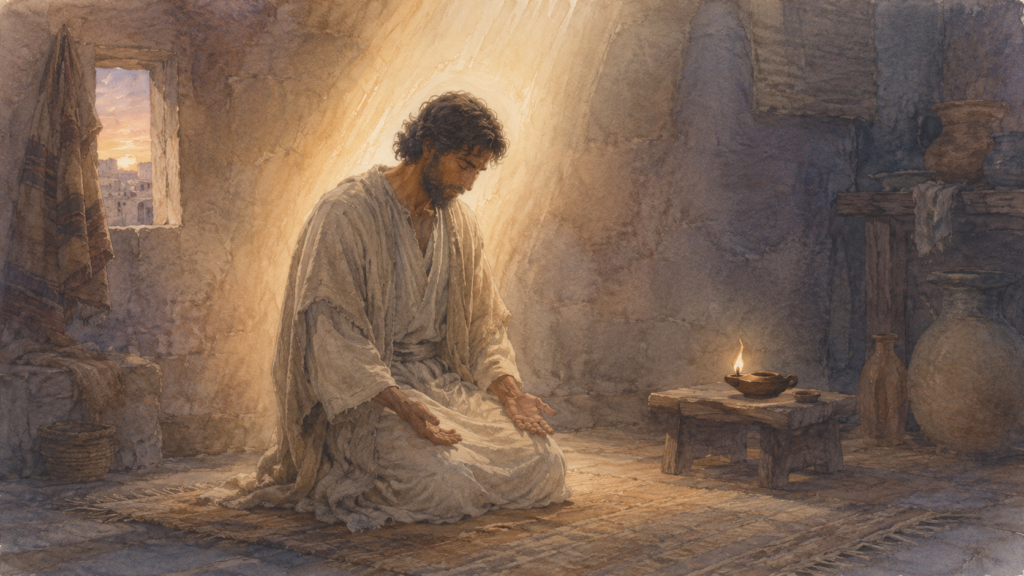
I want to walk through these five verses slowly, because what I came away with was three quiet certainties I did not have when I sat down: a sense of safety, a kind of boldness, and — most surprising to me — a much clearer sense of direction.
When We Do Not Know What to Pray For
Verse 26 names something I have rarely heard a sermon name. Paul does not say our problem is that we pray too little, or that our prayers lack passion. He goes lower than that. He says we do not even know what to pray for as we ought. We do not know which road will save our life and which will quietly kill it. We do not know which person we should meet, which decision will be the hinge of the next decade, which loss is grace in disguise. We pray every day in that ignorance.
And into that exact place, the Spirit enters. Not to give us better prayer technique. Not to scold us for the gaps in our spiritual literacy. The Spirit Himself prays — at a depth where our language cannot reach. The word Paul uses for “groanings” (στεναγμός, stenagmos) is the sound of something too deep to be articulated. Not eloquence. The opposite of eloquence. The kind of sound a person makes in labor, in grief, in love so heavy it cannot find syllables.
What undid me this morning is verse 27. He who searches hearts knows the mind of the Spirit, because the Spirit intercedes for the saints according to the will of God. A conversation is already happening inside me about me, between the Spirit and the Father — and that conversation is in perfect agreement with the will of God. The conversation does not wait for me to phrase my request correctly. It runs underneath my words, and underneath my silences too.
This is where the first quiet certainty arrived: safety. Not the safety of nothing going wrong, but the safety of knowing my well-being does not rest on the accuracy of my prayers. If it did, I would never be at rest. Did I ask for the right thing? Did I leave something out? Did I pray with enough faith? The verse says a deeper intercession is already running inside me — while I sleep, while I am lost, even while I am asking for the wrong things in earnest.
How All Things Work Together for Good
Verse 28 is the verse that gets stitched onto coffee mugs and graduation cards, and so it is the verse most likely to be misunderstood. “All things work together for good” can collapse into a vaguely religious version of “it’ll all work out.” But the verse does not float free. It is anchored to the two verses just before it.

Follow the logic: We do not know what to pray for. Therefore the Spirit intercedes for us. Therefore the Father, who searches hearts, hears the Spirit’s groaning. Therefore what happens in our lives is being moved — without our knowing how — in the direction of the good that the Spirit is groaning toward. That is how all things work together for good. Not because the universe is kind. Because the Spirit is praying.
And the promise has a fence around it. Paul is careful. The verse does not say good things work together for good. It says all things work together for good — for those who love God, who are called according to his purpose. The promise belongs to those in whom the Spirit dwells. I noticed myself wanting to soften that, the way modern readers often want to soften it. But softening it actually weakens the promise. The promise is strong precisely because it is specific. It is not weather. It is parental care.
“And those whom he predestined he also called, and those whom he called he also justified, and those whom he justified he also glorified.” — Romans 8:30 (ESV)
Verses 29 and 30 give the foundation. Why do all things work together for good for the called? Because behind the called is a long, unbroken sequence — foreknown, predestined, called, justified, glorified — and that sequence does not snap. Whatever shakes in my present, that chain underneath my life does not.
Here the second quiet certainty arrived: boldness. I do not know what the next year holds. But I know whose hand the blueprint is in. I do not see the architecture, but I trust the architect. So I take a step into an unknown future, not because the future is clear, but because the One holding the future is.
I want to add a careful word here, because “predestined” can be misread in a direction Paul never intended. Some hear it and slide into a kind of fatalism — if it is all already decided, I can just lie back. The text does not allow that. Predestination here is not a pillow to lie on; it is the ground beneath the road I am walking. Because that ground is firm, I walk with more weight, not less. The doctrine of predestination, read rightly, is not the exemption from action. It is the basis for action.
The Good That God Is Working Toward
Now we come to the verse that shifted everything for me this morning. Because there is one question verse 28 leaves dangling. What is the “good”? All things work together for good — which good? Defined by whom?
Verse 29 answers immediately, and the answer is not what most of us would write if we were drafting the verse ourselves:
“For those whom he foreknew he also predestined to be conformed to the image of his Son.” — Romans 8:29 (ESV)
The good is being conformed to the image of his Son. That is the good toward which all things are working. Not health, not success, not the restored relationship, not financial stability, not the open door at work. Those things may come — sometimes they do, sometimes they do not — but they are not the good of verse 28. The good is Christlikeness.
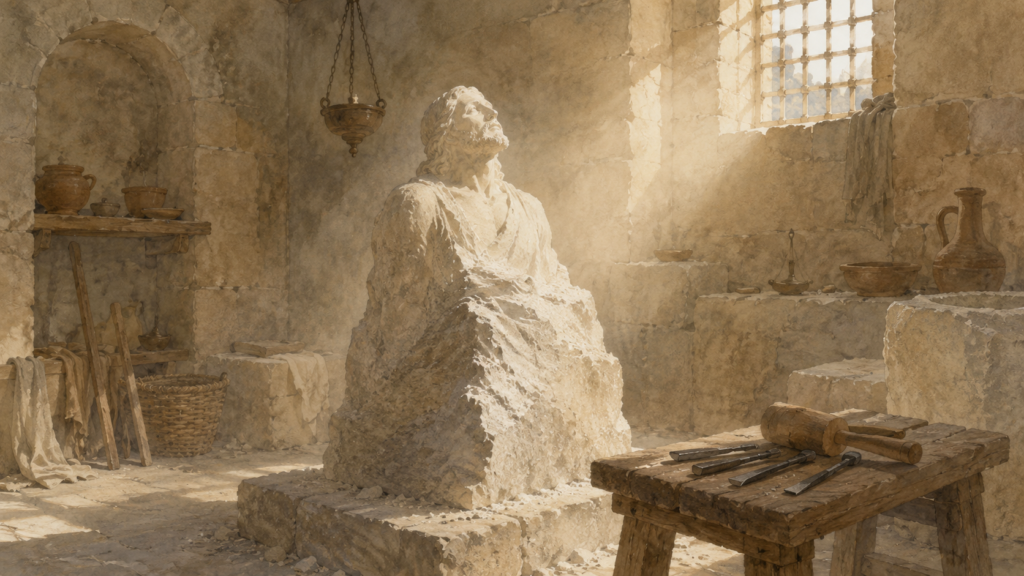
I sat with this for a while, because I realized I have been quietly substituting my own definition of “good” into that promise for years. All things work together for good — meaning, all things work together so that my life looks like the version of itself I would have chosen. And then when life does not look like that version, the promise feels broken. But the promise was never about that version. It was about a deeper good operating through the version of life I actually have, including the parts I would not have chosen.
This is where the third certainty arrived, the one that surprised me most: direction. Vocation talk in church circles is often about discovering your particular shape — your temperament, your gifting, your calling. That talk is not wrong. God really does shape each of us differently and place us into different rooms of His house. But it is incomplete if we leave it there. Whatever the calling, the calling is not finally about my self-actualization. It is one of the tools God uses to conform me to the image of His Son. The people I meet at that work, the conflicts I cannot avoid, the seasons I have to endure — those are not interruptions to the calling. They are the instruments of it.
So even when I do not know what my next assignment is, I know what direction God is sculpting me in. One direction. Always. And every road I walk, He uses for that one sculpting.
A Mirror — How I Was Praying Wrong This Morning
The practical mirror of this passage, for me, was this: I had been kneeling for years and silently asking myself, Am I praying right? Am I praying clearly enough, urgently enough, spiritually enough? This passage looked back at me this morning and said: You are missing the point. The Spirit is already praying inside you. Stop trying to engineer the perfect prayer, and let yourself be carried by the One who is already interceding.
That is the place faith actually begins. Not at I prayed well enough to be heard. At the Spirit is praying in me, the Father is answering through the Spirit, and the whole conversation is moving me toward the image of Christ. Safe. Bold. Directed.
Frequently Asked Questions
Q: What does Romans 8:28 mean when it says “all things work together for good”? A: The phrase is not a general optimism. It is anchored to the verses just before it. Because the Spirit intercedes for us according to God’s will (vv. 26–27), the events of our lives — including hard ones — are being moved toward the good the Spirit is praying for. And that good is defined in verse 29: being conformed to the image of God’s Son. All things work together for good in the sense that they all serve that one shaping.
Q: Who does the promise of all things working together for good apply to? A: Paul is specific: “those who love God, who are called according to his purpose.” It is not a general promise to everyone. It is a covenantal promise to those in whom the Spirit dwells. That specificity is what makes the promise strong rather than vague.
Q: How does the Spirit intercede for us with groanings too deep for words? A: The Greek word for “groanings” (stenagmos) describes sounds too deep to articulate — the sound of labor, grief, or weight that exceeds language. Paul is saying the Spirit prays at a level beneath our words, where our ignorance about what to ask for cannot block the request. The Father, who searches hearts, understands those groanings perfectly.
A Prayer to Close This Romans 8 Devotional
Lord,
I confess that I do not know what to pray for as I ought. I do not know which roads will save my life and which will quietly cost me. I do not know which prayers to lift up tomorrow morning. But this passage says I do not have to know. The Spirit Himself is praying inside me, in groanings too deep for the words I have.
Let me rest in that today. Let me stop trying to engineer the perfect prayer. Let me trust that all things work together for good even where I cannot see the working — because the One praying inside me is praying according to Your will, and You are moving every detail of my life toward one good: the image of Your Son.
I confess too how often I have substituted my own version of “good” into Your promise. I have wanted the comfortable version, the successful version, the painless version. But You are sculpting something deeper than comfort. Conform me to Christ in the rooms I would not have chosen, with the people I would not have picked, through the seasons I would have skipped. Make that one direction more precious to me than the particular shape of my circumstances.
In the name of our Lord Jesus Christ I pray. Amen.
About the Author
Each morning I read one chapter of Scripture and reflect on its resonance in daily life. Writing from the perspective of a layperson rather than a trained theologian, I trace how the ancient text still meets us today.
📖 Learn more: About the Author