This morning, reading through Romans 5, I noticed one phrase that keeps surfacing like a refrain: through our Lord Jesus Christ. It appears in verses 1, 11, and 21 — peace, joy, eternal life, all delivered through Him. But when I reached the end of the chapter, I found myself pulled back to a single verse I couldn’t move past — Paul’s claim that while we were still sinners, Christ died for us.

“but God shows his love for us in that while we were still sinners, Christ died for us.” — Romans 5:8 (ESV)
Romans 5 sits at a hinge in Paul’s letter. Chapters 1–4 build the case for justification by faith — that we are declared righteous not by anything we do but by trusting in what Christ has done. (I spent some time on the opening of that argument in my Romans 1 reflection on the idols of the heart.) Chapter 5 then unfolds what justification actually delivers into our lives: peace with God, access into grace, hope, the love of God poured into our hearts, reconciliation, and eternal life reigning through righteousness. The whole chapter is a long exhale after the argument of chapters 1–4. And verse 8 sits at the emotional center of that exhale.
The Two Letters That Carry the Gospel
When I first read verse 8, my eyes went straight to “sinners.” That seemed like the loaded word. But on a second read, I realized Paul had buried his real emphasis in a much smaller word right before it: still.
That little adverb shows up three times in the surrounding verses, almost like Paul is drumming on it. Verse 6: “while we were still weak, at the right time Christ died for the ungodly.” Verse 8: “while we were still sinners.” Verse 10: “while we were enemies.” Three different framings of the same point, hammered home from three different angles.
Why the repetition? I think Paul is aiming straight at an instinct most of us carry around without realizing it — the assumption that God will love us once we get a little more put together. Let me clean myself up first, then I’ll pray. Let me deal with this sin first, then I’ll come back. The internal censor that tells us to delay coming to God until we’re slightly more presentable.
I am not exempt from this. The morning after I’ve sinned, prayer doesn’t come easily. There is a small voice in my chest that says, not today, you’re too dirty today, wait until you’ve cleaned up a bit. Paul speaks directly against that voice. God didn’t begin loving us after we got cleaned up. He loved us at our dirtiest, when we had the least claim on him, when we were not just weak but actively his enemies. That is when Christ died.
This is the fault line where religion and the gospel diverge. Religion says, I obey, therefore I am accepted. The gospel says, I am accepted in Christ, therefore I obey. Tim Keller used to put it almost exactly that way, and Romans 5:8 is the verse standing under that whole framework. The order matters infinitely. Reverse it and you have a different religion entirely.
Evidence Outside Myself
The other word in verse 8 that has stayed with me is shows. In Greek it is a form of synistēmi (συνίστημι) — to demonstrate, to prove, to set something forward as evidence. It carries a near-courtroom weight. When Paul writes that God shows his love for us in Romans 5:8, the verb suggests evidence put on the table, not feelings reported from a distance.
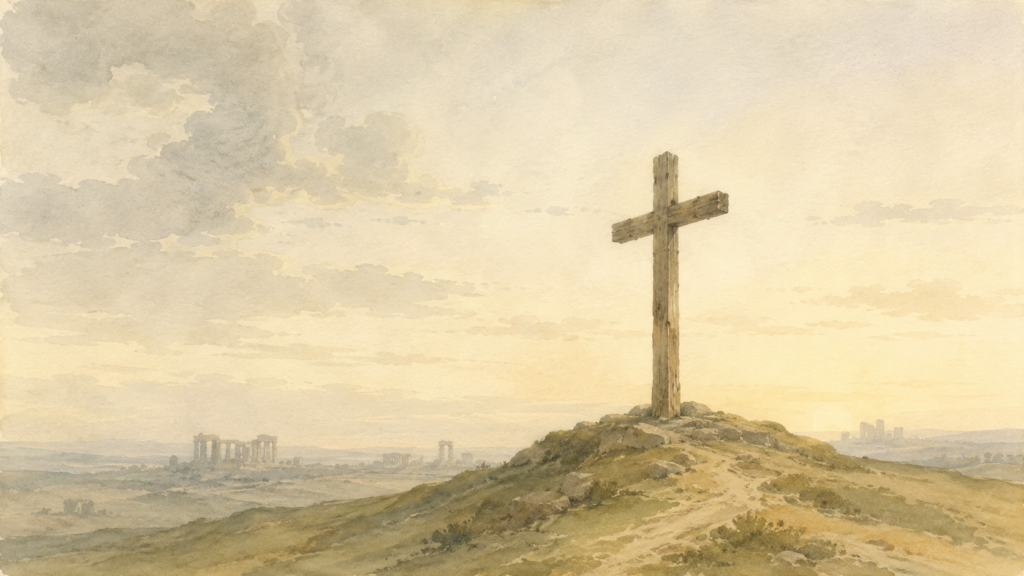
What strikes me about this is where the evidence lives. It does not live inside me. It lives outside me, on a hill, on a cross, in an event that happened two thousand years ago and has not moved since.
I think this matters because I am constantly tempted to verify God’s love by looking inward. Am I feeling peace right now? Am I feeling joy? Does my prayer life feel alive today? Those internal readings fluctuate. They rise and fall with sleep, with stress, with the weather of my own heart. If my assurance is tied to them, my assurance will rise and fall too.
Paul anchors the evidence somewhere else entirely. The cross stays put. Whether I feel close to God this morning or far from him, whether my prayers feel warm or hollow, Calvary remains exactly where it has always been — a public, fixed, unmovable demonstration. The proof is not in me. It was filed two millennia ago and never withdrawn.
There is a strange kind of rest in this. Trying to deepen my experience of God’s love is a good thing, but my experience is not the evidence. The evidence has already been entered into the record.
What Kind of Freedom Is This
I want to be careful here, because verse 8 can be read in a way Paul never intended. If God loves me while I’m still a sinner, why bother changing? Paul anticipates this question and answers it before the chapter ends. In verse 21, he writes that grace reigns “through righteousness leading to eternal life.” Grace doesn’t bypass righteousness; grace establishes the soil where righteousness can actually grow. He spends most of chapter 6 elaborating on this same point. (I felt some of this same logic at work in a different setting in my reading on Acts 26 — when grace spills over.)
So the freedom verse 8 gives us isn’t a freedom to keep sinning. It’s a freedom from having to prove ourselves in order to be loved. Those are very different things. The first is permissiveness. The second is the only soil in which real obedience grows — obedience that flows out of being already loved rather than obedience that tries to earn love.
If I started today asking myself what I’m standing on before God, I’d want the honest answer to be: not my morning devotions, not the fact that I behaved well yesterday, not even how I feel right now. The honest answer is that I’m standing on a love that was demonstrated before I existed, and that doesn’t depend on me for its evidence.
Whenever the answer drifts toward anything else, I have quietly slipped back into a kind of religion that the cross was meant to end. Which is why I think we have to come back to verse 8 again, and again, and again.
Frequently Asked Questions
Q: What does “while we were still sinners” mean in Romans 5:8?
A: Paul is making a point about the order of God’s love. The phrase emphasizes that God loved us before we had cleaned ourselves up, before we deserved it, even while we were still actively his enemies (verse 10). The love was not a reward for our improvement; it was the cause of it.
Q: How does Romans 5:8 show God’s love?
A: The Greek verb behind “shows” (synistēmi) carries a courtroom sense — to demonstrate or put forward as evidence. Paul is saying God did not merely feel love toward us but publicly proved it through the death of Christ. The evidence of his love lives outside us, fixed at the cross, rather than inside our fluctuating emotions.
Q: What is the difference between religion and the gospel in Romans 5?
A: Religion operates on the formula I obey, therefore I am accepted. The gospel reverses the order: I am accepted in Christ, therefore I obey. Romans 5:8 stands under the second formula. Christ died while we were still sinners, which means acceptance came first and any obedience we offer is a response to love, not a condition for receiving it.

A Prayer to Close This Romans 5 Devotional
Lord,
I keep trying to clean myself up before I come to you. Some small voice keeps whispering that I’ll be more lovable once I’ve smoothed out my rough edges, once I’ve gotten this sin under control, once I’ve prayed enough mornings in a row. Today I’m not strong enough on my own to silence that voice.
But you have shown me that while I was still weak, still sinning, even still your enemy, Christ already died for me. The evidence of your love is not inside the fluctuations of my heart. It is fixed at the cross, where you put it forward in plain sight and where it has never moved. Help me to remember that today.
Loosen my grip on every attempt to stand before you on the strength of my own performance. Let me breathe freely inside the love you have already proven, and let that love become the very thing that changes me — not out of fear of falling short, but out of grateful response to being so completely received.
In the name of our Lord Jesus Christ I pray. Amen.
About the Author
Each morning I read one chapter of Scripture and reflect on its resonance in daily life. Writing from the perspective of a layperson rather than a trained theologian, I trace how the ancient text still meets us today.
📖 Learn more: About the Author
Each morning I read one chapter of Scripture and reflect. I hope today’s devotional leaves a quiet resonance in your day as well.
Pingback: What the Law Could Not Do, God Has Done — Romans 8