This morning’s devotion was Acts 24, and I want to write about something I keep running into in my own walk — procrastination in faith. To be honest, finding a verse to meditate on has been hard since chapter 22. Something kept breaking my focus, and from chapter 22 onward Paul’s repeated trial scenes started to feel a little same-y.
Still, I had promised the Lord I would meditate honestly every day, so I keep rereading the passage until something stirs in me. Today, my heart landed on Acts 24:25 — the moment Felix decides to put Paul on the back burner.
“And as he reasoned about righteousness and self-control and the coming judgment, Felix was alarmed and said, ‘Go away for the present. When I get an opportunity I will summon you.'”
— Acts 24:25 (ESV)
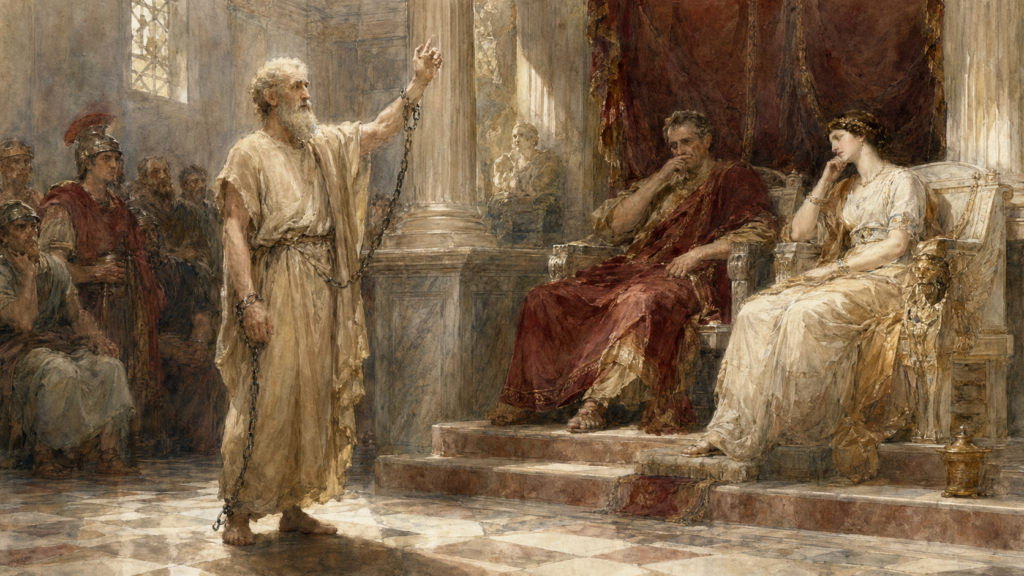
This is the moment Felix gets shaken by Paul’s message and quietly shelves the whole matter. And honestly, Felix and Drusilla had every reason to be afraid. Felix was a corrupt governor who took bribes (24:26), and Drusilla, the daughter of Herod Agrippa I, had been more or less taken from another marriage into his. A ruler whose righteousness had collapsed, a couple whose self-control had collapsed, and a coming judgment waiting for them both. No wonder he trembled.
Paul was preaching about “the judgment to come,” and Felix’s response to that trembling was, “when I get an opportunity.” It’s the same thing we say all the time — “later,” “when I have time.” But two verses later, two whole years pass. Felix hands the case off to his successor Festus and walks away from it entirely. This pattern of “Felix when I have time” is, I think, a portrait of every reader of this blog at one point or another, myself included.
“When two years had elapsed, Felix was succeeded by Porcius Festus. And desiring to do the Jews a favor, Felix left Paul in prison.”
— Acts 24:27 (ESV)
Why Procrastination in Faith Is Not a Small Thing
Procrastination is something we should avoid for all kinds of reasons. If you want to get things done, study, or grow in any area, putting things off is rarely helpful. But I want to think specifically about why procrastination in faith deserves a different kind of seriousness from Christians.
When we put something off, we are not just delaying the action. We are taking on the risk that we ourselves will keep changing during the delay. The first tremble of conviction becomes familiarity the second time, dullness the third time, and eventually we hear the same message and feel nothing at all. That is just how it usually goes.
Here is a small example from my own life. I was studying English on Duolingo, and after skipping a few days, the app’s reminder messages started feeling more and more like background noise. Before I knew it, I had become someone who simply doesn’t do English practice anymore. -_-;; So “not now, later” begins as a problem of timing, but the longer it goes, the more it becomes a problem of who I am becoming.
The promise I make to my future self — that I’ll do later what I should be doing now — rests on the assumption that the future me will be the same as the present me. But every hour I delay before truth is an hour I become more capable of hearing that truth lightly. This is the quiet machinery of procrastination in faith, and it is more dangerous than it looks. It does not announce itself. It feels reasonable. It feels like wisdom.

Don’t Make the Lord Fit Into Your Schedule
Once my thinking reached this point, another question followed: Am I fitting the Lord into my schedule, or fitting my schedule around the Lord? This turns out to be a daily question, not a one-time decision.
- On a morning when I have an early meeting, do I squeeze QT in between calendar slots?
- When work gets heavy on a Sunday, do I just stream the service from home instead of going to church?
- On Friday evening, do I make it to the prayer meeting, or stay in and pray a little longer at home?
These are the small forks in the road.
Lately, prayer has been one of the things I care about most. I keep asking myself whether prayer is something I do in my leftover time, or whether it is the spine of my day. I try to start each day in prayer so I can carry a settled heart into whatever comes. I had been mulling over this for more than a quarter, dragging my feet, and at some point I just decided to start and stick with it.
To be clear, putting things off does not mean someone has weak faith. Some of you reading this might be procrastinators too, and that is okay. You are probably just busy, reasonable people, waiting for a better moment, a more efficient or effective time. But please don’t forget — when that delay repeats itself, I start to change, and the distance between me and the Lord can quietly grow. That trembling obedience we read about elsewhere — like the kind that meets an unfathomable calling head-on — only ever happens now, never later.
One Hope
So how do we turn around from this quiet drift?
There are honestly too many possible answers to give just one. But the single biggest thing I have come to believe since starting this faith journey is this:
The right time is not mine to set. This connects with the Greek concept of kairos (καιρός) — the appointed, decisive moment. The true kairos is not something I schedule. The Lord brings it, and even my own appointed times are set by Him.
So what matters most is recognizing that I am not the one holding the keys to timing — He is. And accepting that for the sake of His kairos, my own schedule may need to be shaken. Obedience flows from there. When something stirs in me during prayer, meditation, or QT, I want to learn not to push it off. I think this is one reason our older brothers and sisters in the faith placed such weight on early morning prayer — not because dawn is more peaceful or efficient, but because giving the first hour of the day to the Lord is, in itself, a refusal to procrastinate. It is a small daily protest against the procrastination in faith that can otherwise creep in unnoticed, the way eyes can slowly lose their ability to recognize grace.

Frequently Asked Questions
Q: What does Felix’s “when I have time” in Acts 24:25 actually mean?
A: Felix was using a polite delay to avoid responding to Paul’s message about righteousness, self-control, and judgment. The Greek word he used is kairos — the appointed moment — which makes the irony sharper: he tried to schedule a moment that was not his to schedule. Two years later, he simply walked away from the case.
Q: Why is procrastination in faith more dangerous than ordinary procrastination?
A: Ordinary procrastination delays a task. Procrastination in faith delays a response to truth, and during the delay, the listener changes. The same conviction that once made us tremble can become background noise, until we eventually hear the message and feel nothing at all.
Q: How do I stop putting off what I sense the Lord is asking of me?
A: Begin by accepting that the right moment is not yours to set. When something stirs during prayer, meditation, or Scripture reading, treat that stirring itself as the appointed time. Move now, even imperfectly, rather than waiting for a more efficient or effective moment that may never come.
Today’s Prayer
Lord,
Thank You for letting me come to this place of prayer again today. You give me these small moments and strengthen my will, and that is how I find myself here once more.
Thank You for letting me see Felix’s words — “when I get an opportunity” — and reflect on the procrastination in my own life. There have been so many times when I read Scripture, listened to a sermon, felt the trembling of conviction, started to resolve something — and then said, “just a little longer,” “when the right time comes,” and pushed the work You had given me to the back of the line. I confess this to You.
I pray that I would not delay the calling You give me, and that I would not miss the times You have appointed for me. Help me to recognize that this very moment is the kairos You have set. Remind me that the same opportunity does not come twice, and that every hour I delay is an hour I am quietly changing.
Help me to look honestly at the places where I have been postponing, without making excuses. Give me the courage to repent there, and to say, “Move now. Move today.”
In the name of our Lord Jesus Christ I pray.
Amen.
About the Author
Each morning I read one chapter of Scripture and reflect on its resonance in daily life. Writing from the perspective of a layperson rather than a trained theologian, I trace how the ancient text still meets us today.
📖 Learn more: About the Author