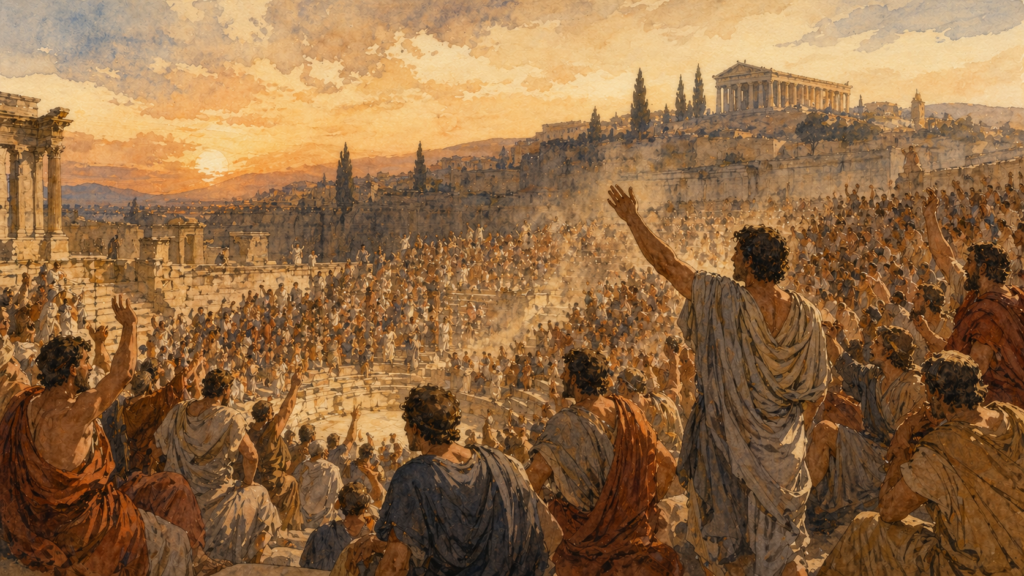
This morning, as I sat with this Acts 19 devotional, my eyes lingered on the riot scene that begins in verse 23. Verse 28 in particular — where the crowd, stirred by Demetrius, shouts “Great is Artemis of the Ephesians!” for two solid hours — held me in place. At first my question was simple: did these people really love Artemis that much, or were they just protecting their wallets?
“And you see and hear that not only in Ephesus but in almost all of Asia this Paul has persuaded and turned away a great many people, saying that gods made with hands are not gods.” — Acts 19:26 (ESV)
“When they heard this they were enraged and were crying out, ‘Great is Artemis of the Ephesians!'” — Acts 19:28 (ESV)
Acts 19 records what happened during Paul’s third missionary journey, centered in Ephesus. For two years he taught daily in the hall of Tyrannus, and as a result the word of the Lord spread across Asia (19:10). God worked extraordinary miracles, and those who had practiced magic gathered up their books and burned them publicly (19:18-20). Then, just as Paul’s ministry seems to be at its most fruitful, Luke abruptly turns the second half of the chapter into a record of riot. From verse 23 to the end, the entire city of Ephesus falls into two hours of chaos, chanting the name of a goddess.
Money, or Faith?
When I first read this passage, my question was simple: why were these people so angry? The scene where Demetrius the silversmith gathers his fellow craftsmen and openly says, “Men, you know that from this business we have our wealth” (v. 25) is unembarrassed. So far, this is a money conversation. But then in verse 27, his rhetoric shifts. He elevates their business problem into an insult against the entire city of Ephesus, and against the worship of Artemis throughout all Asia.
What’s interesting is that the chant the crowd takes up in verse 28 isn’t about money at all. “Great is Artemis of the Ephesians!” That’s the language of pure religious and civic pride. As I sat with this, I started to wonder: where exactly did Demetrius’s persuasion succeed?
The more I thought about it, the more I suspected that for these people, money and faith were already inseparable. The temple of Artemis at Ephesus, I learned, was one of the seven wonders of the ancient world, and it was the center of the city’s economy, tourism, and identity. To live in Ephesus and to worship Artemis were essentially the same thing. So my own framing of the question — “money or faith?” — turned out not to hold up. For them, the two were one to begin with.
Demetrius Understood the Gospel Precisely
The person who summarizes the cause of the Ephesian riot most accurately is, surprisingly, Demetrius himself. In verse 26 he distills Paul’s message into a single line: “gods made with hands are not gods.”
Sitting with this sentence made my heart heavy. Demetrius did not misunderstand the gospel. If anything, he understood it precisely. That is exactly why he felt threatened, and exactly why he resisted. If Paul’s message had been merely “a new religion,” something to add to the lives of the Ephesians as one more option, no riot would have broken out. But Paul taught that gods made by human hands are not gods at all. That message struck the economy, the identity, and the civic pride of Ephesus at the root.
This message, I realized, wasn’t new. It echoed what Stephen had already cried out in Acts 7 — that the Most High does not dwell in houses made by human hands. It echoed what Paul himself had shouted in Lystra in Acts 14 — “turn from these vain things to a living God”. The same gospel had already disturbed the same kind of human structures more than once. And now it was Ephesus’s turn.
This is what stayed with me: truth often draws its strongest opposition from those who have understood it most accurately. There is a kind of resistance that comes not from misunderstanding the gospel, but from grasping it clearly. Demetrius struck me as the textbook case.
The Moment Self-Interest Gets Translated into a Sacred Slogan
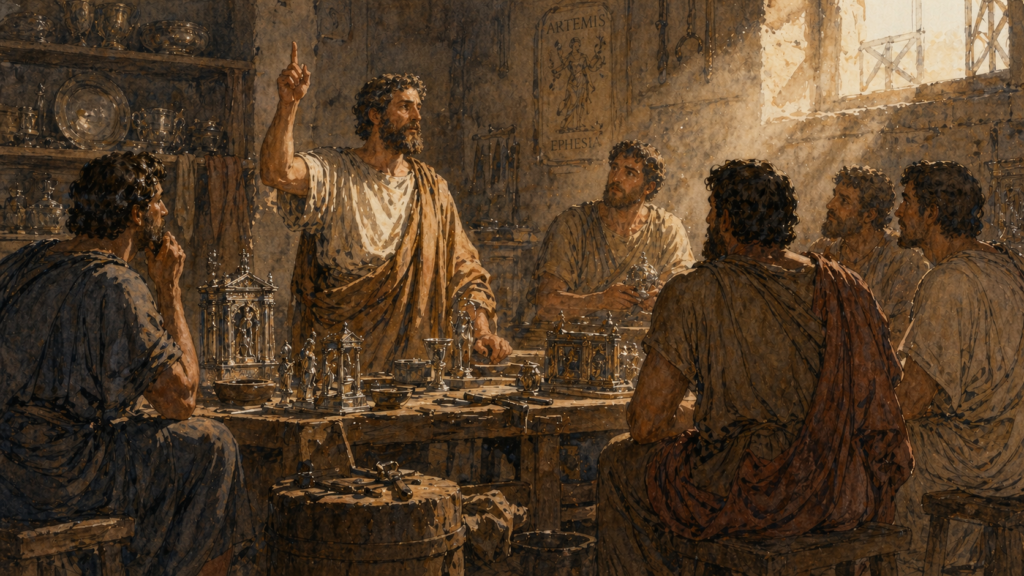
There was one more thing I noticed in verse 28: the act of translation that happens between Demetrius’s words (verses 26-27) and the crowd’s chant (verse 28).
To his fellow craftsmen, Demetrius spoke plainly — “our trade is in danger.” But almost in the same breath, he repackaged that concern into religious language: the temple of the great goddess Artemis would be dishonored, her magnificence diminished. And by the time the crowd takes up the cry, the word “money” has disappeared entirely. Only “Great is Artemis of the Ephesians!” remains. That, I think, is the precise point at which his persuasion landed.
As I turned this over, something about how incitement actually works became a little clearer. Stating your self-interest plainly doesn’t move people. But translating it into a sacred cause pulls in even those who have no stake in the matter. Luke records what this looks like with cool honesty in verse 32: “the assembly was in confusion, and most of them did not know why they had come together.” Most of those who shouted didn’t even know why they were shouting.
So what was Demetrius really trying to protect — the glory of Artemis, or the glory of his own livelihood? The text seems to suggest the latter. But he wrapped it in the name “Artemis.” He borrowed a god’s name to defend his own glory.
How This Acts 19 Passage Is Usually Read
I wanted to dig into how the Ephesian riot scene tends to be read by others. From what I could find, evangelical commentary traditions tend to read the passage along the lines of Paul’s missionary courage, the gospel’s power to dismantle idolatry, and the world’s resistance to the early church. One source I came across (Theology of Work) frames the passage as a clash between the gospel and the economic practices of the Roman world.
These readings aren’t far from what I saw today, but the emphasis sits in a slightly different place. Many commentaries lean toward the triumph of the gospel, while what held me was the question of why this opposition arose in the first place. More precisely, what struck me was the human habit of dressing self-interest in sacred language. That habit, I kept feeling as I wrote this Acts 19 devotional, isn’t something only the Ephesians had.
Standing Before Demetrius’s Mirror
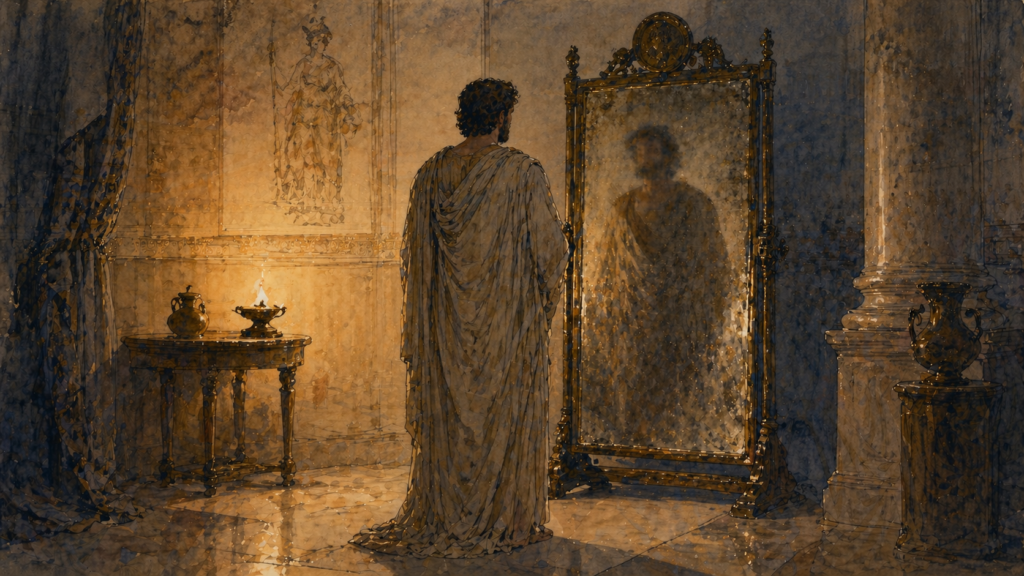
The most uncomfortable moment in this passage came when I realized Demetrius could be a mirror held up to me.
I use the language of faith too — but if I look honestly at what’s underneath, sometimes I find my own self-interest there. When I take a position in church, when I insist on a principle at home, when I defend a decision at work, can I honestly tell whether the real motive is the will of God or my own comfort, my own advantage, my own pride?
What makes Demetrius unsettling isn’t that he was an especially evil man, but that he was an ordinary one. The passage shows, almost dispassionately, how an ordinary craftsman trying to protect his livelihood becomes the spark that throws an entire city into chaos. And the tool he used in that process was religious language.
There’s one more thing I want to add carefully. I’d hate for this Acts 19 devotional to be read as if “any opposition we face proves the gospel is right.” Sometimes we draw opposition because we’re doing something wrong in the name of the gospel. Paul faced opposition because he was preaching truth — but opposition by itself doesn’t prove truth. If we lose that distinction, I suspect we end up becoming Demetrius’s heirs rather than Paul’s. Discerning whether the resistance I face comes from the gospel itself, or from the fact that I’ve wrapped my own interests in gospel language — that, I think, is the question this passage hands back to us.
So as I closed the chapter, I asked myself, gently: what am I really shouting for? Is it “Great is Artemis,” or is it the living Lord? Am I trying to protect His glory, or my livelihood and my pride?
Frequently Asked Questions
Q: What does “gods made with hands are not gods” mean in Acts 19:26?
A: It is the line Demetrius uses to summarize Paul’s preaching, and it captures the heart of the gospel’s challenge to idolatry. Paul taught that anything fashioned by human craft cannot be the true God — a message that echoes Stephen in Acts 7 and Paul himself in Acts 14. In Ephesus, this message threatened not only theology but the city’s entire economy and civic identity.
Q: Why did the Ephesians riot against Paul?
A: The riot began with the silversmith Demetrius, whose livelihood depended on selling shrines of Artemis. He framed his economic concern as a religious crisis, claiming Paul’s message dishonored the goddess. The crowd that shouted “Great is Artemis of the Ephesians!” for two hours had been moved less by genuine devotion than by the translation of self-interest into sacred language.
Q: What can we learn from Demetrius today?
A: Demetrius is unsettling not because he was unusually evil but because he was ordinary. He shows how easily we can wrap personal interest in religious words and how persuasive that wrapping can be to others. The passage invites honest self-examination: when I argue, insist, or protest in the name of faith, what am I actually trying to protect?
A Prayer to Close This Acts 19 Devotional
Lord,
As I read the riot scene in Ephesus today, Demetrius did not feel like a stranger. I confess there have been days when I used the language of faith while hiding my own interests inside it. Give me the courage to look honestly at the bottom of my motives — to see what it is I am really trying to protect when I call on Your name.
Let the gospel not stay in my life as mere comfort, but speak sometimes as a word that shakes the things I have been holding on to. Keep me from the place of Demetrius — understanding the gospel precisely and still resisting it — and bring me instead to the place of understanding precisely and laying myself down.
Guard me also from the crowd that shouts without knowing why. When the loud voices around me all insist on the same thing, open my ears to discern Your voice. And when I face opposition, help me tell honestly whether it comes because of the truth, or because I have dressed my own interests in sacred clothing.
In the name of our Lord Jesus Christ I pray. Amen.
About the Author
Each morning I read one chapter of Scripture and reflect on its resonance in daily life. Writing from the perspective of a layperson rather than a trained theologian, I trace how the ancient text still meets us today.
📖 Learn more: About the Author
Pingback: Acts 20 Devotional: Hidden Reason Behind Paul's Tears
Pingback: Acts 23 Devotional — When Conviction Quietly Defies God
Pingback: Idols of the Heart: The Seat That Is Never Empty