This Acts 18 devotional began this morning with a single scene that held me for a long time. One night in Corinth, the Lord appeared to Paul in a vision and said, “Do not be afraid.” The fact that even Paul the apostle was afraid — and that the Lord’s voice came to him in the very middle of that fear — caught me, especially as a number of my own worries began to surface alongside it.
“And the Lord said to Paul one night in a vision, ‘Do not be afraid, but go on speaking and do not be silent, for I am with you, and no one will attack you to harm you, for I have many in this city who are my people.’ And he stayed a year and six months, teaching the word of God among them.” — Acts 18:9-11 (ESV)

Acts 18 covers the closing stretch of Paul’s second missionary journey. Coming down from Athens, Paul arrives in Corinth, meets Priscilla and Aquila, lives with them, and supports himself by making tents alongside them (vv. 1-3). He reasons in the synagogue every Sabbath until Jewish opposition hardens (vv. 4-6). Right after the conversion of Crispus the synagogue ruler (v. 8) — a notable breakthrough — the Lord’s vision is given (vv. 9-11). Paul stays in Corinth for a year and six months, and later, as he leaves Ephesus, he says, “I will return to you if God wills” (v. 21) before setting sail.
Today’s Acts 18 devotional took me to two moments I wanted to hold side by side — the vision in verses 9-11, and the farewell in verse 21.
Paul in Corinth — Three Layers of Pressure
The first thing this Acts 18 devotional surfaced for me is that when the Lord says “Do not be afraid,” it implies Paul was already afraid. I looked up the Greek phrase, μὴ φοβοῦ (mē phobou), and it turns out to be a present imperative. English translations don’t quite capture the nuance, but the grammar leans less toward “don’t begin to be afraid” and closer to “stop the fear that is already running.” Before the vision ever came, Paul was evidently in the grip of fear.
What was weighing on him? In 1 Corinthians 2:3, Paul looks back on his time in Corinth and writes, “I was with you in weakness and in fear and much trembling.” The word translated “weakness” there can include physical weakness — bodily frailty, not just emotional or spiritual low-ebb. Then there’s another practical reality in Acts 18:3: the apostle who came to preach the gospel was stitching leather by day to make ends meet. And the Jewish hostility in verses 4-6 was a form of sustained pressure against the ministry itself.
Physical weakness. Financial precariousness. Ministerial opposition. Three layers of pressure were bearing down on Paul at the same time. It struck me how uncomfortably familiar that combination feels. I worry about my health. I worry about whether the finances will hold. I worry about problems at work. These aren’t the peculiar anxieties of spiritually immature believers; they’re the common weight most people are carrying. Paul’s Corinthian chapter bears witness to that.
“Do Not Be Afraid” — A Promise of Presence, Not Removal
The heart of this Acts 18 devotional, for me, sits in the two grounds the Lord gave Paul for his reassurance: “I am with you,” and “I have many in this city who are my people.”
The first phrase stayed with me the longest. This promise of presence is a formula that echoes across the Old Testament. It was given to Moses (Ex 3:12), to Joshua (Josh 1:9), to Gideon (Judg 6:16), to Jeremiah (Jer 1:8) in the same shape. And the risen Jesus uses almost identical language when he tells his disciples, “I am with you always, to the end of the age” (Matt 28:20).
So what Paul heard that night wasn’t a private, extraordinary consolation reserved for a special apostle. It was the same covenant promise of presence that God has spoken consistently to his people across Scripture, arriving now in Paul’s Corinthian moment. This matters because it means I can stand inside that same promise. When I found myself thinking, “I wish I could hear a voice like that,” the truth is that the voice has been sounding across Scripture all along, in the form of a promise already made.
I want to be careful about one thing, though. I don’t want “Do not be afraid” to be misread as a guarantee that the circumstances of fear will simply be removed. The second half of verse 10 — “no one will attack you to harm you” — is actually demonstrated in verses 12-17, where Jewish opponents do drag Paul before the proconsul Gallio, but the case is dismissed. Opposition wasn’t absent; it was present, and God kept Paul through it. Not around it.
This distinction matters. A deepening faith doesn’t necessarily mean health problems vanish, financial anxiety dissolves, or workplace pressures lift. Paul himself lived with a “thorn in the flesh” (2 Cor 12:7), and the answer he received wasn’t its removal but “my grace is sufficient for you.” God’s rescue rarely looks like one simple shape — something I wrestled with in an earlier Acts 12 devotional, where one apostle was delivered from prison and another was not. So if the situations I’m worried about stay as they are, that doesn’t mean the Lord has stepped away. The heart of the promise is that he will be present in the middle of them.
“If God Wills” — When Reassurance Leads to Surrender
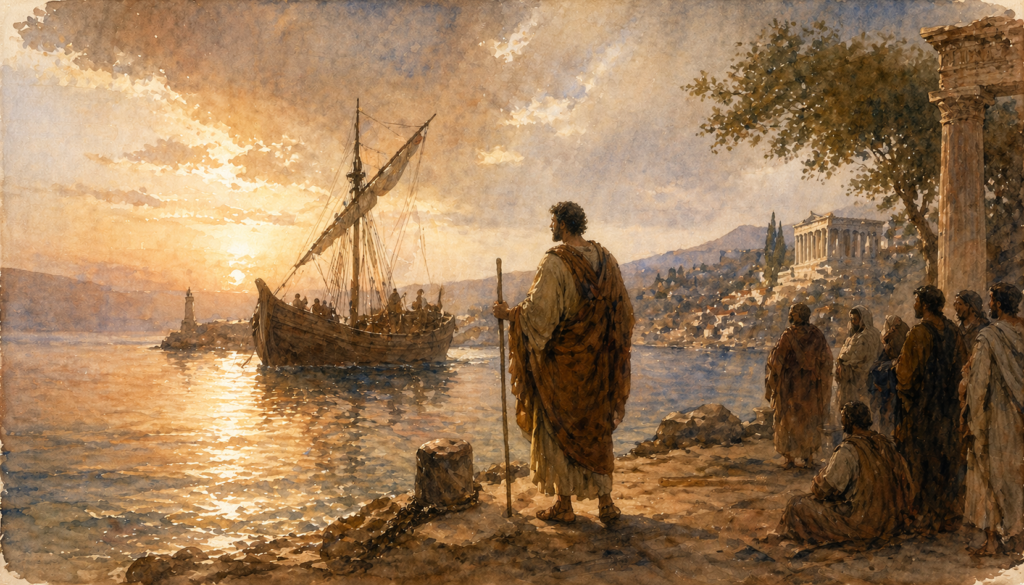
There’s another line in this Acts 18 devotional passage that caught my attention today. In verse 21, as Paul takes leave of the believers in Ephesus, he says, “I will return to you if God wills.” Such a short conditional clause, yet it binds Paul’s entire plan of return — and, by extension, the shape of his whole journey — to the will of God.
What struck me is that Paul was not passive. Look at everything he decides and does in this same chapter. He actively chooses to stay in Corinth for eighteen months (v. 11). He cuts his hair at Cenchreae in connection with a vow (v. 18). He reasons in the synagogue at Ephesus (v. 19). When the believers there ask him to stay longer, he actively declines (v. 20). This is a man making decisions and moving with great intentionality.
And yet, on top of all that active planning, he lays down “if God wills.” The two postures aren’t in contradiction. This was the heart of what I took from the passage today: planning with full effort, while holding the plan loosely in open hands. It echoes the same quiet theology as James 4:15: “If the Lord wills, we will live and do this or that.”
I hope “if God wills” isn’t taken as an alibi for passivity or a way to avoid responsibility. Paul’s words aren’t a letting-go of effort — they’re a way of pointing the direction of that effort toward God. He’s moving and yet entrusting, entrusting and yet still moving. A posture of held tension — the same pattern I found myself tracing in an earlier Acts 14 devotional, where Paul and Barnabas kept walking back into danger while commending everything into the Lord’s hands.
And the thing that moved me most today was how naturally the reassurance in verses 9-11 flows into the surrender of verse 21. You can only entrust your steps to God once you’re convinced he’s walking with you. Presence comes first; surrender is the response. Without “I am with you,” the phrase “if God wills” risks becoming an anxious resignation. But with that promise held first, “if God wills” becomes a trusting handing-over, not a reluctant one.
In My Own Place — Health, Finances, Work
If I lay out honestly what I’m worried about right now, it comes down to health, finances, and work. The same three zones where Paul was under pressure in Corinth. My body isn’t quite what it used to be, and every little signal makes me flinch. The account balance doesn’t give me much breathing room from one month to the next. And anything going sideways at work — a relationship, a performance issue — can shake me more than it should.
I want to hold onto the fact that “Do not be afraid” is a word spoken to me as well, not just to Paul. But I also want to remember that it doesn’t promise the situations will vanish. They might remain. They might even get harder. What the promise actually offers is that “I am with you” holds in the middle of them, and that I can lay “if God wills” over my own plans and calendar without giving up the hard work of planning itself.
Worrying doesn’t mean I’m faithless. Paul worried too — the present-imperative μὴ φοβοῦ is already evidence of that, as is his own recollection in 1 Corinthians 2:3. Being someone who keeps an ear open to the Lord’s “Do not be afraid” in the middle of worry — that’s the most I can do, and perhaps the whole of what I’m called to.
My health, my finances, my work will still be on my mind today. But this Acts 18 devotional tells me that those very worry-zones can become the places where I hear the Lord’s voice. I want to plan carefully in those zones today — and quietly add “if God wills” over the plan, and walk through the day that way.
Frequently Asked Questions
Q: Why did God tell Paul “Do not be afraid” in Acts 18? A: The Greek form of the command (a present imperative) implies Paul was already experiencing fear in Corinth — most likely a mix of physical weakness, financial pressure from making tents to support himself, and sustained Jewish opposition. The vision was not a rebuke of that fear, but the Lord’s reassurance in the middle of it, grounded in “I am with you” and “I have many in this city who are my people.”
Q: What does “if God wills” mean in Acts 18:21? A: Paul says this as he takes leave of the believers in Ephesus and sets sail. It isn’t a resignation or an alibi for passivity — the same chapter shows Paul making strong, specific decisions about where to stay, where to go, and whom to teach. “If God wills” is Paul holding his active plans loosely in open hands, pointing the direction of his effort toward God rather than grasping outcomes for himself.
Q: Does the Acts 18 devotional passage “Do not be afraid” mean God will remove my problems? A: Not quite. The same chapter shows Jewish opponents dragging Paul before the proconsul Gallio (vv. 12-17), so opposition wasn’t absent — God kept Paul through it, not around it. The promise is about the Lord’s presence remaining unshaken in the middle of hard circumstances, not a guarantee that health, financial, or relational pressures will simply disappear.
A Prayer to Close This Acts 18 Devotional
Lord,
I began today worrying about my health, my finances, and my work. Just as Paul was in weakness and fear in Corinth, I too am pressed by a tangle of concerns. What you showed me in today’s passage is that worrying isn’t a sign of absent faith; the very middle of worry can be a place where your voice is heard.
Lord, let the voice that said to Paul that night — “Do not be afraid; I am with you” — also be heard by me today. Even if my circumstances are not immediately removed, hold me in the middle of them. Help me remember that the promise of your presence can remain unshaken even when outer conditions do not change.
And as Paul set out his plans and still said “if God wills,” teach me to ask after your will first, before my own planning and striving for this day. Let me not put down my diligence, but let me point its direction toward you. Teach me how to move while entrusting, and to entrust while still moving.
In the name of our Lord Jesus Christ I pray. Amen.
About the Author
Each morning I read one chapter of Scripture and reflect on its resonance in daily life. Writing from the perspective of a layperson rather than a trained theologian, I trace how the ancient text still meets us today.
📖 Learn more: About the Author
Pingback: When God Doesn't Calm the Storm in Acts 27 — Reflection