This Acts 12 devotional began this morning, as two scenes from the chapter held me for a long time. One was Peter sleeping in verse 6, and the other was James martyred in verse 2. Peter lies deep in sleep, bound with two chains, the night before his scheduled execution. And James, one of Jesus’ inner circle of three, is dispatched in a single line. I want to hold these two scenes and follow them slowly.
“The very night when Herod was about to bring him out, Peter was sleeping between two soldiers, bound with two chains, and sentries before the door were guarding the prison.” (Acts 12:6, ESV)
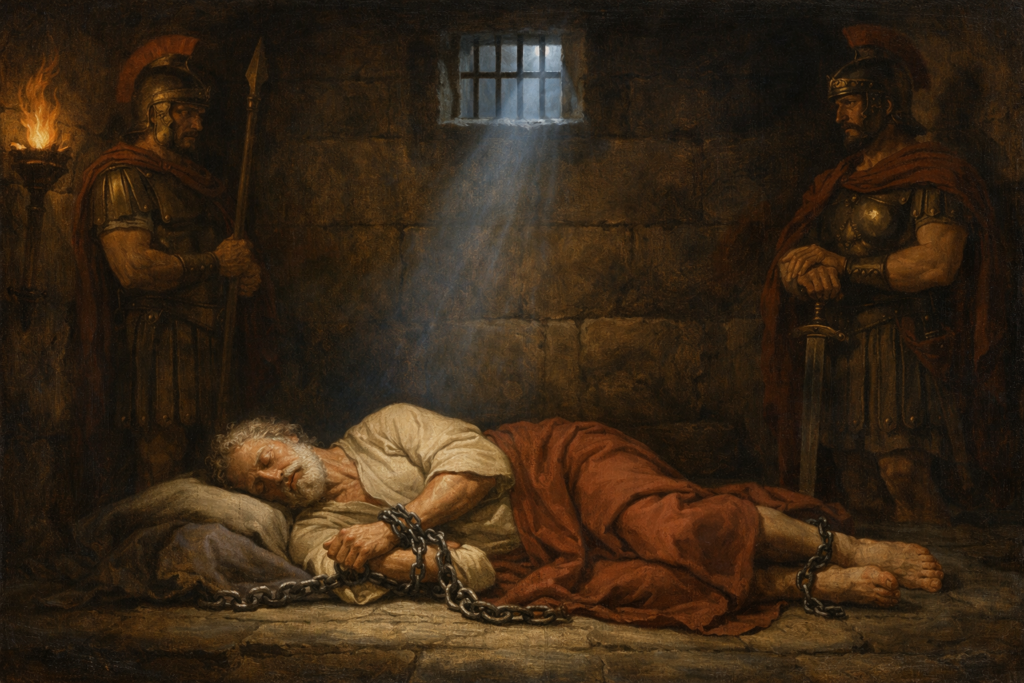
Peter’s Sleep — The Action of One Already Rescued
A man scheduled to be executed the next day is sleeping so deeply that an angel has to strike him on the side just to wake him up. Something feels off here… Peter himself later writes about days like this:
“Casting all your anxieties on him, because he cares for you.” (1 Peter 5:7, ESV)
The Greek word for “casting” here is ἐπιρίπτω (epiripto, to throw upon) — you can look up the full semantic range at Blue Letter Bible. It is the motion of hurling away something you have been holding. Peter in that prison cell seems to have already been a man who had thrown his fate onto Jesus.
But reading this sleep as simple “courage” or “boldness” falls short. Courage still belongs to the realm of self-effort. This sleep is rather the natural state of a person already freed from the dominion of sin and death. Whether his neck would be cut tomorrow, or whether he would be martyred ten years later, he knew that was no longer the final word.
Perhaps — even before Jesus’ death — witnessing the three predictions of Jesus’ death and the resurrection that followed had brought him to this place. This is also the same Peter who once denied Jesus three times in a courtyard, and who was later restored by the risen Lord with a threefold “Feed my sheep.“ Only someone who has walked that road — from failure to restoration — and who knows there is One who holds onto him even beyond death, could sleep this peacefully on a prison floor.
“It is in vain that you rise up early and go late to rest, eating the bread of anxious toil; for he gives to his beloved sleep.” (Psalm 127:2, ESV)
Psalm 127:2 says that rising early and lying down late, eating the bread of anxious toil, is all in vain — therefore the Lord gives sleep to those he loves. After declaring that toil is vain, the psalm uses the conjunction “therefore” to arrive at sleep. It is sleep given on the opposite side of trying to hold oneself up by one’s own strength. What Peter experienced on the prison floor was precisely this sleep.
This maps exactly onto a lens I have long held — the contrast between the peace the world gives and the peace Christ gives (John 14:27). The peace the world gives is peace that comes only when circumstances are resolved. If tomorrow looks survivable, I can sleep. But the peace Christ gives is peace already given, regardless of circumstances. I can sleep even if I die tomorrow. What Peter showed in that cell was this second kind of peace.
So this sleep is not a level of faith achievement but a consequence of the gospel. It is not “sleep well and your faith will be good,” but “when you hold onto the fact that you have already been rescued, this action becomes naturally possible.”
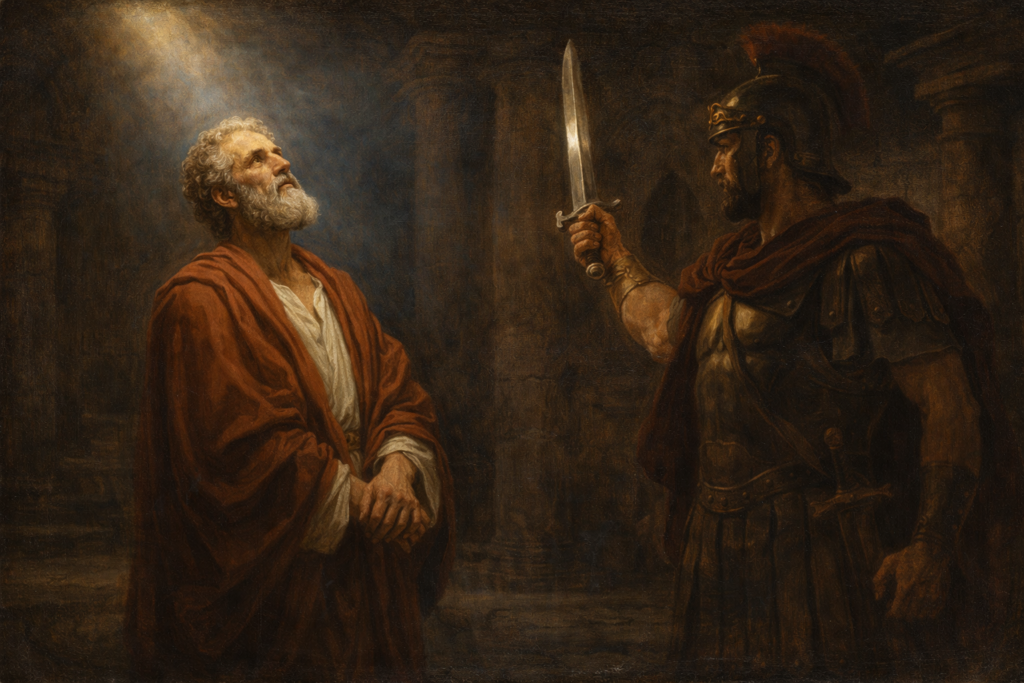
James’ Martyrdom — Not Abandonment, But Another Kind of Rescue
But in verse 2 of the same chapter, James dies by the sword. A single line: “He killed James the brother of John with the sword.” We must not skip over this verse.
James, along with Peter and John, was part of Jesus’ inner circle of three. He went up to the Mount of Transfiguration and prayed together in Gethsemane. Such a man is dispatched in one line, and in the very next scene, Peter is miraculously rescued.
Why Did James Die but Peter Was Saved?
This is the question that rises most honestly in the reader’s heart when reading Acts 12. Two men, both apostles. Both in Jesus’ inner circle. Both prayed for by the same church. Yet one walks free and the other falls to the sword. The text itself does not answer this question directly, and that silence is uncomfortable.
One common answer is that “Peter’s work was not yet finished, but James’ was.” There is a real truth in this, but taken alone it can sound transactional — as if God measures remaining usefulness and decides who stays. That framing keeps us trapped in the very logic the gospel breaks. A more honest reading begins by noticing what the text does not say. It does not say James was less faithful. It does not say the church prayed less for him. It does not say God loved Peter more. The text simply places the two outcomes side by side, without explanation, and moves on.
I think this silence is itself a theological statement. When the text refuses to explain why one was rescued and the other was not, it is refusing to let us build a formula. Because if there were a formula — pray harder, believe more, live more faithfully — then rescue would become a reward we earn, and non-rescue would become proof of our failure. The gospel cannot survive that logic. What the text gives us instead is a harder but truer word: both men were held within the same sovereignty, and that sovereignty expressed itself in two different shapes. Peter’s chains fell off. James’ neck was cut. And Luke records both in the same chapter, in the same breath, as though both are equally “the Lord’s doing.”
So the question is not really “why did James die but Peter was saved?” The deeper question underneath it is: can I trust a God whose rescue sometimes looks like deliverance and sometimes looks like being taken home? Acts 12 asks me to answer yes — not because I understand the reason, but because the One holding both men is the same One who first walked the path of the cup himself.
If we read this contrast through the formula “pray and you will be rescued,” James cannot be explained. Did they pray less for James? Would he have been rescued if they had been more earnest? Going down this path collapses the text. And this kind of formula still wounds many believers today — it turns those who prayed but were not rescued into “people whose faith was lacking.”
We need to look at the text again here. James’ death is not an event of God “abandoning” him. James was someone who had already been foretold of his own death by Jesus. In Mark 10:39, Jesus says this to James and John:
“Jesus said to them, ‘The cup that I drink you will drink, and with the baptism with which I am baptized, you will be baptized.'” (Mark 10:39, ESV)
In Mark 10:39, the subject is “you,” but the owner of the cup is “I (Jesus).” In other words, the cup that James would drink is the very cup Jesus drank first. So James’ martyrdom is closer to “walking the path Jesus first passed through” than “an event the Lord let slip from his hands.” If Jesus’ cup and James’ cup are the same cup, then James’ death is an event in which Jesus led James into his own suffering.
So in this Acts 12 devotional, we see two kinds of rescue placed side by side. Peter was rescued from Herod’s hand and continued his ministry. James was rescued through Herod’s hand into glory. One by means of rescuing to life, the other by means of bringing home. Both rescues are within God’s sovereignty.
This same pattern — the Lord working through seemingly opposite outcomes — has been threaded throughout the earlier chapters of Acts. Stephen was stoned while Peter walked free from prison in earlier chapters. The scattering that followed Stephen’s death became the seed of the gospel reaching Samaria and beyond. God’s sovereignty has consistently held both the rescued and the released-into-glory within one sovereign hand.
From this perspective, even the fact that Peter himself would later be martyred ceases to be a contradiction. On the night of Acts 12, he was rescued from Herod’s hand, but later, from Nero’s hand, he would be rescued “by the way of not being rescued.” On both nights, Peter was fundamentally one already rescued. That is why he could sleep on the first night, and on his final night, he could call upon the Name while being crucified upside down.
When the Two Scenes Are Placed Together
When we place verse 6’s sleep alongside verse 2’s sword, the theology of this Acts 12 devotional becomes clearer.
The reason Peter could sleep and the reason James did not waver before the sword are the same. Both were men already rescued. The worst the world could do to them was death, and one who knows that death is not the final word can sleep in prison and can also stand before the sword.
These two scenes come to my own life with two faces as well. There are times when the Lord changes the circumstances for me, and times when he leaves the circumstances as they are and walks me through them. Both are rescue. When he rescues, I give thanks like Peter’s sleep; when he walks me through, I walk like James’ steps. Whichever it is, the foundation does not change — I am already one rescued.
Questions for Reflection
- When I face an uncertain “tomorrow,” does my peace depend on the circumstances being resolved, or on the fact that I have already been rescued in Christ?
- Am I reading God’s silence or non-intervention as abandonment, when it might actually be another form of rescue?
- Do I pray with the expectation that the Lord will truly move, or merely out of habit?
Today’s Prayer
Lord,
Peter asleep in prison, and James before the sword. One you sent back alive, and the other you took home first — but both were already in your hands. Thank you for showing me this today.
There will be nights when I, like Peter, do not know what tomorrow holds. On that night, grant me the peace that the world cannot give — the peace that flows from the fact that you have already rescued me. Let me not try to seize the faith that can sleep through tomorrow by my own striving, but receive it by your grace.
And like James, there will also be times when I must pass through without the circumstances being resolved. In that time, do not let me resent and ask “why am I not being rescued,” but help me to trust that you are rescuing me in another way. Let me not forget that rescue on this earth and rescue into a better resurrection both rest within one and the same sovereignty.
I also examine myself today — whether I am standing in the place of praying without believing the answer. Teach me a prayer that is not merely offered with the lips, but offered in expectation that you will truly move.
In the name of our Lord Jesus Christ I pray. Amen.
Pingback: Acts 18 Devotional — A Profound Promise in Paul's Fear