This morning’s Romans 9 devotional brought me to a question I couldn’t move past: what makes me a child of God? Not bloodline, not works, not willpower — then what holds my identity in place? Paul’s answer in the opening section of the chapter is one phrase, used twice in the New Testament, that I think most readers slide past too quickly: children of the promise. Two verses, working together from different angles, describe what this kind of belonging actually means.
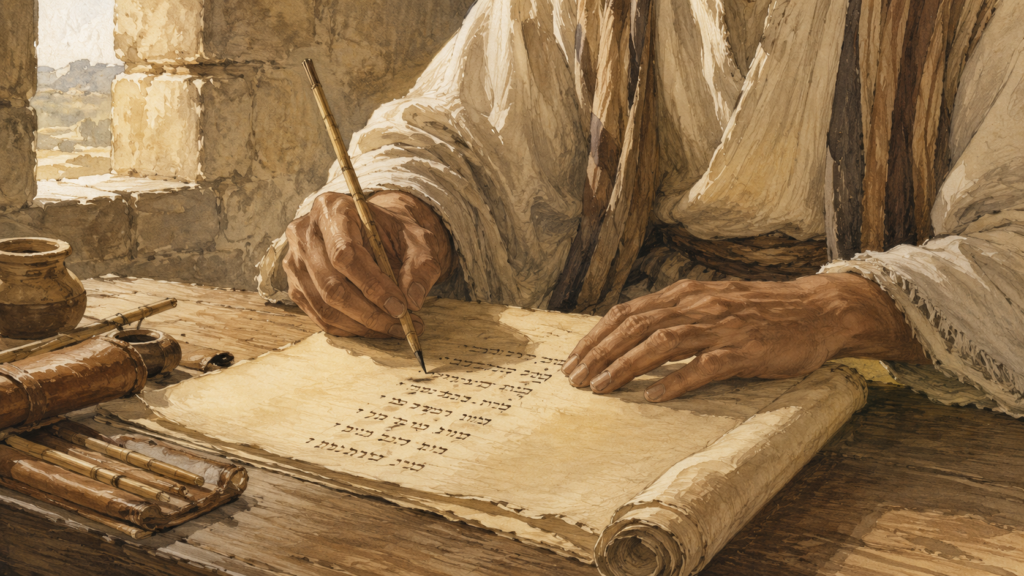
“This means that it is not the children of the flesh who are the children of God, but the children of the promise are counted as offspring.” — Romans 9:8 (ESV)
“though they were not yet born and had done nothing either good or bad—in order that God’s purpose of election might continue, not because of works but because of him who calls—she was told, ‘The older will serve the younger.'” — Romans 9:11-12 (ESV, via BibleGateway)
The Question Underneath Romans 9
Romans 9 marks a pivot in Paul’s argument. After eight chapters of dense theological reasoning, he turns to the Old Testament story — Abraham and Isaac, Jacob and Esau, Pharaoh, the potter — to answer a heavy question: if the gospel is for everyone, why has Israel, the people of promise, largely refused it? Today’s two verses sit in the first pillar of his answer (verses 6–13), where he establishes a foundational principle: belonging to God’s family was never about lineage in the first place. Bloodline does not produce a child of the promise. Something else does.
Counted as Offspring: How Children of the Promise Are Reckoned
I wanted to dig into the verb “counted” in verse 8. The Greek is λογίζομαι (logizomai) — a word that means “to reckon,” “to credit to an account.” It is accounting language, the kind a bookkeeper uses when entering a transaction in a ledger.
Then I remembered where I had seen this verb before. Romans 4:3 — “Abraham believed God, and it was counted to him as righteousness.” Same verb. I had sat with this earlier when writing the Romans 4 devotional on the righteousness of faith, and now in chapter 9 Paul is quietly doing something remarkable. He is lifting the language of justification from chapter 4 and applying it to identity in chapter 9. Just as righteousness is something credited to us rather than manufactured by us, the children of the promise are made by divine reckoning rather than by human inheritance. (Blue Letter Bible traces logizomai through both passages, which makes the parallel even clearer.)
That insight settled into me slowly. My identity is not a quality I produce. It is an entry written into the ledger by someone else’s hand. The children of the promise are counted — reckoned, recorded, named.
Not from Works, but from Him Who Calls
Verse 12 has to be read together with verse 11, because the timing changes everything. Paul stresses that Jacob and Esau were chosen “though they were not yet born and had done nothing either good or bad.” Before any deed, before any merit, before any history — the calling was already in motion.
Two prepositional phrases carry the weight. Not from works (οὐκ ἐξ ἔργων, ouk ex ergōn) but from him who calls (ἐκ τοῦ καλοῦντος, ek tou kalountos). The preposition ἐκ (“from, out of”) appears twice, anchoring the question of origin. Where does belonging come from? Paul will not let his readers locate it inside themselves.
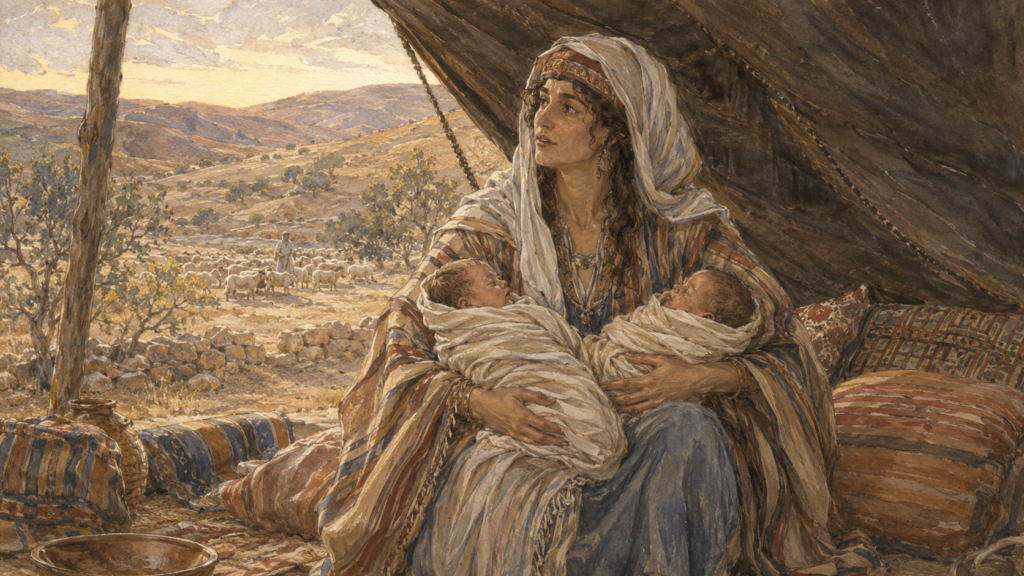
There is one more word here that I sat with. “That God’s purpose of election might continue” — the verb behind “continue” is μένω (menō), to remain, to stand firm. Paul is saying that the stability of God’s choosing depends on its source. If election rested on human performance, it would tremble whenever performance trembled. But because it rests on the One who calls, it stands as firmly as His own faithfulness. This is the same call language Paul builds on in the Romans 8 devotional on all things working together, where “those whom He called, He also justified, and those whom He justified, He also glorified.” The chain holds because none of its links is forged in human effort.
Where Does the Stability of Identity Come From?
Taken together, these two verses make a single claim from two directions. Verse 8 says: the promise reckons you as offspring. Verse 12 says: the One who calls makes you stand. Both locate identity outside the self — and that turns out to matter every morning.
The self is not stable. I am one person on a day I prayed well and another on a day I snapped at someone before I had finished my coffee. If my belonging to God rises and falls with that internal weather, I will spend my whole life anxious — and most of the performance-driven cultures we inhabit train us to do exactly that. But if my belonging rests on a declaration spoken over me from outside, written into the ledger by another hand, then my fluctuations cannot unwrite it.
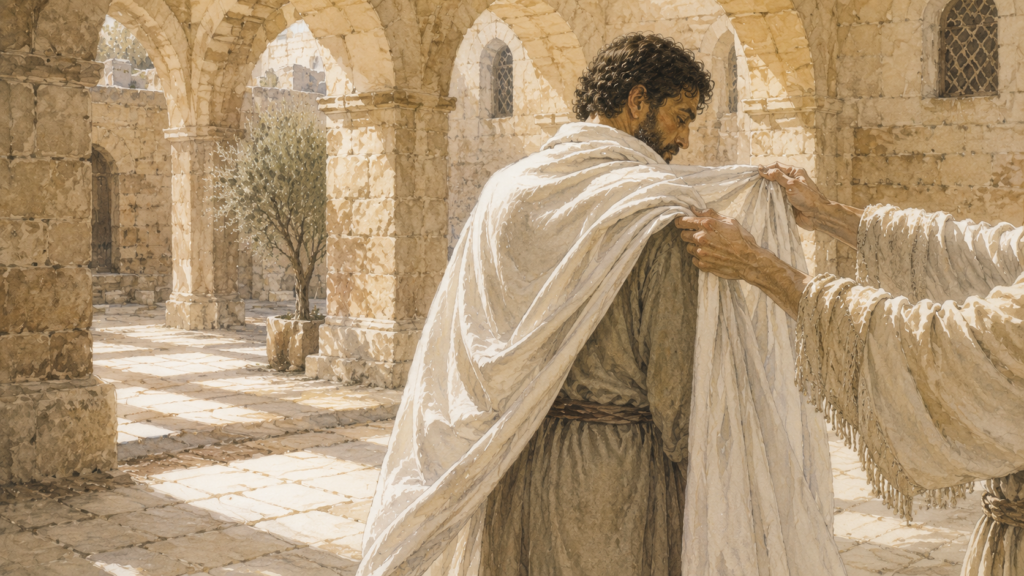
Martin Luther had a phrase for this: iustitia aliena, an alien righteousness. Not a righteousness produced inside me, but one that comes from outside and is placed on me like a robe. Romans 9:8 sits in exactly that territory. An alien sonship. An external identity. The children of the promise are not rooted in the volatile self but in the faithful Other.
Action Doesn’t Disappear — It Changes Position
I wouldn’t want this to be misheard. The fact that works are not the foundation of being among the children of the promise does not mean that works don’t matter. Paul is dismantling one particular function of works — works as the basis of belonging — not works themselves.
In fact, the more deeply identity is rooted in the One who calls, the freer our action becomes. A person trying to earn belonging acts under pressure; a person who has received belonging acts out of overflow. Tim Keller often framed this as the difference between moralism and the gospel: the moralist says, “I obey, therefore I’m accepted.” The Christian says, “I’m accepted, therefore I obey.” The behavior may look identical from the outside, but the engines are running in opposite directions. (For a longer treatment of this distinction, The Gospel Coalition keeps an accessible library on Keller’s moralism-versus-gospel framework.)
I want to start today by asking one honest question of myself: which engine is running in me right now? Am I living to prove I belong, or am I living because I belong? When that question is asked seriously in the morning, it has a way of rearranging the rest of the day.
Frequently Asked Questions
Q: What does “children of the promise” mean in Romans 9? A: In Romans 9:8, Paul distinguishes between physical descent from Abraham and true belonging to God. The children of the promise are those whom God Himself reckons as His offspring through His promise, not those who claim it through bloodline or human effort. Paul uses the same accounting verb here (logizomai) that he used for justification in Romans 4, suggesting that sonship — like righteousness — is something credited to us rather than earned.
Q: Why does Paul emphasize that Jacob and Esau were chosen before they had done anything? A: The timing in Romans 9:11 protects the principle. By emphasizing that election occurred before either twin had done good or evil, Paul shows that God’s choice cannot rest on human merit. The stability of our standing with God depends on its source: if it came from us, it would be as unstable as we are; because it rests on the One who calls, it stands firm.
Q: Does Romans 9 mean that works don’t matter for the Christian life? A: Romans 9 is not dismissing works themselves — it is dismissing works as the foundation of belonging. Once identity is grounded in God’s call rather than in human performance, works actually become more meaningful, not less. They shift from being a way to earn acceptance to being a response to acceptance already given.
A Prayer to Close This Romans 9 Devotional
Lord, this morning I keep trying to confirm my belonging with my own track record — relieved on the days I do well, shaken on the days I fall. But Your Word shows me that long before any of my doing or undoing, You spoke a word over me and counted me among the children of the promise. Anchor me there. Let my fluctuating self rest on Your unfluctuating call. Move my actions out of the territory of proving and into the territory of responding, so that this whole day becomes an answer to a love I already have. In the name of our Lord Jesus Christ I pray. Amen.
About the Author
Each morning I read one chapter of Scripture and reflect on its resonance in daily life. Writing from the perspective of a layperson rather than a trained theologian, I trace how the ancient text still meets us today.
📖 Learn more: About the Author
Pingback: God Who Has Mercy: A Romans 9:15-16 Devotional