This morning’s Romans 9 devotional stopped me at the center of the chapter, at a verse that quietly dismantles two of the strongest engines we trust in: our own wanting and our own running. Paul is not after a smaller god. He is after a more particular one — the God who has mercy, not simply a sovereign deity, but a sovereign whose character has a name. The difference between those two phrases turns out to change everything about how I read this passage.
“For he says to Moses, ‘I will have mercy on whom I have mercy, and I will have compassion on whom I have compassion.’ So then it depends not on human will or exertion, but on God, who has mercy.” — Romans 9:15-16 (ESV, via BibleGateway)

Where These Two Verses Sit in Romans 9
Romans 9 moves through five sections — Paul’s grief in verses 1–5, the principle of promise in 6–13, sovereign mercy in 14–18, the potter and the remnant in 19–29, and the closing reversal of works and faith in 30–33. Today’s two verses are the heart of the third section. Paul has just been pressed by the toughest objection in the letter: “Is there injustice on God’s part?” (verse 14). His answer is not a defense in his own words. He goes back to Exodus, lays the divine speech down on the table, and lets it draw the conclusion.
Exodus 33 — The Mercy Spoken After Failure
I wanted to dig into where verse 15 actually comes from. It is a direct quotation of Exodus 33:19. The setting matters more than the verse number suggests. Israel has just shattered the covenant by making the golden calf. Moses goes back up the mountain not to receive new laws but to plead for a people who have already disqualified themselves. And the answer he receives from God is the line Paul quotes: I will have mercy on whom I have mercy.
If those words had been spoken before the golden calf, “mercy” might have sounded like a reward for the deserving. But spoken after the calf, the word lands with completely different weight. This is a mercy given precisely to those who have nothing left to bargain with. It is restoration aimed at a people who have already failed.
The Greek verb behind “have mercy” is ἐλεέω (eleeō), and the related noun ἔλεος (eleos). In the Septuagint, the Greek translation of the Old Testament, ἔλεος is the word most often used to translate the Hebrew חֶסֶד (ḥesed) — the covenant loyalty of God, His steadfast love that holds onto a people once He has chosen them. (Blue Letter Bible traces both senses in one place.) So when Paul speaks of the God who has mercy, he is not pointing to a mood that comes and goes. He is pointing to a faithfulness God has bound Himself to.
“So Then” — How a Quotation Becomes a Conclusion
Verse 16 begins with a small Greek phrase that does heavy lifting: ἄρα οὖν (ara oun), translated “so then.” This is the connector Paul reaches for when he is drawing one of his weight-bearing conclusions (Romans 5:18, 7:25, 8:1 all use it). Verse 15 is the objective ground — God’s own self-disclosure spoken in Exodus. Verse 16 is the inference Paul draws from it.
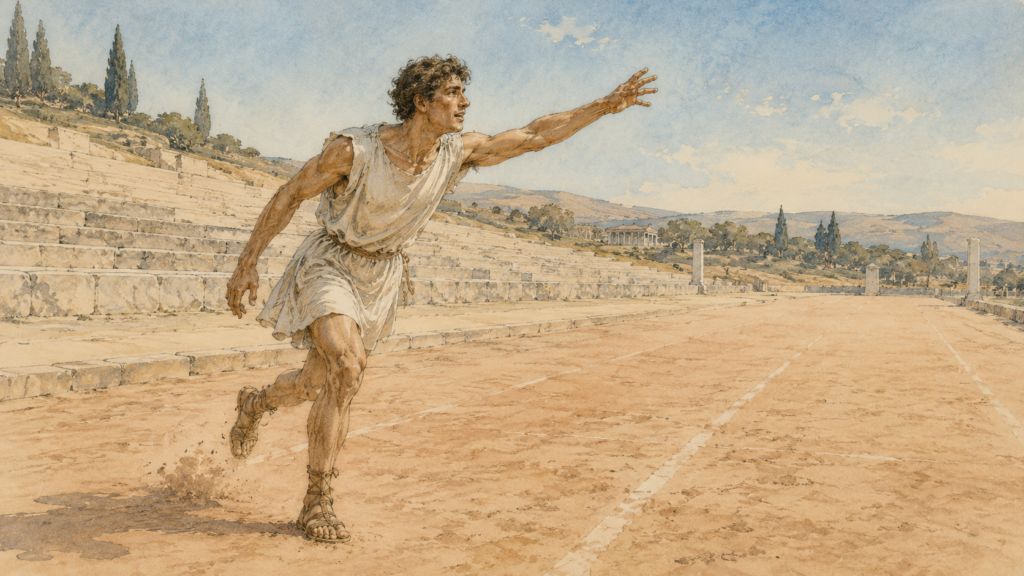
Two human capacities get named and then displaced. Human will is θέλω (thelō) — the wanting, the inner desire, the resolve to do something. Human exertion is τρέχω (trechō) — to run, to sprint, the outward effort of striving toward a goal. Between them, Paul has covered the inner and outer life of religious effort. Both the intensity of my wanting and the energy of my running. Both are quietly set aside as the source of mercy. They are not the engine. Something else is.
“God, Who Has Mercy” — The Modifier That Changes Everything
I sat with the phrase a long time this morning. Paul could have stopped at “but on God.” That would already have been a strong claim — that the origin of salvation lies entirely in the divine. But that ending alone would leave God’s character undefined, and a sovereignty without a known character can be a cold and frightening thing.
Paul does not stop there. He adds a participial modifier: τοῦ ἐλεῶντος θεοῦ (tou eleōntos theou) — literally “of the God who has mercy.” This is not a generic sovereign. This is a sovereign whose defining action is mercy. The clause does not describe a power doing something occasionally merciful; it describes a mercy doing something inherently sovereign. The modifier doesn’t decorate God’s sovereignty — it interprets it.
That shift changes the emotional weather of the verse. To hear that my willing and running are not the foundation of my standing with God can feel terrifying if the One who holds that foundation is unknown to me. But to hear that the foundation rests on the God who has mercy — the covenant-keeping God of Exodus 33, the ḥesed God who held onto Israel even after the calf — is something else entirely. The same theological claim that could sound like exile sounds, in this framing, like home.
The Will and the Running Don’t Disappear — They Change Position
I would not want this to be misheard. Paul’s “not of him who wills or runs” is not a verdict against willing and running themselves. He is not telling Christians to stop wanting things or stop working hard. What he is dismantling is one particular role for willing and running — their function as the source of mercy.
Once mercy is no longer something we generate, the same willing and running take on a different shape. The wanting becomes the wanting of a child who has already been embraced, not the wanting of a stranger trying to get inside. The running becomes the running of someone responding to a grace already received, not the sprinting of someone trying not to lose what they never had in the first place. The energy is the same. The direction is the same. But what is at the bottom of it has been replaced. This is much the same shift I traced in the Romans 9 devotional on the children of the promise — a different angle on the same external grounding.
Tim Keller used to put this contrast simply: the moralist runs in order to be accepted; the Christian runs because they are accepted. The activity looks identical from the outside, but the engines are running in opposite directions. (The Gospel Coalition keeps an accessible library on this moralism-versus-gospel distinction.)
A Surrender That Is Actually Rest
There is one more thing I want to name. When verse 16 says my willing and running are not the source, the first reaction in me is often resistance — as if something is being taken from me. But sitting with it longer, the opposite begins to surface. If the source of my standing with God were my own willing, it would rise and fall with my willing. If the source were my own running, it would rise and fall with my running. And both of these are deeply unstable. I want differently on different mornings. I run faster some weeks than others.
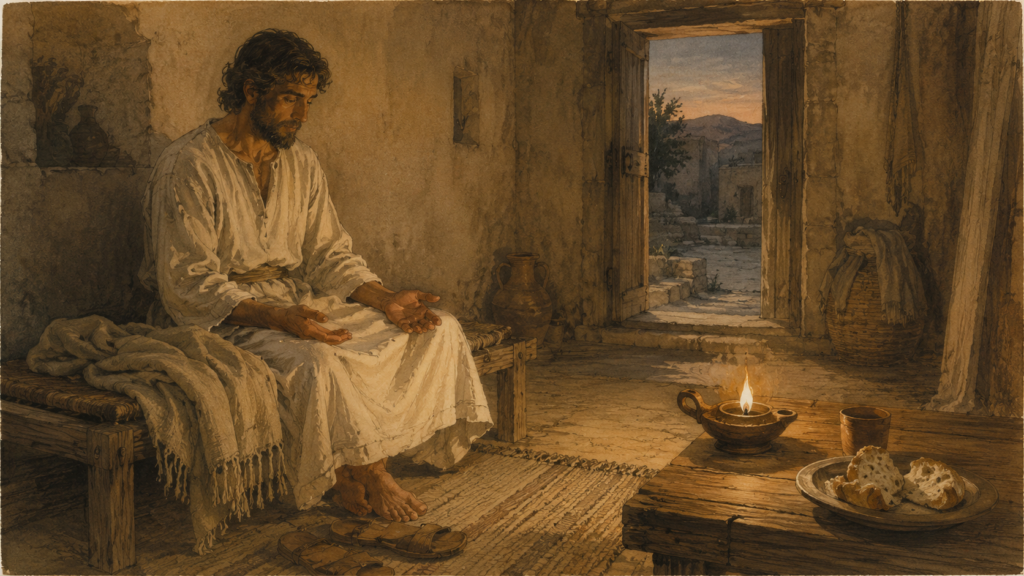
To hear that the source lies elsewhere — and that the elsewhere is the God who has mercy — is not the loss of agency. It is the relocation of agency to a far more reliable place. The handing over here is not a robbery. It is a rest.
Maybe that is the one honest question to carry into today. Where is the engine of my faith actually running from this morning — from the urgency of my own willing, or from the steady mercy of the One who has bound Himself to me?
Frequently Asked Questions
Q: What does Romans 9:16 mean by “not of him who wills or runs”? A: Paul uses two Greek verbs — thelō (to will, to desire) and trechō (to run, to exert effort) — to cover both the inner and outer life of religious striving. He is not condemning wanting or working themselves; he is saying that neither is the source of God’s mercy. Mercy originates outside of human effort, with the God who has mercy.
Q: Why does Paul quote Exodus 33:19 in Romans 9:15? A: Exodus 33:19 was spoken to Moses after Israel’s failure with the golden calf. By grounding his argument there, Paul shows that God’s mercy is given to those who have nothing left to claim — restoration to a people who have already disqualified themselves. The quotation grounds Paul’s whole point in the covenant character of God, not in a philosophical principle.
Q: Does Romans 9:16 teach that human will doesn’t matter? A: Romans 9:16 is dismantling one particular role for willing and running — their role as the foundation of standing with God. Once that role is taken from them, willing and running take on a new shape: they become the response of someone already loved, not the effort of someone trying to earn love. Action is not erased; its position changes.
A Prayer to Close This Romans 9 Devotional
Lord, I come this morning carrying both the wanting I trust and the running I am proud of, and Your Word quietly tells me that neither is the engine. At first that sounds like a loss, but as I sit with it I begin to see that the One who holds the engine in His own hands is the God who has mercy — the One who spoke to Moses after the calf, the One whose covenant love does not let go. Move the source of my standing out of my unstable will and into Your steady mercy. Let my wanting become the wanting of a child already embraced, and my running become the running of one responding to a love already given. In the name of our Lord Jesus Christ I pray. Amen.
About the Author
Each morning I read one chapter of Scripture and reflect on its resonance in daily life. Writing from the perspective of a layperson rather than a trained theologian, I trace how the ancient text still meets us today.
📖 Learn more: About the Author
Pingback: The Potter and the Clay: A Romans 9:21~24 Devotional
Pingback: The Stumbling Stone: A Romans 9 Devotional