This morning’s Romans 4 devotional pulled me into a single half-sentence I’d read many times without really stopping at — not through the law, but through the righteousness of faith. Right after Romans 3 closes with Paul’s declaration that “one is justified by faith apart from works of the law” (Rom 3:28), Romans 4 turns to Abraham as the concrete proof that this isn’t a new teaching at all. The man who came before the law, before circumcision, the founding father of Israel — even he was counted righteous by faith, not by works. Justification by faith isn’t a New Testament novelty; it’s been God’s way with people from the beginning. That’s what Romans 4 is doing with Abraham.
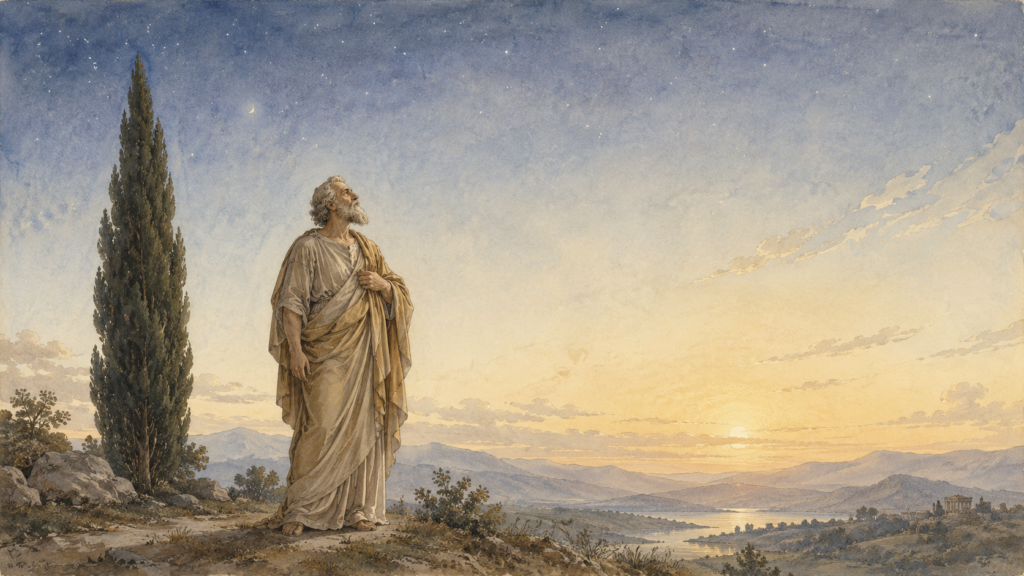
“For the promise to Abraham and his offspring that he would be heir of the world did not come through the law but through the righteousness of faith.” — Romans 4:13 (ESV)
The first half of that verse — heir of the world — is itself worth a long pause. But this morning my eyes wouldn’t move past the second half. The Romans 4:13 meaning I kept circling back to wasn’t really about the scope of the promise but about the channel through which it comes.
Law and Faith Cannot Coexist
Paul follows up immediately in verse 14: “If it is those of the law who are the heirs, faith is null and the promise is void.” What struck me is that he doesn’t treat law and faith as two equally valid paths to the same destination. He treats them as mutually exclusive principles. If one stands, the other collapses.
Why such an absolute framing? Because the moment we try to gain righteousness through law-keeping, the promise becomes a conditional transaction. I get what I earn. The basis of the promise shifts from God’s faithfulness to my own performance. The righteousness of faith, by contrast, returns the basis entirely to God. The one who receives brings no qualifications — only trust in the One who promised. This logic isn’t only Paul’s — it sits at the heart of the Reformation’s recovery of justification by faith as well.
So Romans 4:13 isn’t only a verse about the mechanism of justification. It’s a verse about the architecture of God’s covenant. From the beginning, the promise was never structured as a reward for those capable of keeping the law. It was structured as a gift to those who trust the One making the promise. And the moment we slip back toward law as the ground of standing, something quietly fills that space — often the very idols of the heart that Romans 1 warned about.
The Two Limits of Human Effort
Legalism’s pull is strong, and not only in obvious places. The drive to secure something by my own effort, to prove I’m worth what I receive — it shows up everywhere, including in spiritual life. Pray more, meditate more, give more — and somehow faith itself becomes another extension of the same effort-economy.
But effort has two kinds of limits.
The first is impossibility. Some things you cannot reach no matter how much time or capability you have. A sinner cannot make himself righteous. A dead body cannot raise itself. Abraham faced exactly this limit in Romans 4:19 — “his own body, which was as good as dead (since he was about a hundred years old), or… the barrenness of Sarah’s womb.” It wasn’t a question of trying harder. The biological capacity was simply over.
The second is finitude. Things you can do, but cannot complete. This is where law-keeping always breaks down. James 2:10 puts it sharply: “Whoever keeps the whole law but fails in one point has become accountable for all of it.” Ninety-nine percent doesn’t get you anywhere.
These two limits meet at the same conclusion: from my side, there is no path. And it’s precisely there that the righteousness of faith finds its footing.
Seeing the Limit Is Itself Grace
Here’s the harder admission though. Seeing the limit of self-effort isn’t easy — and it might already be a grace just to see it.
Effort works in most areas of ordinary life. Study and grades go up. Train and the body changes. Work and money comes in. These wins quietly dull the sense that there are realms where effort simply does not apply. And we drag that dulled instinct into spiritual life, applying the same logic where it never belonged.
Which is why the limit usually becomes visible through some kind of breaking. For Abraham, it took a hundred years. Had Isaac come at seventy, he might have credited his own vitality. Letting the body wear all the way to “as good as dead” was, I suspect, God’s intention — so that the end of self-power could really be seen. When the body is “as good as dead,” there’s nothing left to credit oneself for — which is, paradoxically, the very condition under which trust becomes possible. Paul’s later boldness rose from exactly this same soil: not from his own resources but from a power he could only receive.
I notice I’m in something like that place right now. I could do better than I’m doing. I know how, I know the steps, I have the skill. But the energy to bring it out isn’t there. In some ways that’s more frustrating than not knowing what to do. The gap between knowing and doing has stretched wider than I remember it ever being.
Legalism gets its strongest grip in seasons like this. The very fact that I know I could do better becomes a stick to beat myself with. I call my low-energy self lazy, or spiritually dull, or short on faith. That self-criticism pushes for more effort, which drains the little energy left, which makes everything worse. A perfect little loop.
Prayer That Listens Rather Than Demands
So what about praying when exhausted? The natural instinct is pray harder, ask for strength. And I do. But this morning I caught a quiet trap inside that instinct — a trap that’s especially easy to fall into when energy is already gone.
If prayer becomes “the thing I do to extract strength from God,” then prayer itself has been folded back into the effort-economy. Pray more sincerely, longer, with more feeling — and you’ll get what you need. It’s a transaction again, just dressed in spiritual clothes. And when energy is gone, prayer becomes another duty I’m failing at, another reason to feel inadequate. Legalism’s most subtle disguise.
Scripture shows prayer differently. The lament psalms don’t try to extract strength. They bring the state itself before God. Psalm 6’s “my soul is greatly troubled,” Psalm 22’s “why have you forsaken me?” — these aren’t demands for resolution. They’re acts of placing one’s condition in God’s presence and leaving it there.
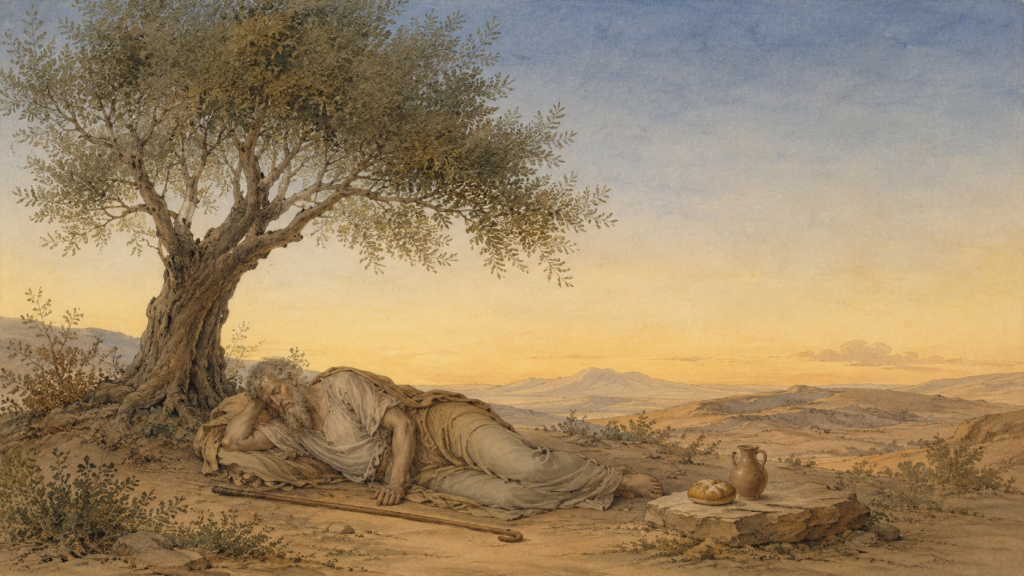
When Elijah collapsed under the broom tree and said, “It is enough; now, O Lord, take away my life” (1 Kings 19:4), God didn’t rebuke him for weak faith. He didn’t tell him to try harder. He fed him. Twice. Let him sleep. Only then did the journey to Horeb begin, and even there God came not in wind or earthquake or fire, but in a low whisper.
So maybe the prayer for today isn’t give me what I want. Maybe it’s bringing the state as-is and listening for whatever comes. Listening is harder than asking, because the answer rarely arrives in the shape we expected. Sometimes “strengthen me” gets answered with “it’s okay to stop for now.” Bread and sleep, not lightning.
And listening, in itself, is already an act of trust. To sit before God without a predetermined answer in mind, open to whatever response He gives — that requires putting down the ego. In that sense, the kind of prayer the lament psalms model is, quietly, its own small death of self-effort.
One thing worth noting before this gets misread: none of this means doing nothing. Abraham still walked. He still left Ur. He still circumcised his household. The point isn’t that action stops — it’s that action stops being the basis on which we stand before God. Trust the One who promised; then walk where He leads.
Closing
Romans 4:13’s “only the righteousness of faith” rang in a new way today. As long as we leave even a sliver of self-effort intact, we’ll cling to it. The cutting has to be complete before we can really see the One who promised. And the cutting doesn’t happen in one moment — that’s the part I keep relearning. Faith life seems to be the process of having the I-can-do-this illusion broken, again and again, in one area after another. Romans 4 keeps reading fresh for that reason.
What the chapter said today was, in the end, simple. Not by law but by the righteousness of faith. Not by my effort but by trust in the One who promised. Not by prayer that extracts strength, but by prayer that brings emptiness as it is.
Frequently Asked Questions
Q: What does “the righteousness of faith” mean in Romans 4:13? A: It means that righteousness comes to us not through law-keeping or moral performance but through trusting the God who promised. Paul uses Abraham as proof — he was counted righteous before circumcision and before the law existed, showing that this has always been God’s way with people.
Q: Why can’t law and faith coexist as two paths to God? A: Because they rest on opposite foundations. Law-keeping makes the promise a conditional transaction earned by my performance; the righteousness of faith makes the promise an unearned gift grounded in God’s faithfulness. The moment one stands as the basis, the other collapses — which is exactly what Paul argues in Romans 4:14.
Q: How should I pray when I’m exhausted and have no energy? A: Bring the exhaustion itself to God rather than trying to extract strength from him. The lament psalms and Elijah under the broom tree (1 Kings 19) model this — they place their condition before God without demanding a particular outcome. Sometimes the answer to “give me strength” looks like bread and sleep, not lightning.
A Prayer to Close This Romans 4 Devotional
Lord, Thank you for showing me again, through Romans 4, that your promise comes only through the righteousness of faith. I see how deeply the instinct to secure and to prove runs in me — and how it has crept even into my prayer life, turning prayer into another transaction.
In this season when my energy is low, help me bring myself to you as I am, rather than punishing myself for what I cannot summon. Teach me to pray not to extract strength, but to honestly place my weakness before you. Open my ears to the answer you give rather than the one I demand. You who gave bread and sleep to Elijah — let me receive whatever you are giving me now, even if it looks different from what I asked for.
Pour into me the faith of Abraham, who trusted you at the end of his own power. In the name of our Lord Jesus Christ I pray. Amen.
About the Author
Each morning I read one chapter of Scripture and reflect on its resonance in daily life. Writing from the perspective of a layperson rather than a trained theologian, I trace how the ancient text still meets us today.
📖 Learn more: About the Author
Pingback: Children of the Promise: Identity in Romans 9