I sat down with Romans 1 this morning, after finishing a long walk through Acts. Acts told the story of how the apostles carried the gospel into the world; Romans is Paul’s letter explaining what that gospel actually is. The shift took me a few minutes to settle into — Acts moves like a narrative, and Romans opens like a courtroom argument. What kept rising to the surface as I read was a question about idols of the heart: are they really gone in our age, or have they just changed disguise?
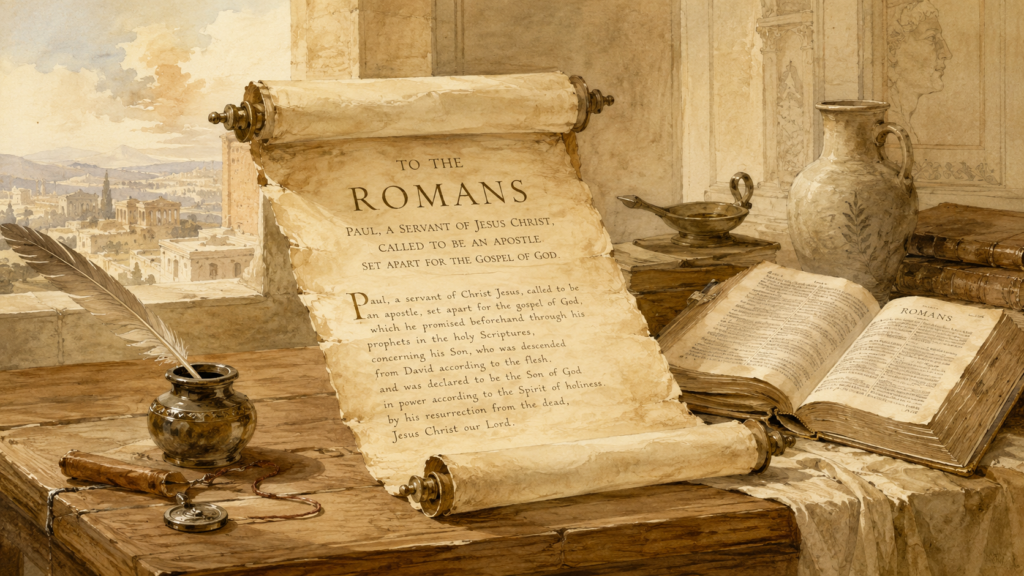
“For in it the righteousness of God is revealed from faith for faith, as it is written, ‘The righteous shall live by faith.'” — Romans 1:17 (ESV)
Romans 1 falls into four movements: Paul’s greeting (vv. 1–7), his longing to visit Rome (vv. 8–15), the gospel declaration (vv. 16–17), and a long diagnosis of human idolatry that runs from v. 18 to the end of the chapter. The verse that sparked the Reformation sits at the chapter’s hinge, and the tone shifts dramatically right after it. What stayed with me today were two passages on either side of that hinge — and how they ended up reading each other.
What First Stopped Me — Romans 1:22–25 on Idolatry
“Claiming to be wise, they became fools, and exchanged the glory of the immortal God for images resembling mortal man and birds and animals and creeping things. Therefore God gave them up in the lusts of their hearts to impurity, to the dishonoring of their bodies among themselves, because they exchanged the truth about God for a lie and worshiped and served the creature rather than the Creator, who is blessed forever! Amen.” — Romans 1:22–25 (ESV)
The first time through the chapter, these verses were what caught me. Humans haven’t changed, I thought. Paul’s portrait — people calling themselves wise while becoming foolish, putting more weight on the creature than on the Creator — didn’t read like a description of the first century. It read like the present. The names of the idols have changed; the structure of the human heart has not.
The Seat That Was Never Empty
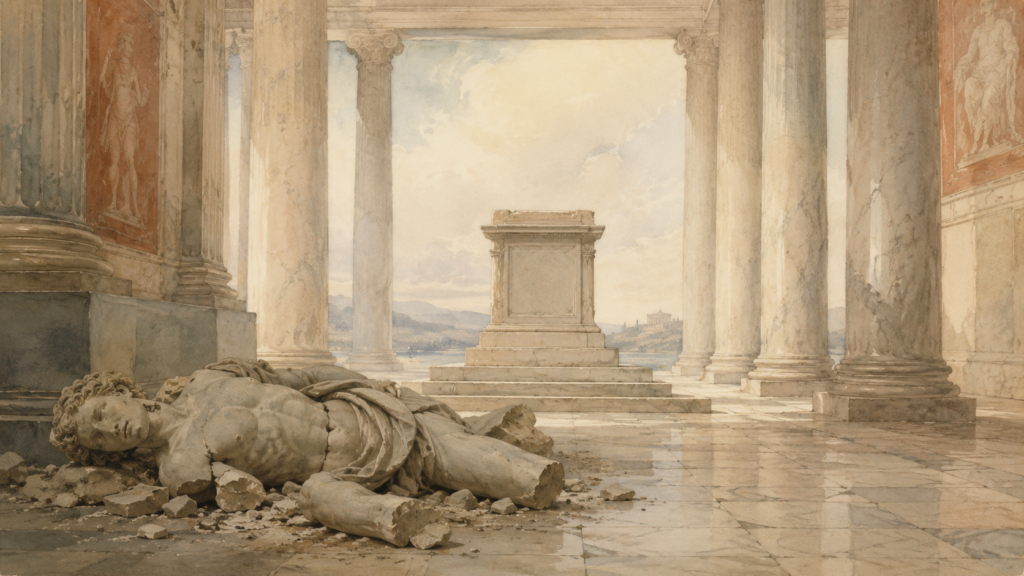
The age of carved stone idols is gone. But the seat the idol used to occupy doesn’t seem to stay empty. The old idols were visible — anyone could tell they were objects of worship. Today’s idols of the heart wear other faces, and the disguise is so good that we don’t recognize ourselves bowing.
Money is the clearest example for me. “I don’t love money, I just need it to live” — that very sentence might be the most polished veil the modern idol wears. (I traced this same dynamic from a different angle in Acts 19, where Demetrius’s outrage over Paul reveals an economic loyalty disguised as religious zeal — the silversmith’s mirror is not a 1st-century artifact.) When Paul writes in v. 25 that they “worshiped and served the creature rather than the Creator,” I wanted to dig into the underlying Greek and learned that the preposition παρά (para) carries both “instead of” and “more than.” Idolatry isn’t only the wholesale replacement of God; it includes giving more weight to something else while still acknowledging Him. Saying “I believe” while my actual hours, attention, and anxiety lean somewhere else — that fits what Paul is naming.
It seems that even outside of religious life, the same pattern shows up in human experience: people and societies tend to construct something ultimate, something they orient their lives toward. The object changes by century, but the seat itself is never quite vacated.
Why We Can’t Get Rid of the Idols of the Heart
So what do we do? I have to admit that simply trying to cut an idol off has not worked in my life. “I will not love money” as a resolution lasted a few days at most, and the seat was never actually emptied — something else just slipped in.
A different direction has worked better for me. When I hold to the Lord more deeply, the seat where the idol sat begins to be filled by Him, not vacated. Augustine’s famous reflection in the Confessions — that his old loves fell away only when a greater love took hold — names the same pattern. Tim Keller, drawing on Calvin’s idea of the heart as an “idol factory,” puts it bluntly: idols of the heart can’t be removed, only replaced. The old affection isn’t expelled by being pushed; it is displaced when something larger moves in. (In ordinary life this rhymes with how new habits cover old ones more reliably than willpower alone tears them out.)
I want to be careful here, though. I would not want this to be read as a license to skip the discipline of repentance and wait passively for some spiritual experience. The point isn’t “effort doesn’t matter.” It is that effort directed at the wrong target — the idol itself — keeps us inside its same orbit. Effort directed toward holding to Christ moves us into a different orbit altogether.
What Romans 1:17 Means — From a Source, Not by Force
The second time I read Romans 1:17, the meaning landed differently. “The righteous shall live by faith” sounds at first like a slogan I already know. But the Greek phrase is ἐκ πίστεως (ek pisteōs), which literally means “from faith” — out of faith as a source. The preposition ἐκ (ek) is described in Strong’s lexicon as denoting origin — the point whence action proceeds. The righteous don’t live by deploying their faith as a tool; they live out of faith, drawing from it the way water is drawn from a well. (The same “from a source” pattern surfaced in my reading of Acts 22, where Paul’s boldness flowed not from his courage but from an earlier encounter that kept feeding him.)
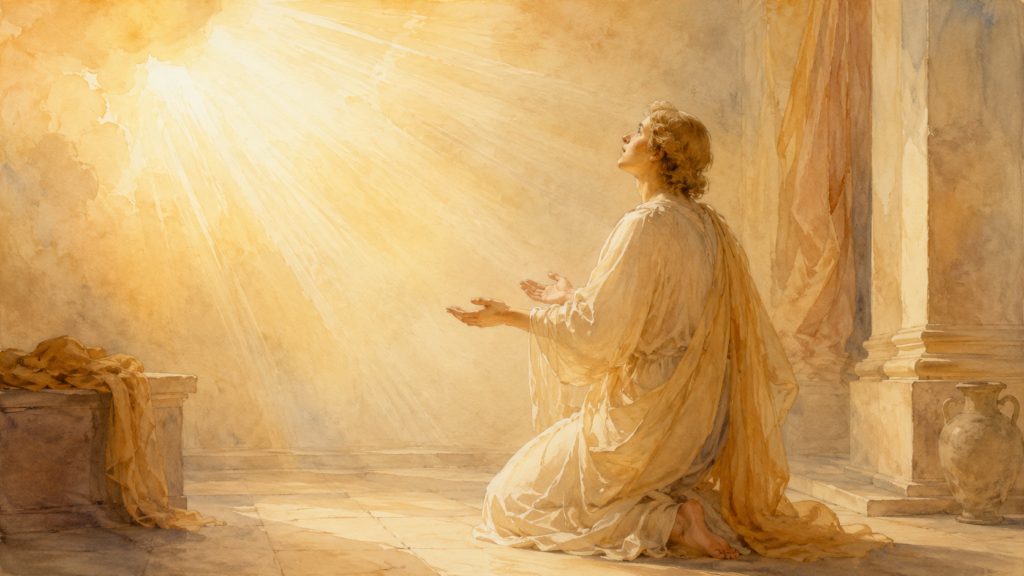
I read that Luther broke down before this verse. He had read “the righteousness of God” as a standard he was supposed to reach, and the demand terrified him. When he came to see that this righteousness was a gift God gives rather than a target the believer attains, he said the gates of paradise opened. The pattern is the same as the question of idols. The way out of the idol’s seat isn’t a stronger grip on myself. It is a deeper grip from Someone else, made possible because I am holding to Him.
Without the diagnosis of vv. 22–25, v. 17 sounds like a moral aphorism. Without v. 17, vv. 22–25 end in despair. The two passages had to read each other before Romans 1 became, for me, a way of life rather than a piece of theology.
Frequently Asked Questions
Q: What are “idols of the heart” in Romans 1?
A: Paul’s diagnosis in vv. 22–25 names exchanging the Creator’s glory for created things. Today the form has changed — money, success, image — but the underlying structure of the heart has not. Idols of the heart are anything we treat as ultimate, even while still acknowledging God with our words.
Q: What does Romans 1:17 mean?
A: The Greek phrase ἐκ πίστεως (ek pisteōs) literally means “from faith” — out of faith as a source. The Romans 1:17 meaning that Luther recovered is that righteousness flows from faith rather than being achieved by it. Faith is the well; the righteous life is the water drawn from it.
Q: Why can’t we just get rid of the idols of the heart?
A: Augustine’s experience in the Confessions suggests we don’t expel idols by force. He wrote that his old loves fell away only when a greater love took hold. Effort directed at the idol itself keeps us in its orbit; effort directed toward holding to Christ moves us elsewhere — though this is no license to skip the discipline of repentance.
A Prayer to Close This Reflection on Idols of the Heart
Lord,
The age of carved idols is past, but the seat in my heart that an idol once occupied has not stayed empty. I confess I acknowledge You with my words while letting other things — money chief among them — carry more weight in my actual hours.
I have tried to push these idols out by force, and the force runs out. Help me hold to You more deeply, Lord, so that the seat is not merely vacated but filled by You. Let my righteousness flow from faith as from a source, not from my own strength. And let me not mistake this for permission to drift; let the daily turning toward You become its own kind of stillness.
In the name of our Lord Jesus Christ I pray. Amen.
About the Author
Each morning I read one chapter of Scripture and reflect on its resonance in daily life. Writing from the perspective of a layperson rather than a trained theologian, I trace how the ancient text still meets us today.
📖 Learn more: About the Author
Pingback: The Righteousness of Faith When Effort Runs Out — Romans 4
Pingback: While We Were Still Sinners — Romans 5 Devotional
Pingback: Evil Lies Close at Hand: An Honest Romans 7 Reflection