This is my second time writing on the storm in Acts 27. The chapter has been giving me more than I can fit into a single post, and one thread in particular wouldn’t let me go this morning. It’s the strange fact that, in the middle of a fourteen-day tempest, an angel comes to Paul — but the storm doesn’t stop.
“When neither sun nor stars appeared for many days, and no small tempest lay on us, all hope of our being saved was at last abandoned. … For this very night there stood before me an angel of the God to whom I belong and whom I worship, and he said, ‘Do not be afraid, Paul; you must stand before Caesar. And behold, God has granted you all those who sail with you.’ So take heart, men, for I have faith in God that it will be exactly as I have been told.”
— Acts 27:20, 23-25 (ESV)
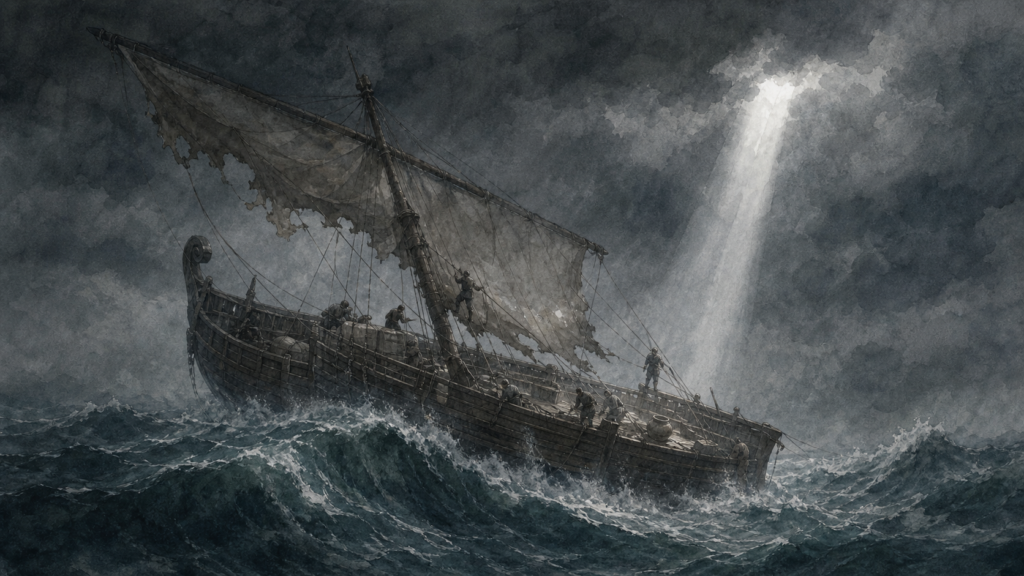
The angel arrives. He delivers a promise. And then he leaves. The wind keeps howling. The waves keep crashing. The ship keeps drifting, and eventually it runs aground.
So what was the angel for? That question stayed with me all day.
When the Promise Arrives in the Storm
I want to start with the timing of the promise inside the storm in Acts 27.
Verse 20 ends with a striking phrase: “all hope of our being saved was at last abandoned.” The Greek behind it is περιῃρεῖτο ἐλπὶς πᾶσα (periēreito elpis pasa). Translated literally, it means every hope was being stripped away — like layer after layer of clothing pulled off until nothing was left. The sun gone. The stars gone. The horizon gone. Every coordinate by which a sailor could navigate had been taken.
It’s only at this exact moment — only after every human handhold has been stripped — that the angel comes.
I don’t think this sequence is accidental. We don’t tend to lean on a promise while we still have other things to lean on. The voice of heaven becomes audible only when every other voice has fallen silent. Paul couldn’t have heard the promise the same way three days earlier; there were still stars in the sky then. The heavenly coordinate is given when the human coordinates are gone.
What the Angel Actually Brought into the Storm in Acts 27
Look closely at what the angel says in verses 24-25.
“Do not be afraid, Paul. … So take heart, men.”
The verb behind “take heart” in verse 25 is εὐθυμεῖτε (euthymeite) — from εὐθυμέω (euthymeō), which breaks down literally as “to hold the heart (thymos) well (eu-).” The closest English translation might be keep your inner being upright. Not cheer up, not don’t worry — but let your heart stand straight in the middle of this.
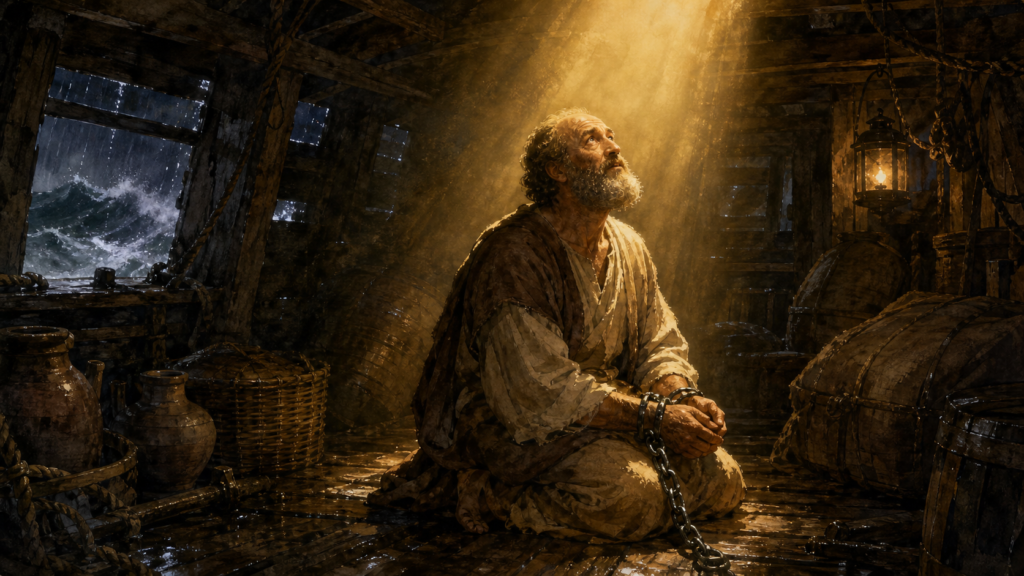
So what the angel brought into the storm in Acts 27 was not a change of circumstance. It was a change of interior. The wind would keep raging. But in the middle of it, a heart could stand upright.
I’ll be honest. The first time this struck me, it felt almost stingy. Couldn’t the One who has authority over wind and waves simply have stopped them? Why fourteen more days of drifting? I’ve sat with that question many times — in this passage, and in my own life. Why does God so often answer with strength to endure rather than removal of the thing? This pattern of presence-rather-than-removal is the same one I traced in my Acts 18 devotional, where the Lord’s “Do not be afraid” to Paul in Corinth was given as a promise of presence, not as a guarantee that opposition would disappear.
But the longer I sit with verse 25, the more I think the fact that the angel brought only a word — and not a calmed sea — is the heart of what’s being given.
The One Who Walked Through
This pattern repeats throughout Scripture in ways I find hard to ignore.
“Even though I walk through the valley of the shadow of death, I will fear no evil, for you are with me.” — Psalm 23:4
David’s promise isn’t that the dark valley is removed. It’s that he walks through it. The Hebrew preposition is straightforward: through, not around. David doesn’t sing about the valley being lifted; he sings about the One who walks beside him while it lasts.
Jesus himself prayed in Gethsemane, “Father, if you are willing, remove this cup from me” (Luke 22:42). The cup wasn’t removed. Yet Luke records what came next: “And there appeared to him an angel from heaven, strengthening him” (Luke 22:43). The cup stayed. The strength to drink it was given.
When I trace this pattern, I find that the deepest place in our faith is occupied by one who walked through. The cross is what happens when the cup is not removed. Jesus did not save us by escaping suffering. He saved us by passing through it. And the One who passed through is now the One giving us hearts to pass through, too.
One Steady Person in the Middle of a Storm
Following that thread, I notice one more thing about the storm in Acts 27.
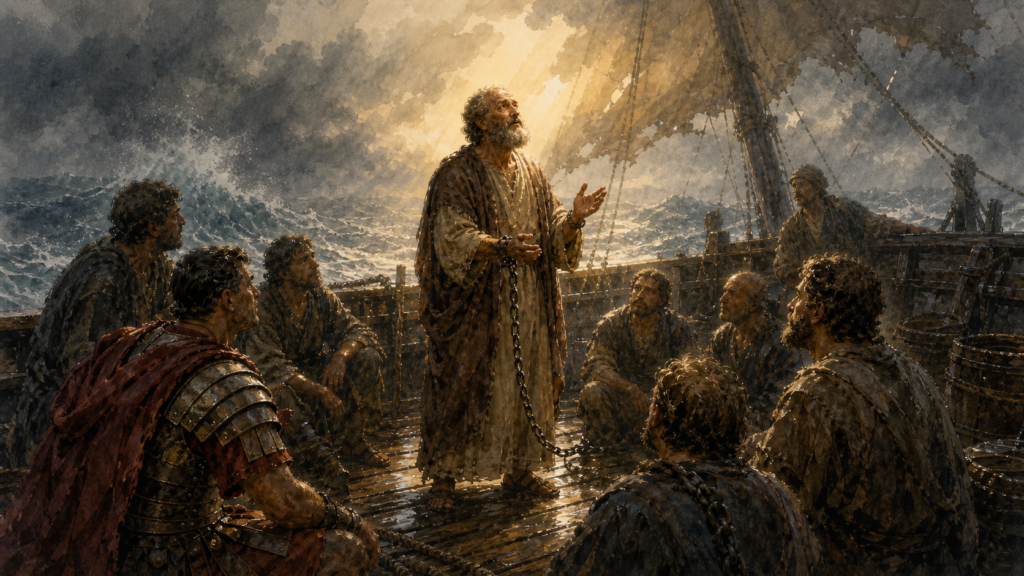
If the angel had stopped the wind immediately, the rescue would have been a miracle for Paul alone. But because the storm continued, the promise Paul received became something the entire ship could see and hear. He could speak the angel’s words aloud (verse 25). The two hundred and seventy-five other men aboard could watch him remain steady for fourteen more days. And in the end, all 276 of them came ashore alive, through that one steadied man.
The Acts 27 storm wasn’t kept going for Paul’s sake. It was kept going, perhaps, for the sake of everyone drifting with him.
That changes something for me. The storm wasn’t an obstacle to the rescue — it was the medium through which the rescue spread. If the wind had died on the spot, no one else on that ship would have ever known what was happening between Paul and his God. They would have simply gone home with a strange story about good weather. Instead, they went home having seen a man unshaken in the middle of black skies. (I noticed something similar in my Acts 12 devotional, where God’s deliverance didn’t come in a single uniform shape — Peter was rescued from prison while James was not — and that asymmetry had something to teach us about how God’s salvation actually moves through the world.)
I think this happens to us, too. Sometimes the storm we’re walking through isn’t only ours. There’s someone drifting beside us — a coworker, a family member, a friend who hasn’t yet heard the promise — and the steadiness God is forming in us is meant, somehow, to reach them. The heart we’ve been given may not be only for our own survival. It may be a quiet anchor for someone else who’s still in the dark.
What I’m Learning to Pray in the Storm in Acts 27
Sitting with all this, my prayers are starting to shift, just a little.
I want to be careful here. Asking God to calm the storm is not a lesser prayer. It’s an honest prayer. Jesus himself asked for the cup to be removed. There is nothing wrong with begging God to take the suffering away — Scripture is full of saints doing exactly that, and I will keep doing it too.
But I’m starting to hold open another possibility alongside that prayer. When the answer to “please stop this storm” doesn’t come immediately, God may not be silent. He may be sending a different answer. The circumstances may stay exactly as they are, while inside me, an upright heart is being formed. The storm may not lift, but a path may be opening through it — one that ends with me carrying a quiet word of comfort to someone still adrift.
I don’t want to think of a stilled storm as the only kind of answered prayer. The voice that says “do not be afraid” inside the storm is also an answer. And I’m coming to suspect it may sometimes be the deeper one.
Frequently Asked Questions
Q: Why doesn’t God calm the storm in Acts 27 when Paul prays?
A: When God doesn’t calm the storm in Acts 27, what he gives instead is an angel’s word and an inner steadiness for Paul. The storm continued for fourteen more days after the promise was given. Scripture often shows God answering by giving strength to pass through suffering rather than by removing it — David walking through the valley, Jesus drinking the cup in Gethsemane.
Q: What does Acts 27:25 mean when Paul says “take heart”?
A: The Greek verb behind “take heart” (εὐθυμεῖτε, euthymeite) literally means “hold your heart upright.” It is not an instruction to cheer up or stop worrying. It is a call to keep one’s inner being steady in the middle of a circumstance that has not changed. Paul says it on the basis of a divine promise he received, not because the storm itself had improved.
Q: How can I apply Acts 27:20-26 when I am suffering?
A: The passage doesn’t teach that prayers for relief are wrong — Jesus himself asked for the cup to be removed. But it does teach that when relief doesn’t come, God may not be silent; he may be giving the strength to pass through. It also suggests that the steadiness formed in us during suffering may become a comfort to someone else who is suffering alongside us.
A Prayer to Close This Acts 27 Reflection
Lord,
Thank you for bringing me to the place of prayer again this morning. Thank you for the days you’ve given me to sit with the storm in Acts 27.
I have so often prayed only that the storm would stop — that the situation would resolve, that the difficulty would lift. And when those things didn’t happen, I assumed you hadn’t yet answered.
But this morning I see that you did not calm Paul’s storm. You gave him a heart instead. I remember David walking through the valley of the shadow without fear. I remember your Son in Gethsemane, not delivered from the cup but strengthened to drink it. You are not a God who lifts us over suffering. You are a God who brings us through it.
In the storm I am walking through right now, give me a heart that does not fear. Even if the circumstances do not change, let me stand in the middle of them and hear your voice. And let the heart you give me not be only for myself — let it become a word of peace for someone drifting beside me who has not yet heard you.
I trust the God who answers not by removing the storm but by leading us through it. I trust that at the end of this passage, there is a harbor you have prepared.
In the name of our Lord Jesus Christ I pray. Amen.
About the Author
Each morning I read one chapter of Scripture and reflect on its resonance in daily life. Writing from the perspective of a layperson rather than a trained theologian, I trace how the ancient text still meets us today.
📖 Learn more: About the Author