This morning’s Acts 20 devotional began with a word I almost passed over — tears. At first I nearly skipped right by it, but as I read again, this single word seemed to change the entire tone of the passage. Several thoughts came to me through it.
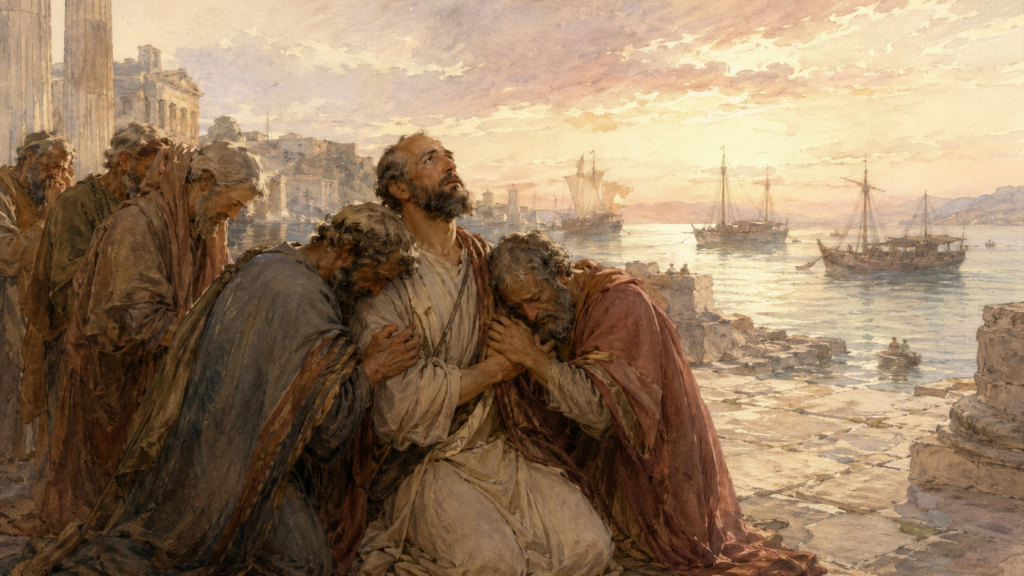
“serving the Lord with all humility and with tears and with trials that happened to me through the plots of the Jews” — Acts 20:19 (ESV)
Acts 20 — Paul’s Farewell to the Ephesian Elders
Acts 20 is the chapter where Paul calls the elders of Ephesus to Miletus and bids them his final farewell. These are the men who had walked with him through years of ministry in that city — including the unrest stirred up by Demetrius the silversmith just chapters earlier. So when Paul stands before them now, the air is thick with shared history.
Verses 18–35 form Paul’s farewell address to the Ephesian elders, and it parallels Jesus’s farewell discourse in Luke 22 and the longer one in John 13–17. Luke is said to have intentionally crafted these parallels — Acts has its own farewell address, and this is it.
Paul looks back on his ministry (vv. 18–21), speaks of the road ahead of him (vv. 22–27), and entrusts the flock to the elders (vv. 28–35). Knowing he will not see them again, every word carries weight. Perhaps that’s why tears appear explicitly twice in this chapter (vv. 19, 31). And in the final scene (v. 37), the elders weep loudly, embrace Paul, and kiss him.
This is less a chapter of teaching and more a chapter of the heart, I thought.
Serving the Lord with Tears — A Closer Look
When I first read verse 19, I almost reflexively read those tears as tears of suffering — tears shed under persecution, tears endured through trial. That was my automatic reading.
But when I looked at the structure of verse 19 more carefully, something shifted. Paul is actually speaking of two things side by side. One is serving the Lord with humility and with tears; the other is enduring the trials that came through the plots of the Jews. These are two parallel items, not one bundled experience.
In other words, the tears were not shed because of the trials. The tears were, separate from the trials, part of the very posture in which Paul served the Lord. “Humility and tears” form a pair that describes the manner of his serving.
The moment I caught this, the verse read differently. Paul’s tears, I came to think, were not a byproduct of suffering but a quality of his service. This is what reframed the whole Acts 20 devotional for me.
Tears as a Mark of Personal Communion with God
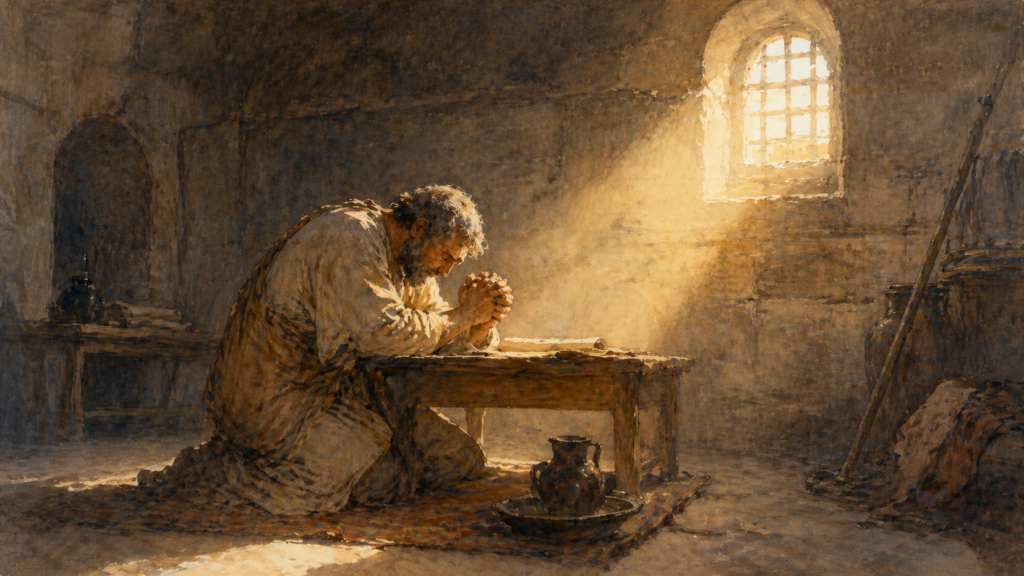
So why did tears accompany his way of serving? As I sat with that question, the phrase “personal communion with God” came naturally to mind.
Think of how this works in our daily lives. In formal relationships, in obligatory meetings, in distant acquaintances, tears rarely come — because the heart doesn’t reach that far. But in relationships where we genuinely care, where we love sincerely, the smallest things move us, and tears follow.
That Paul served the Lord over many years with tears woven into that serving suggests, I think, that he did not approach God as a task but met him as a living person. We catch a glimpse of that intimacy back in Corinth, where the Lord himself appeared to Paul one night with words of reassurance. Each day of his ministry was a real encounter, and the depth of that encounter naturally overflowed into emotion.
Reading it this way, verse 31 came alive in the same key.
“Therefore be alert, remembering that for three years I did not cease night or day to admonish every one with tears.” — Acts 20:31 (ESV)
To admonish each person with tears means that each individual was a matter of the heart to Paul. Not administrative instruction, but admonition flowing from a place where his own heart had already reached into the soul of the one he was speaking to.
The personal communion with God in verse 19 and the personal communion with people in verse 31 share the same texture. Someone who has met God personally begins to encounter people personally too. This was the natural overflow of Paul’s ministry.
As I sat with this longer, a desire stirred in me — I want to walk in that kind of personal communion with God too. I found myself wanting my morning time in the Word to be not a task to complete but a real meeting with the living One.
But Tears Are Not the Measure of Spirituality

Here I want to add one careful note. Reading verse 19 and walking away with the conclusion “I should become a tear-filled servant too” — that doesn’t quite seem to be what the text is asking, I thought.
Tears are a result, not a goal. Paul didn’t wake up one day and resolve, “Starting today, I’ll serve with tears.” That texture formed naturally over years of walking with the Lord. So what we are meant to imitate, I’d say, is not the phenomenon of tears but the depth of communion from which tears might flow.
I’d hate for this Acts 20 devotional to be read as a call to perform emotion. People express feeling differently, and some of the deepest personal communion with God can be quiet and tearless. What the text shows us, I think, is not “weep” but “stay where the heart goes.”
Put another way, what we’re meant to follow is not a method but a direction of the heart.
This passage offers a quiet mirror to me. When I opened the Word this morning, was that place a place of tasks to complete, or a place of meeting the living One? When I prayed, was I reciting, or was I in conversation? When I encountered someone in daily life, was that person a task to handle, or a soul to care for?
Paul’s tears, I think, were a sign that his heart had reached all the way there — into the Lord, into the people he served. I paused this morning to ask how far my own heart has actually reached.
Frequently Asked Questions
Q: What is the meaning of Paul’s tears in Acts 20?
A: Paul’s tears in Acts 20:19 are not described as a byproduct of persecution but as part of his very posture in serving the Lord. The grammar of the verse places “humility and tears” as one paired description of his serving, with “trials” listed separately. The tears, then, point to the depth of his personal communion with God rather than to the intensity of his suffering.
Q: Why did Paul serve the Lord with tears?
A: Paul served with tears because his relationship with God was personal rather than transactional. When we genuinely care about someone, our hearts reach into theirs and emotion naturally follows. Paul’s years of walking with the living Lord produced that same texture — a serving in which tears were a sign of how far his heart had reached.
Q: How can I cultivate personal communion with God like Paul?
A: The Acts 20 devotional reading suggests that personal communion with God isn’t a method to apply but a direction of the heart to follow. Rather than trying to imitate the phenomenon of tears, we are invited to treat our time in the Word and prayer as a real meeting with a living person rather than a task to complete. The depth grows over time, naturally.
A Prayer to Close This Acts 20 Devotional
Lord,
Reading Paul’s farewell address today, I find myself thinking again about the tears that accompanied his serving. Thank you for showing me that those tears were not a byproduct of persecution but a mark of personal communion with you.
Do not let my journey of faith become a place of mere task completion. Let my morning time in the Word become a real meeting with you, the living Lord. Let my prayer become conversation rather than recitation, and let my dealings with others become not the handling of tasks but the caring of souls.
Keep me from trying to imitate tears for their own sake. Hold me instead in a depth of communion from which tears might naturally flow. Let me live this day with the kind of heart that overflows from meeting you as a person.
In the name of our Lord Jesus Christ I pray. Amen.
About the Author
Each morning I read one chapter of Scripture and reflect on its resonance in daily life. Writing from the perspective of a layperson rather than a trained theologian, I trace how the ancient text still meets us today.
📖 Learn more: About the Author
Pingback: Acts 21 Devotional: Discerning the Spirit's Voice