Each morning I read one chapter of Acts and sit with it before the day begins. Today was chapter 17, the famous scene where Paul stands on the Areopagus and addresses the philosophers of Athens. What struck me this morning wasn’t the rhetorical brilliance of the speech itself but the religious structure it quietly dismantles. As I worked through this Acts 17 devotional, one question began to surface and refused to leave: am I still trying to earn God’s favor with what I bring, or am I coming empty-handed to a God who has already given me everything?
“nor is he served by human hands, as though he needed anything, since he himself gives to all mankind life and breath and everything.” — Acts 17:25 (ESV)
Chapter 17 follows Paul through three cities on his second missionary journey. In Thessalonica he reasons in the synagogue before opposition drives him out (vv. 1–9). In Berea he meets believers who receive the word eagerly and examine the Scriptures daily (vv. 10–15). Then he arrives alone in Athens, and as he waits for Silas and Timothy, his spirit is provoked within him at the sight of a city full of idols (v. 16). Athens at the time was a city of intellect and religion, its streets crowded with temples, its philosophers debating in the open air. Paul reasons in the synagogue and in the marketplace, and eventually stands before the council on the Areopagus to deliver the sermon that occupies verses 22–31. The place where I lingered today was the heart of that Areopagus sermon — verses 25 through 28.
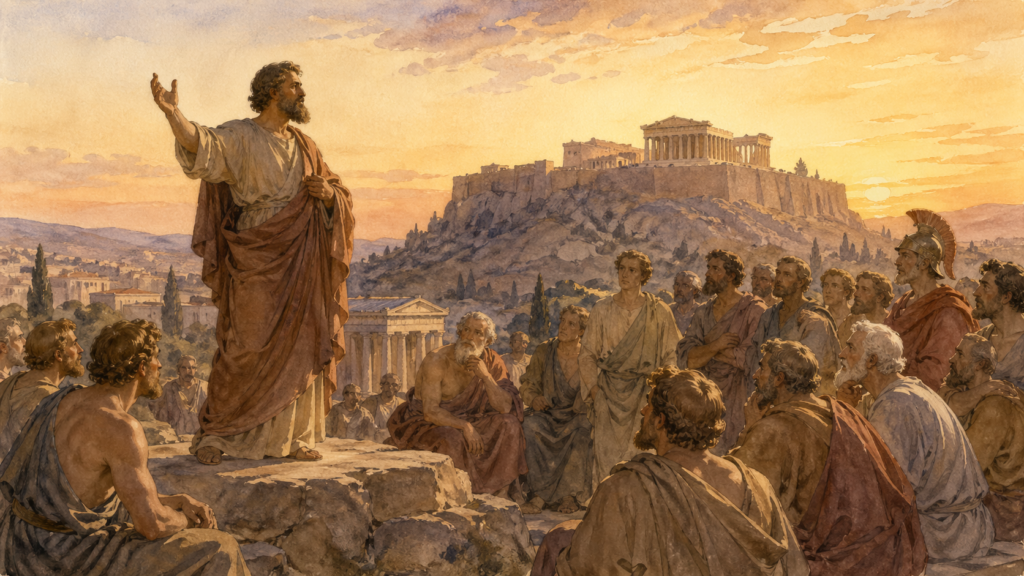
Athens: A Religion of Transaction
In verse 23 Paul describes what he saw as he walked through the city: “I found also an altar with this inscription, ‘To the unknown god.'” The Athenians were so anxious not to miss any deity that they had built an altar even for gods they didn’t know, just in case. The underlying religious logic started to come into focus for me as I sat with this image. The gods of Athens were beings who had to be served by human hands in order to move on behalf of their worshipers. Offerings, sacrifices, and devotion were the currency of divine favor. You gave in order to receive. You withheld, and you risked the god’s indifference. It was, fundamentally, a religion of transaction.
Paul inverts this entire structure in verse 25. God is not served by human hands “as though he needed anything.” The direction of the relationship, he says, runs the other way. God “gives to all mankind life and breath and everything.” The worshiper is not the one who sets the exchange in motion. The Giver has been giving all along. The echo with Stephen’s sermon two chapters earlier is hard to miss — where Stephen tells the Sanhedrin that God does not dwell in houses made by human hands, Paul now tells the Athenians that God is not served by human hands either. Two audiences, one stubborn reversal of the transactional instinct.
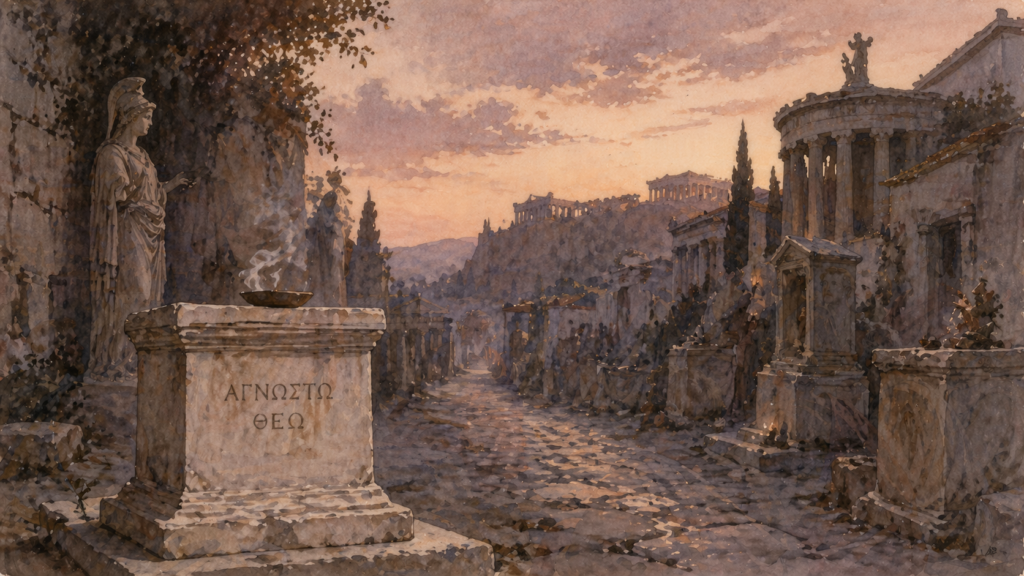
The God Who Is Still Giving
I wanted to dig into the Greek on this one. The word translated “gives” in verse 25 is διδοὺς (didous), a present active participle. A present participle in Greek carries a continuous, ongoing sense — not a one-time act completed in the past, but an action that keeps unfolding in the present moment. God didn’t just give us life once at creation and step back. He is giving, right now, at this very moment. The breath filling my lungs as I write this sentence, the pulse in my wrist, the quiet attention with which I’m reading these words — all of it is his ongoing gift.
Verse 28 pushes this even further: “In him we live and move and have our being.” Three Greek verbs stand side by side here: ζῶμεν (zōmen, we live), κινούμεθα (kinoumetha, we move), ἐσμέν (esmen, we are). The middle verb, κινούμεθα, is not active but middle/passive in form, as some commentaries point out. The nuance shifts from “we move ourselves” to something closer to “we are being moved” or “movement happens within him.” Our very agency — the fact that we act at all — is something that takes place inside the sustaining life of God.
That small grammatical detail stayed with me for a while. I so easily assume that my willpower and initiative are mine alone, that I am the engine of my own movement. But the text suggests something quieter and more radical — even my motion is being carried. Even as I write this sentence, I am not a self-contained agent but a creature being held in the ongoing life of the One who gives.
Groping Hands and the Nearness
Verse 27 reached me from another angle: “that they should seek God, and perhaps feel their way toward him and find him. Yet he is actually not far from each one of us.” The phrase “feel their way” translates the Greek ψηλαφάω (psēlaphaō), a verb that describes touch rather than sight — groping in the dark, reaching out with uncertain hands. I was struck by how candidly Scripture admits this. The search for God is not portrayed as a clean intellectual inference from clear premises. It is groping. It is fumbling. It is a hand extended into shadow.
And yet the very next clause refuses to let that groping end in despair: “Yet he is actually not far from each one of us.” Even while we reach with uncertain fingers, he is not distant. Our fumbling toward him is not a stretch across impossible distance; it is a movement toward a Presence that has already drawn near. I found this deeply consoling. Faith, it seems, does not require a crisp and confident grasp before it begins. The trembling reach itself is already an answer to the nearness that surrounds us.
From Transaction to Discovery
The more I sat with this passage, the clearer it became that Paul’s Areopagus sermon is not merely introducing a new deity to a pagan audience. He is overturning the structure of religion itself. Athens assumed that divine favor must be purchased; Paul proclaims a God who has already given. Athens assumed its gods must be sought at a distance through ritual; Paul proclaims a God who is not far from any of us. The movement is from a religion of transaction to a faith of discovery.
The same contrast appears, in a different key, in the story of Simon the sorcerer in Acts 8, who tried to buy the gift of the Spirit with money. Simon’s instinct and the Athenians’ altars share the same underlying grammar — that the divine can be moved, secured, or possessed through the right offering. Paul’s Areopagus sermon, like Peter’s sharp rebuke of Simon, refuses that grammar outright.
This framework connects with something I keep returning to in Tim Keller’s writing. Keller often contrasts what he calls religion and the gospel: religion performs in order to be accepted, while the gospel responds because it has already been accepted. Paul’s Athens sermon, in its own first-century terms, announces that same reversal. The God of the gospel is not a being whose altars we build in anxiety; he is the One who has already given us life and breath and now asks only that we turn and find the One in whom we have always been living.
I do want to say, gently, that this insight can be misheard. I wouldn’t want anyone to take “God has already given everything” as “so there is nothing for me to do.” Verse 27 still speaks of seeking, of reaching out, of finding. Our part remains. What changes is the nature of the movement. We are no longer bargaining; we are responding. We are not paying our way to acceptance; we are coming empty-handed to the One who has already received us. Hebrews 11:6 carries the same double note: “whoever would draw near to God must believe that he exists and that he rewards those who seek him.” Belief that he is. Belief that he meets those who seek him. Both of those convictions together make real seeking possible.
Where Does My Worship Actually Stand?
Toward the end of this reflection, a quieter and more uncomfortable question began to surface. How different am I, really, from the Athenians? Does my prayer sometimes function as a means of securing divine favor rather than as communion with the One who has already given everything? Does my worship sometimes slide into a posture of “I have offered this much, so now I can expect that much”? Does my obedience sometimes feel less like the grateful response of an accepted child and more like the anxious labor of someone still trying to be accepted?
The idols of Athens were carved from stone, but the idol inside me may well be this invisible ledger — the quiet assumption that God moves in response to what I bring. Paul’s provoked spirit in the streets of Athens finds an echo in my own chest this morning, as I notice how often I still live inside a transactional religion I thought I had left behind. He has already given me life, breath, and everything. I am, even now, living and moving and having my being inside him. So the work of today is not to offer more but to come empty-handed and, in that emptiness, to seek the face of the God who has never been far.
Frequently Asked Questions
Q: What is the main message of Paul’s Areopagus sermon in Acts 17?
A: Paul overturns the transactional religion of Athens by proclaiming a God who is not served by human hands but who himself gives life and breath and everything to all mankind. The sermon moves the audience from a religion where worshipers bargain with distant deities to a faith in which they discover a God who is already near and already giving.
Q: What does “in him we live and move and have our being” mean?
A: In Acts 17:28 Paul declares that our very existence, agency, and movement take place inside the sustaining life of God. The Greek verb for “move” is in a middle/passive form, suggesting that our motion is not self-generated but carried within God — we are held in his ongoing life rather than operating independently of him.
Q: Why did Paul reference the altar to an unknown god in Acts 17?
A: Paul uses the Athenian altar inscribed “To the unknown god” as a rhetorical bridge, telling his audience that the God they worship in ignorance is the God he now proclaims. Rather than condemning their religiosity outright, he redirects it toward the true God who made the world and is not far from any of us.
A Prayer to Close This Acts 17 Devotional
Lord,
I confess that I so often live as though you were a distant God who must be persuaded, as though my offerings and my effort were the price of your nearness. I forget that I have already received life and breath and everything from your open hand. Help me to remember that the very breath in my lungs and the motion of my steps are your ongoing gift to me this morning. Teach me to come empty-handed into your presence, not to purchase your favor but to find the One who has never been far from me. Let my seeking today be the response of a child who has already been welcomed, not the labor of a stranger trying to earn a place at your table. In the name of our Lord Jesus Christ I pray. Amen.
Each morning I read one chapter of Scripture and reflect. I hope today’s devotional leaves a quiet resonance in your day as well.
About the Author
Each morning I read one chapter of Scripture and reflect on its resonance in daily life. Writing from the perspective of a layperson rather than a trained theologian, I trace how the ancient text still meets us today.
📖 Learn more: About the Author