This Acts 13 devotional began this morning, as two passages from the chapter held me for a long time — verses 38-39, and verses 51-52. At first these two passages came to me separately, but as I kept meditating, I was able to connect them naturally into one line of thought.
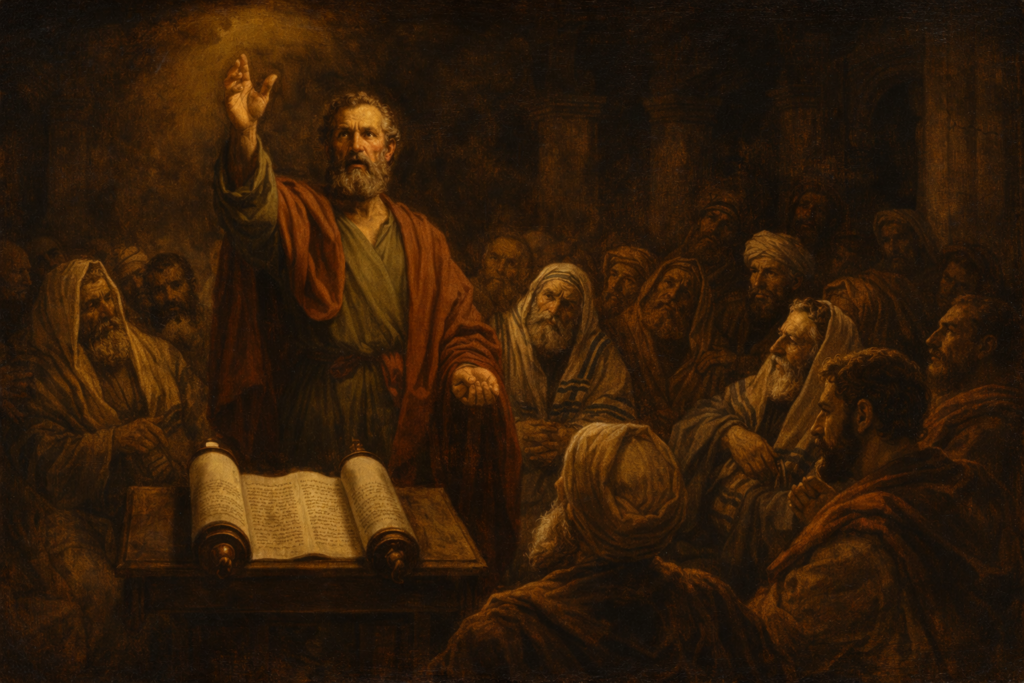
Acts 13:38-39 — Where the Law Could Not Reach
“Let it be known to you therefore, brothers, that through this man forgiveness of sins is proclaimed to you, and by him everyone who believes is freed from everything from which you could not be freed by the law of Moses.” (Acts 13:38-39, ESV)
Paul’s declaration in the synagogue of Pisidian Antioch is known as the most explicit statement of justification by faith in the entire book of Acts. The gospel that will later be unfolded in Romans and Galatians is already compressed into this single sentence.
A brief note on this doctrine, since it sits at the center of this Acts 13 devotional: justification by faith is the core Protestant teaching that a person is declared righteous before God through faith in Jesus Christ, not through any work of the law. It is a doctrine often misunderstood and criticized — and Protestants sometimes take unnecessary blame for how this doctrine is framed — but its central claim remains unchanged. Precisely because it is central, careful interpretation matters.
What struck me in this passage was the phrase “from everything from which you could not be freed by the law of Moses.” There is something the faithful keeping of the law cannot reach. No matter how diligently I try to keep the law, there is a realm where the law cannot declare me righteous. This is why faith matters. And this is precisely where the text says: everyone who is in Christ is declared righteous.
The Greek phrase here for “by him” is ἐν τούτῳ (en touto, in this one) — you can look up the full semantic range at Blue Letter Bible. The preposition ἐν (en, in) stands at the very heart of Paul’s theology. In fact, expressions throughout John’s gospel — to abide, in the Lord, in Jesus — all run along this same line. And the phrase ἐν Χριστῷ (en Christō, in Christ) appears throughout Paul’s other letters with remarkable frequency. The seed of that theology is already planted here in this sermon.
The verb translated “declared righteous” or “freed” is δικαιόω (dikaioō). This word should not be read as “gradually improving morally.” It is a courtroom declaration — God pronouncing me righteous because I am held in Christ, not because I have become righteous on my own. If the order gets reversed — if my keeping of the law comes before my being held in Christ — faith gets tangled quickly.
The Days I Lived with This Order Reversed
Honestly, I have often lived with this order flipped upside down. Even while practicing my faith, there was this quiet calculation sitting at the bottom of my heart: “If I do this much, God will accept me.” Reading the Word, praying, serving — all of these acts, at some point, had turned into performances aimed at securing God’s acceptance.
But verses 38-39 say the opposite. It is not that I keep the law well and therefore God accepts me. It is that God has already accepted me, and therefore this kind of life becomes possible. Justification is the engine, not the reward. This order must not be forgotten.
The difference between these two orders is enormous. If I try to earn acceptance through performance, life becomes an endless loop of anxiety. Did I do enough today? Am I better than yesterday? Am I more devout than that person? These comparisons never leave the mind. But when I start from the place of already being declared righteous in Christ, performance is no longer a solution to anxiety — it becomes an expression of gratitude. Of course, I do not think that skipping performance and keeping only belief is truly what the Lord desires either. The order is what matters, not the elimination of one side.
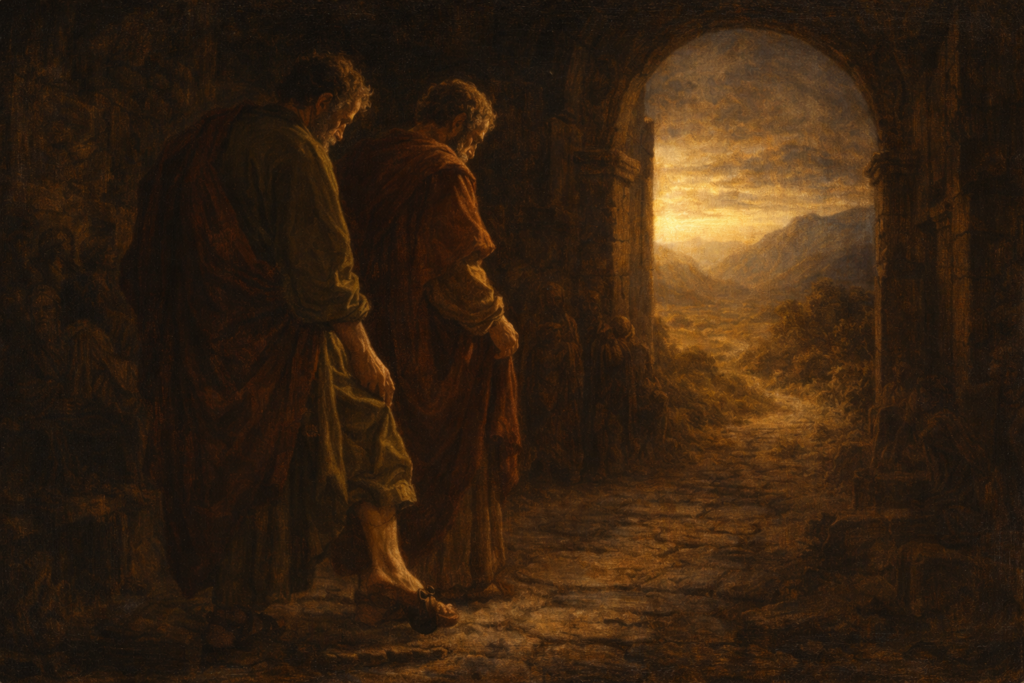
Acts 13:51-52 — Rejected, Yet Full of Joy
“But they shook off the dust from their feet against them and went to Iconium. And the disciples were filled with joy and with the Holy Spirit.” (Acts 13:51-52, ESV)
These are the final two verses of the chapter. Just before this, Paul and Barnabas had been persecuted and driven out by “the devout women of high standing and the leading men of the city.” Rejection that erupted the moment the first fruit of Gentile mission was just taking hold.
At first, this verse felt strange to me. Does it really make sense to be “filled with joy and with the Holy Spirit” right after being driven out? By the logic of emotion, it does not add up. Wouldn’t frustration, anger, or at the very least deep exhaustion be the normal response?
But when I read the source of this joy alongside verses 38-39, it finally made sense.
Let me look again at who drove Paul and Barnabas out. “Devout women of high standing and leading men of the city.” There is something painfully ironic here — devout people became the agents of persecution. I do not think these people resisted the gospel because they failed to understand it religiously. I think they resisted precisely because they understood it accurately. If Gentiles could be declared righteous by being held in Christ, without keeping the law — then the entire structure of “righteousness” they had built their whole lives upon was collapsing. Their religious identity, which had rested on being uniquely accepted by God, was being shaken at its very foundation.
So when Paul and Barnabas “shake the dust from their feet” in verse 51, I do not think it is a simple outburst of emotion. It is an act of obedience to what the Lord commanded his disciples when sending them out (Luke 9:5). At the same time, it is an act that protects the gospel of verses 38-39 as gospel, all the way to the end. If they had compromised in that place, if they had pulled back and said “you have the priority,” the gospel of 38-39 would have been damaged in that very moment. The gospel, it seems, is sometimes a gospel that must leave a place precisely in order to preserve itself as gospel.
The Joy of Those Who Were Left Behind
And then verse 52. “The disciples were filled with joy and with the Holy Spirit.”
The word “disciples” here is οἱ μαθηταί (hoi mathētai), and in context it refers to the new believers who were left behind in Pisidian Antioch. The apostles had departed. The persecution was still unfolding. Their spiritual leaders were gone. And yet these new believers of the Antioch church were rejoicing.
Where does this joy come from? Searching through my own daily experience, there have been many moments of joy because circumstances were good — when things worked out, when I was recognized, when I got what I wanted. But the experience of joy being sustained when circumstances collapsed has been very rare for me. My joy was tethered to my circumstances.
What allowed the disciples of verse 52 to rejoice may be that their identity was not rooted in their circumstances. They were people who had just received the gospel of verses 38-39. They had just grasped that the basis of their being declared righteous was not their own performance, but their being held in Christ. And if that is so, then neither persecution nor the departure of the apostles can shake that foundation. Because the foundation lies outside their circumstances.
And the grammar of verse 52 is striking. The verb translated “were filled” is ἐπληροῦντο (eplērounto), and it is passive. They did not manufacture joy themselves — they were filled with joy and the Holy Spirit. The justification in verses 38-39 was also passive — to be declared righteous, not to become righteous by oneself. Both the basis of the gospel and the fruit of the gospel follow the grammar of the passive voice. This must be remembered: what is given is what we receive.
Why Did the Rejected Disciples Rejoice? — A Closer Look
This is the question that rises most honestly in the reader’s heart when reading Acts 13: why did the rejected disciples rejoice rather than grieve? Two apostles had just been driven out. Persecution was ongoing. The new believers were left without their spiritual leaders. By every measurable external standard, this was a scene that called for mourning, not rejoicing.
One common answer is that “they were spiritually mature enough to rejoice in trials.” There is truth in this, but taken alone it risks turning joy into another performance metric — the more spiritual you are, the more you should be able to rejoice. This framing keeps us trapped in the very logic the gospel is meant to break. A more honest reading begins by noticing what the text does say. It does not say the disciples mustered up joy. It does not say they forced a brave face. It simply says they were filled — in the passive voice, from outside themselves.
I think this grammar is itself a theological statement. When Luke writes that the disciples “were filled with joy and with the Holy Spirit,” he is telling us that their joy was not a product of their spiritual effort. It was a gift received by people whose identity had just been relocated — from “accepted if I perform” to “already accepted in Christ.” The joy of verse 52 is the natural overflow of the justification of verses 38-39. If my being declared righteous rests outside my circumstances, then my joy can also rest outside my circumstances.
So the deeper question underneath “why did they rejoice?” is this: do I believe that the foundation of my acceptance before God is outside anything that can be taken from me? Acts 13 invites me to answer yes — not because I have arrived at unshakable spiritual maturity, but because the One who declares me righteous first declared the disciples of Pisidian Antioch righteous on the same ground.
When the Two Passages Are Placed Together
Seen this way, verses 38-39 and verses 51-52 are like the front and back of the same gospel. If 38-39 is the content of the gospel, then 51-52 is the result of the gospel. If 38-39 answers “why am I declared righteous,” then 51-52 shows “so what does my life become?”
And in both passages, the initiative is not in my hands. I am declared righteous; I am filled with joy and the Holy Spirit. These are not things I do. This is where I find deep relief. The same passive grammar — the same reality of being held by Another — appeared to me earlier in Acts 12, where Peter slept in prison and James fell to the sword. Both chapters keep pointing to the same truth: the foundation is not in my hands.
Instead, the gospel invites me to walk into the place of receiving. The place of being held in Christ, and opening myself to be filled there.
Questions for Reflection
- Where am I still performing to secure acceptance — before God, before others, before myself?
- Is my joy tied to the resolution of circumstances, or rooted in the fact that I have already been declared righteous in Christ?
- Are there places in my life where leaving is actually the form of obedience, precisely in order to preserve the gospel as gospel?
In My Daily Life
I am thinking today about how this passage should touch my everyday life.
Where am I still performing in order to be accepted? Where, before God and before people and even before myself, am I living by constantly scoring myself? That is the place where the gospel of 38-39 must be proclaimed again. I have already been declared righteous. This declaration must become the starting point of my performance, not the reward for it.
And is my joy still tethered to my circumstances? If the pattern of rejoicing only when things go well and collapsing whenever things break is repeating itself, it is a signal that my identity is still rooted somewhere outside of Christ. Like the disciples of verse 52 who were left behind, I must believe that there is a joy that fills even when external conditions are shaking. And I must pray for it.
Today’s Prayer
Lord,
Thank you for speaking the gospel to me again today through Acts 13.
I still often stand in the place of trying to earn your acceptance through my performance. There are many days when reading your Word, praying, and serving become not expressions of gratitude but solutions for my anxiety. To me in that place, the words of verses 38-39 become gospel again. Before the declaration that everyone who is held in Christ is declared righteous in every place the law could not reach — I lay myself down again.
I also confess that my joy is tied to my circumstances. To me, who rejoices only when things go well and collapses quickly before small setbacks — grant the joy of the disciples of Pisidian Antioch, who were filled with the Holy Spirit even in the place of being rejected. Let me experience not the joy I manufacture, but the joy you fill me with.
You have also taught me that there are places I must leave in order to preserve the gospel. When that time comes, grant me the bold obedience of shaking the dust from my feet.
In the name of our Lord Jesus Christ I pray. Amen.