
I sat down for my Acts 10 devotional this morning expecting a straightforward story about Peter meeting Cornelius. But as I read, I realized the entire chapter is driving toward a single question: “Can you stop what God has declared clean?” In front of that question, Peter’s lifelong convictions crumble, the door to the Gentiles swings open, and the Holy Spirit leaps ahead of every human procedure. I sat with this Acts 10 devotional for a long time.
“And the voice came to him again a second time, ‘What God has made clean, do not call common.’ This happened three times, and the thing was taken up at once to heaven.” — Acts 10:15-16 (ESV)
Acts 10 is widely regarded as one of the most pivotal turning points in the early church. In Caesarea lives Cornelius, a Roman centurion—a Gentile, but one who fears God, gives generously, and prays continually. An angel appears to him with instructions to summon Peter. Meanwhile in Joppa, Peter receives a vision from heaven. God is preparing both sides simultaneously. The precision of that timing is itself the message. That alone makes this Acts 10 devotional unlike any other chapter in Acts.
Peter’s Devout Refusal — The Prison of the Law
The verses I underlined were 10 through 16. Peter is praying on the rooftop, hungry, waiting for food. He falls into a trance: the heavens open, a great sheet descends, filled with animals the Jewish law forbids. God says, “Rise, kill and eat.” Peter’s response stopped me: “By no means, Lord; for I have never eaten anything that is common or unclean.”
My first instinct was that this was about obedience—God says eat, Peter refuses. But the more I thought about it, the more I saw a deeper layer. Peter wasn’t being rebellious. He refused because he had been so faithful to the law. “I have never eaten anything common or unclean” carries a note of pride. It’s a sentence loaded with a lifetime of devotion.
Yet God shattered that very frame of devotion. “What God has made clean, do not call common.” This was never about dietary laws. By verse 28, Peter himself understands: “God has shown me that I should not call any person common or unclean.” The animals in the sheet were symbols of the Gentiles—the people Jewish tradition had excluded. The paradox is striking: the very faithfulness that defined Peter was now blocking the expansion of the gospel. His devout refusal was, in truth, a prison built from the law. This is a pattern we also saw in Acts 4—the religious establishment rejecting what God was doing right in front of them.
Three Times: God’s Language of Finality

Verse 16 caught my eye: “This happened three times.” Why three? In Scripture, threefold repetition signals God’s irrevocable decree. In Genesis 41, Joseph interprets Pharaoh’s double dream as confirmation that God has firmly decided the matter. Three times goes even further. Think of Isaiah 6:3: “Holy, holy, holy.” It is the way God speaks when the decision is final and unalterable.
Peter refused once. He refused twice. And still God showed him again. God knew Peter’s resistance and met it with patience. This was a proclamation: “This is not about your feelings or your traditions. This is what I have decided.” The threefold repetition felt like grace to me — and it is one of the moments in this Acts 10 devotional that I keep coming back to.
The Holy Spirit Falls Before the Sermon Ends
The most stunning moment in this Acts 10 devotional, I think, is verse 44. Peter is preaching in Cornelius’s house, and while he is still speaking, the Holy Spirit falls on everyone who is listening. The Jewish believers who came with Peter are described as “amazed”—but this was not simple surprise. This was the shock of watching their entire worldview collapse in real time.
The order matters here. Baptism did not come first. The Spirit came first. These Gentiles had not completed any Jewish procedure. Yet God did not wait for the procedure to be finished. Acceptance came first; the ritual followed as a response. When Peter says in verse 47, “Can anyone withhold water for baptizing these people, who have received the Holy Spirit just as we have?”—he is not granting permission. He is belatedly acknowledging what God had already done. This moment echoes what we saw in Acts 2—the Spirit moving in ways no one expected.
It struck me that the principle “faith precedes understanding” operates in both directions here. On Cornelius’s side, the Spirit came before full comprehension. On Peter’s side, God acted before Peter was ready to accept it.
He Saw It All — And Still Said No
Here is what I find remarkable: Peter had already witnessed scenes like this. Jesus met the Samaritan woman. Jesus praised the Roman centurion’s faith. Jesus sought out every person the religious leaders had excluded. Peter watched all of it, right beside Him. And yet, when it was his turn, out came the words: “By no means, Lord.”
That, I think, is the terrifying power of legalism. You can know the gospel in your head, but the boundaries written into your body do not dissolve easily. That is why God repeated the vision three times and poured out the Spirit without waiting—an overwhelming confirmation. God did not wait for Peter’s understanding to catch up. He created the event first, and let Peter follow. When Peter finally confesses in verses 34-35, “Truly I understand that God shows no partiality, but in every nation anyone who fears him and does what is right is acceptable to him,” this is not a theological position he reasoned his way into. It is a confession he arrived at through lived experience—broken open by grace. In Acts 5, Gamaliel said, “If it is of God, you cannot overthrow it.” Here in Acts 10, we see exactly that—God’s plan moving forward, unstoppable. If there is a single takeaway from this Acts 10 devotional, it might be this: God does not wait for our readiness.
A Prayer to Close This Acts 10 Devotional
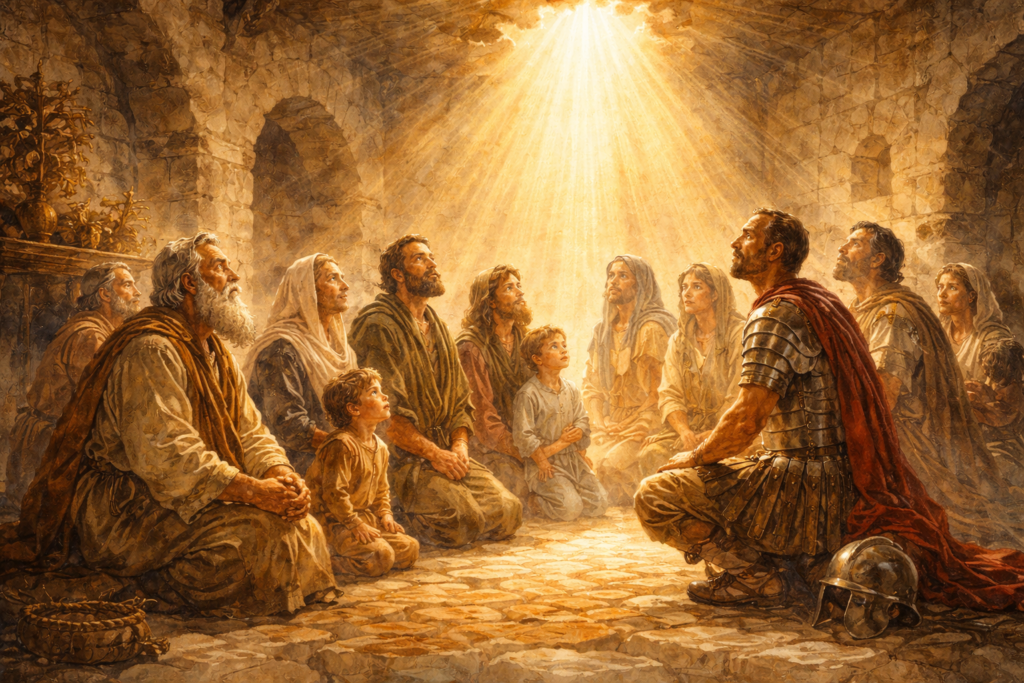
Lord, As I reflected on Acts 10 today, I found myself wondering whether I, like Peter, have been refusing Your new work from inside the fortress of my own devotion. The standards I have faithfully kept may have become walls that call “common” what You have made clean. Thank You for not waiting until my understanding is complete before You act. Open the closed doors within me, and keep me from rejecting those whom You have already received. Lead me today with the same patient love that showed Peter the vision not once, not twice, but three times. In the name of our Lord Jesus Christ I pray. Amen.
Acts Devotional Series
- Acts 1 – The Power to Be a Witness
- Acts 2 – On Resurrection Joy and a Lighter Heart
- Acts 3 Meditation — Holokleria and the Faith That Makes Whole
- Acts 4 Devotional — The Stone the Builders Rejected Became the Cornerstone
- Acts 5 Devotional — If It Is of God, You Cannot Overthrow It
- Acts 6&7 Devotional — God Does Not Dwell in Houses Made by Human Hands
- Acts 8 Devotional — The Heart That Tried to Buy Grace, and the God Who Crossed Every Barrier
Each morning I read one chapter of Scripture and reflect. I hope this Acts 10 devotional leaves a quiet resonance in your day as well