This morning I opened Acts 8 devotional. Persecution, scattering, a sorcerer named Simon, an Ethiopian eunuch — so much packed into a single chapter. As I read, two passages stopped me. One made me think, “Going through the motions isn’t enough.” The other made me ask, “Do I have Simon’s heart too?”
“Who came down and prayed for them that they might receive the Holy Spirit, for he had not yet fallen on any of them, but they had only been baptized in the name of the Lord Jesus.” — Acts 8:15-16 (ESV)
“But Peter said to him, ‘May your silver perish with you, because you thought you could obtain the gift of God with money!'” — Acts 8:20 (ESV)
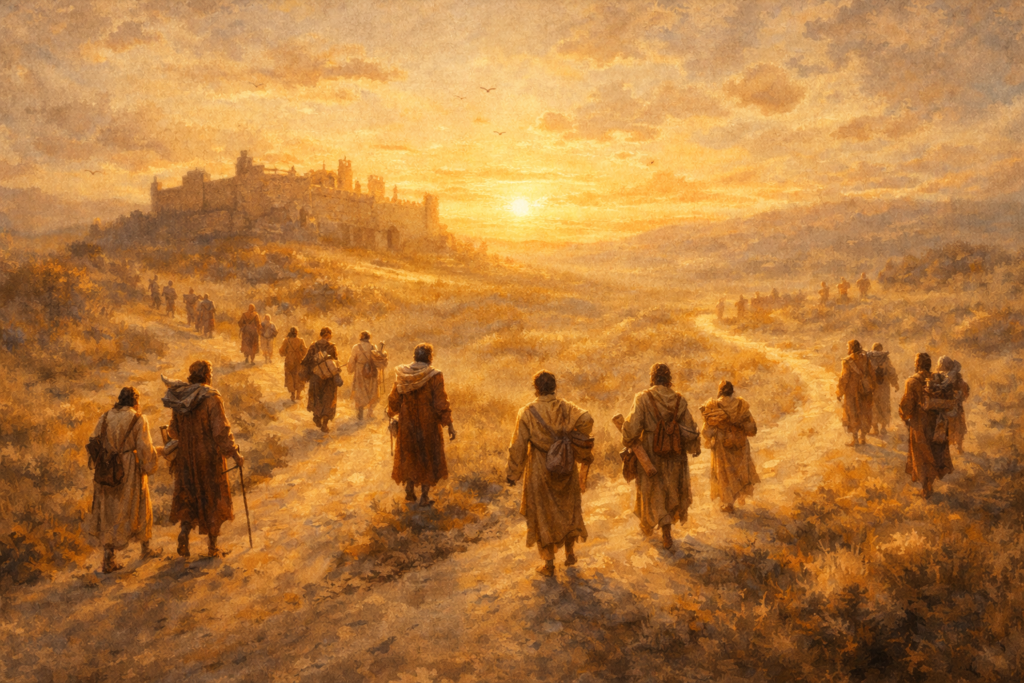
Acts 8 marks a decisive turning point: the gospel breaks out of Jerusalem. The roadmap Jesus gave before his ascension — “Jerusalem, Judea, Samaria, and to the ends of the earth” (Acts 1:8) — enters its “Samaria” phase here. What’s striking is how it happens. No one remembered the Great Commission and launched a strategic mission plan. Stephen was martyred, persecution erupted, and believers scattered. Flight became mission. (If you’d like to trace how the early church grew through the previous chapters, see my earlier reflections on Acts 5 and Acts 4.)
The Scattered Ones Who Preached
One detail in verses 1-4 caught my eye: the people who scattered and preached were not the apostles. The apostles actually stayed behind in Jerusalem (v. 1). Philip himself was one of the seven appointed in chapter 6 for distribution work — not an official missionary. Yet when he went down to Samaria and proclaimed Christ, the whole city was filled with “much joy” (v. 8). Gospel proclamation isn’t reserved for those with formal titles. Anyone scattered into an unexpected place can carry the word. Maybe the place where I feel displaced right now is exactly that kind of place.
Baptized but Without the Spirit
Verses 15-16 stopped me. The Samaritans had heard Philip’s gospel, believed, and been baptized — yet the Holy Spirit had not fallen on any of them. It took Peter and John coming down from Jerusalem, praying and laying on hands, before the Spirit came. “They had only been baptized” — that phrase unsettled me.
I’m told this passage shouldn’t be turned into a universal formula requiring a separate Spirit experience after baptism. In Acts itself the pattern varies: at Pentecost the Spirit came first (ch. 2), with Cornelius the Spirit fell during the sermon (ch. 10), and in Ephesus the Spirit came after the laying on of hands (ch. 19). Luke’s concern isn’t to establish a fixed sequence but to show how God works across new boundaries in each situation.
Still, the thought lingered: “Going through the motions isn’t enough.” Being baptized, attending church, tithing — are these forms giving me a false sense of security? Shouldn’t I be asking whether the reality of the Spirit exists beyond the form? There’s another layer too: given the centuries-old rift between Jews and Samaritans, the Jerusalem apostles personally going down to Samaria to lay hands on them was a public declaration — “You belong to the same body.” The gospel doesn’t just cross boundaries; it confirms unity on the other side.
Simon’s Attempt to Buy Grace — and Mine
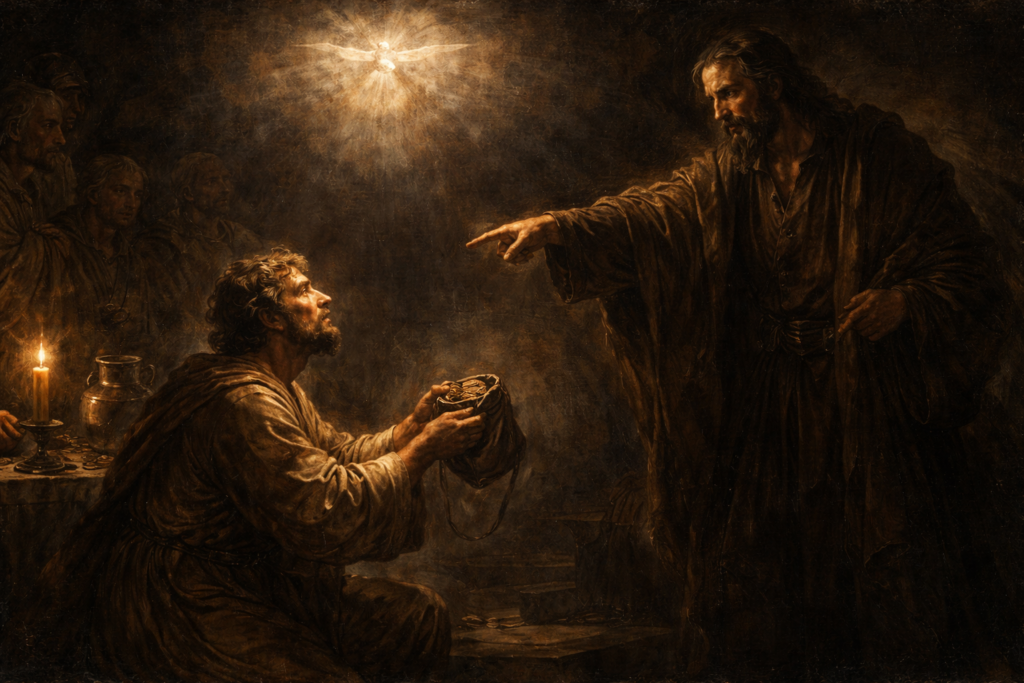
Verses 18-24 cut deeper. Simon the sorcerer had long been known in Samaria as “the power of God that is called Great” (v. 10). The text says he “believed and was baptized” (v. 13). But when he saw the Spirit given through the apostles’ hands, he brought money and said, “Give me this power also” (v. 19).
Peter’s response is fierce: “You thought you could obtain the gift of God with money!” The word for “gift” here is δωρεά (dōrea) — a freely given gift, no strings attached. That’s the essence of grace, and Simon tried to turn it into a transaction. Peter diagnosed the root: “Your heart is not right before God” (v. 21). Outwardly, Simon believed and was baptized. Inwardly, his operating system hadn’t changed.
Reading this, I had to ask myself: where is the Simon in me? It may not be money — but my effort, my diligence, my devotion, my streak of early-morning prayers… Have I been trying to earn God’s grace with these currencies? The unconscious ledger: “I’ve done this much, so I deserve that much in return.” In Tim Keller’s framework, this is precisely how legalism operates — converting grace from gift into transaction.
Whether Simon truly repented, the text doesn’t say. His last recorded words are “Pray for me to the Lord, that nothing of what you have said may come upon me” (v. 24). Is that genuine repentance or fear of punishment? Luke leaves the verdict open. Perhaps he’s asking me, the reader: “Which side are you on?”
The Man Beyond the Barrier: The Ethiopian Eunuch
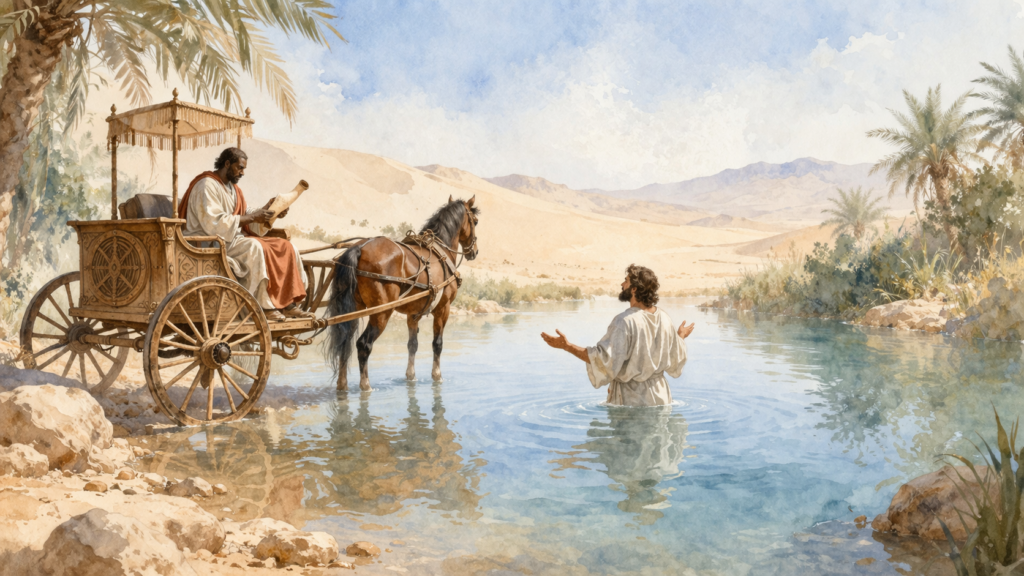
In verses 26-40 the scene shifts entirely. Philip, led by the Spirit, meets an Ethiopian eunuch on a desert road. This man occupied multiple layers of “outside.” He was a Gentile. As a eunuch (εὐνοῦχος, eunouchos), Deuteronomy 23:1 barred him from the assembly of the Lord. Yet he had traveled all the way to Jerusalem to worship and was reading Isaiah on his way home. Longing was there; the door was shut.
The passage he was reading was Isaiah 53 — “Like a sheep he was led to the slaughter…” Philip, starting from that very Scripture, told him the good news about Jesus (v. 35). When the eunuch saw water and asked, “What prevents me from being baptized?” (v. 36), the weight of that question hit me. By the law, plenty prevented him. But in the gospel, those barriers had fallen. This echoes a theme I keep encountering throughout Acts — the power God gives is never for our own prestige but for witness.
Here’s what fascinated me: just three chapters after Isaiah 53, Isaiah 56:3-5 promises the eunuch not a “dry tree” but “an everlasting name.” Luke almost certainly placed this connection deliberately. The excluded one being embraced — this is what the gospel crossing boundaries looks like in practice.
Samaritans, a sorcerer, a eunuch — every figure in Acts 8 stood outside the existing boundaries. Yet Simon, who considered himself inside, heard “You have neither part nor lot in this matter” (v. 21), while the eunuch, who was definitively outside, “went on his way rejoicing” (v. 39). The chapter quietly inverts the question of who is truly “in.”
A Prayer to Close This Acts 8 Devotional
Lord,
Reading Acts 8 today, I watched the gospel cross boundary after boundary that humans had drawn — into Samaria, onto a desert road, toward people we dared to call “outside.” You were already there ahead of us.
Lord, I confess: I have Simon’s heart. Even as a baptized, church-going believer, somewhere deep down I have thought I could purchase Your grace with my effort, my devotion, my consistency. That if I prayed enough I would earn the right to be answered, that if I served hard enough blessings would come back around. Expose the places where I have tried to turn Your δωρεά (dōrea, freely given gift) into a transaction.
Wake me from resting in mere form, and make me long for the reality of the Spirit beyond the waters of baptism. Let me experience a gospel that changes not just my beliefs but my operating system.
Show me, too, the invisible boundary lines inside me — the impulse to keep someone “out,” the arrogance of drawing a line and saying “they’re not ready yet.” Just as the eunuch asked “What prevents me?” let that same question confront every barrier I have built.
Help me remember that I stand before Simon’s open ending, and grant me the humility to say, today and every day, “Pray for me.”
In the name of our Lord Jesus Christ I pray. Amen.
Acts Devotional Series
- Acts 1 – The Power to Be a Witness
- Acts 2 – On Resurrection Joy and a Lighter Heart
- Acts 3 Meditation — Holokleria and the Faith That Makes Whole
- Acts 4 Devotional — The Stone the Builders Rejected Became the Cornerstone
- Acts 5 Devotional — If It Is of God, You Cannot Overthrow It
- Acts 6&7 Devotional — God Does Not Dwell in Houses Made by Human Hands
Each morning I read one chapter of Scripture and reflect. I hope today’s devotional leaves a quiet resonance in your day as well.
Pingback: Acts 12 Devotional — Two Kinds of Rescue in One Chapter
Pingback: Acts 16 Devotional: The Hidden Grammar of Grace