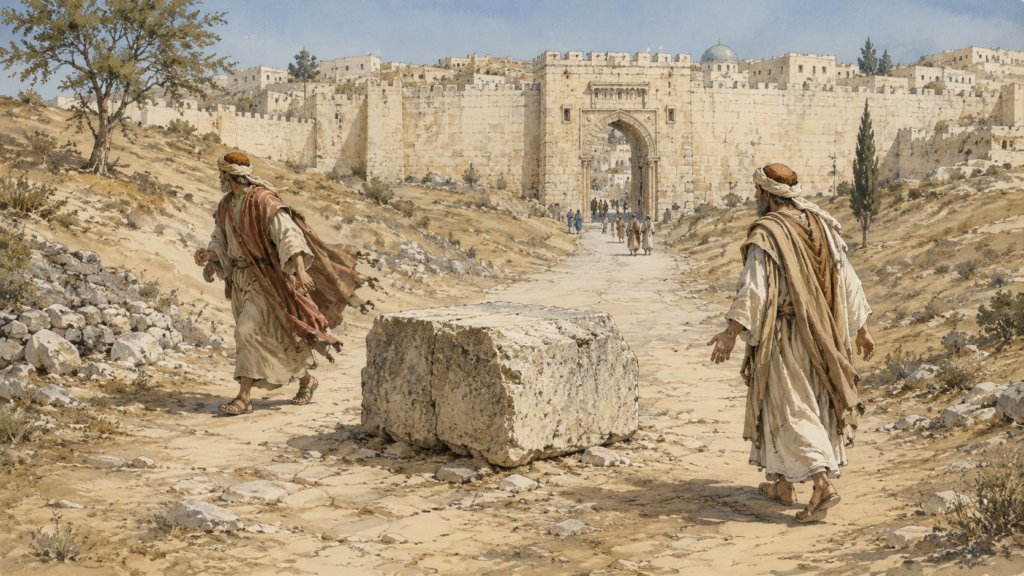
This morning’s Romans 9 devotional brought me to the chapter’s closing paradox, and at the center of it stands a single image: the stumbling stone. Israel ran hard after righteousness and missed it; the Gentiles, who were not even chasing it, received it. The reason Paul gives is unsettling, because the stumbling stone he describes was placed deliberately — and the people most committed to their own effort were precisely the ones who tripped over it. I have spent enough mornings tripping over the same stone to want to look at this closely.
“What shall we say, then? That Gentiles who did not pursue righteousness have attained it, that is, a righteousness that is by faith; but that Israel who pursued a law that would lead to righteousness did not succeed in reaching that law. Why? Because they did not pursue it by faith, but as if it were based on works. They have stumbled over the stumbling stone, as it is written, ‘Behold, I am laying in Zion a stone of stumbling, and a rock of offense; and whoever believes in him will not be put to shame.'” — Romans 9:30-33 (ESV, via BibleGateway)
Where the Stumbling Stone Sits in Romans 9
Romans 9 moves through five sections and arrives here, at verses 30-33, its conclusion. After the grief of verses 1-5, the principle of promise in 6-13, sovereign mercy in 14-18, and the potter and the remnant in 19-29, Paul now compresses the whole chapter into a single historical result: two peoples, two outcomes, one stone between them. The abstract theology of the earlier sections becomes concrete here. The stumbling stone is where the doctrine meets the road.
The Runner Who Missed and the One Who Wasn’t Running
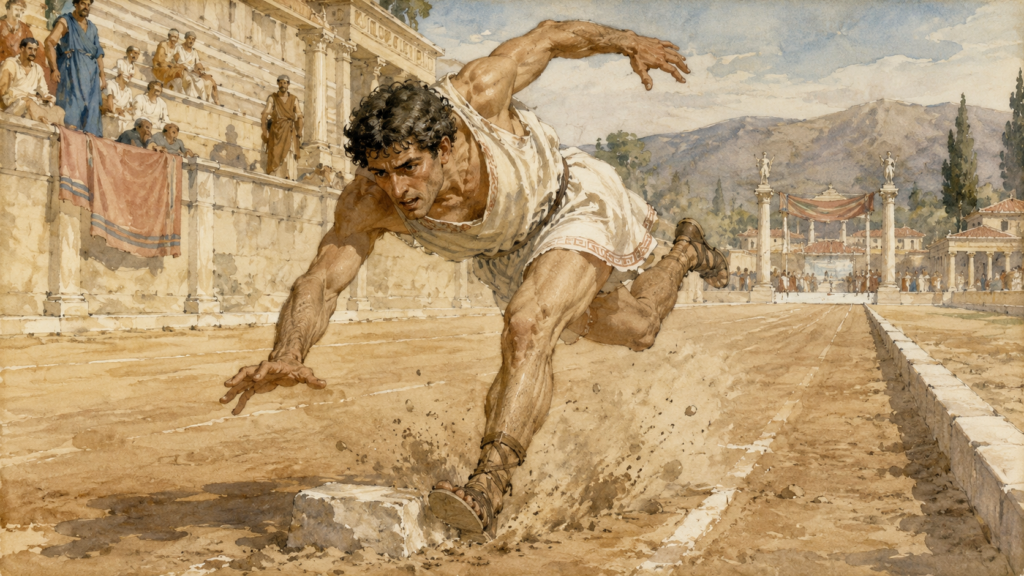
The picture in verses 30-31 is genuinely shocking. The Gentiles who did not pursue righteousness attained it; Israel, who pursued the law of righteousness, did not reach it. The normal relationship between effort and outcome has been turned upside down.
I wanted to dig into the verb Paul uses for Israel. It is διώκω (diōkō), to pursue, to chase, to hunt down — the word for a hunter after prey or a runner driving toward the finish line. It is the same energetic register as the “running” of verse 16. Israel was not lazy. Israel was the opposite of lazy; Israel was zealous. And that zeal is exactly what caused the stumble. The one running hard missed; the one not running received. Effort, here, was not the solution. (Blue Letter Bible traces diōkō and its intensity across Paul’s letters.)
Not from Faith, but as If from Works
Verse 32 gives the reason: “Because they did not pursue it by faith, but as if it were based on works.” The contrast in the Greek is between ἐκ πίστεως (ek pisteōs), from faith, and ἐξ ἔργων (ex ergōn), from works. It is a question of starting point — of where righteousness is sourced.
Israel’s tragedy was not that the law was wrong, but that their approach to the law was wrong. The law was originally given inside a covenant that began with grace: God redeemed Israel out of Egypt first, and then gave the law at Sinai. The law was guidance for a people already redeemed — “how shall those who are already mine now live?” — not a condition for becoming His. But Israel reversed the order. They turned the law, which was meant to be a response to grace, into a means of securing it. The same deeds can point in opposite directions depending on where they start.
The Stone Laid in Zion — Where Self-Made Righteousness Trips
Verses 32-33 compress that stumble into one image. “They have stumbled over the stumbling stone… ‘Behold, I am laying in Zion a stone of stumbling.'” The quotation fuses Isaiah 8:14 and 28:16, and the striking detail is that God Himself lays the stone — the verb is τίθημι (tithēmi), to place, to set deliberately. The stumbling stone did not roll into the road by accident. God set it in Zion on purpose. And that stone is Christ.
This connects directly to where the chapter’s mercy was heading. In the Romans 9 devotional on the God who has mercy, verse 16 said that salvation depends “not on human will or exertion, but on God, who has mercy.” How did that mercy become concrete in history? By laying Christ as a stone in Zion. The way of salvation is not something I chase down and seize; it is the One God placed in the middle of the road, whom I meet almost by collision.
I think Israel stumbled not merely because they pursued by works, but because they got snagged on themselves. A person trying to earn righteousness ends up bound to their own righteousness; what they have built becomes their identity. So when they stand before the stumbling stone who is Christ, receiving Him would mean admitting that everything they have piled up counts for nothing — and that is unbearable. They have run too far. They have stacked too much.
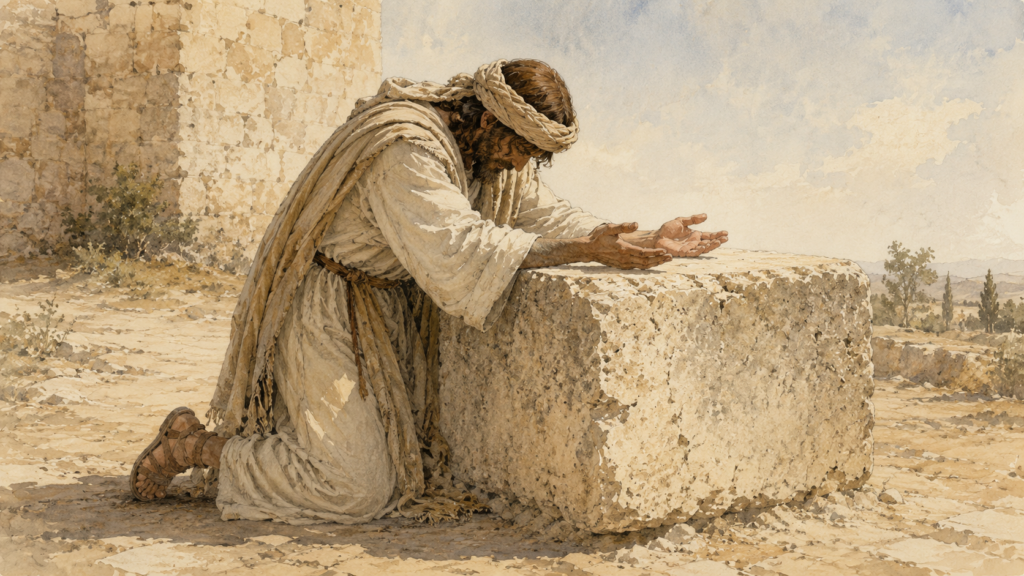
The Gentiles, by contrast, had not been running, so they had nothing to lose. Their hands were empty. And so when they came to the stumbling stone laid in Zion, they could simply take hold of Him — without shame, without regret. That empty-handedness is the same posture I traced in the Romans 9 devotional on the children of the promise, where belonging was never produced by what we bring but received from outside ourselves.
The Two Faces of Self-Made Righteousness
What makes this passage so searching is that the impulse to earn righteousness wears two faces — the face it shows on good days and the face it shows on bad ones.
On a good day, when I have made it to morning prayer, kept up my Scripture reading, and shown some real kindness to someone, a quiet satisfaction rises in me: today I was a decent Christian. That satisfaction is itself a form of self-righteousness. It is the moment my performance, rather than Christ, becomes the ground of my identity.
On a bad day, when prayer is dry and Scripture is silent and I have fallen into the same sin again, something collapses: I am unworthy. That collapse is also a face of self-righteousness. Because for me to feel I have fallen, there had to be somewhere in me a place expecting an un-fallen version of myself. That expectation is the very thing the stumbling stone exposes.
So self-made righteousness shows up as pride and as despair at once. Both have their gaze fixed on the self rather than on Christ — the same root, two expressions. And both are undone the same way: by moving the gaze off the self and onto Christ. On a good day, returning to “this righteousness is not mine but Christ’s”; on a collapsed day, returning to “the place where my righteousness fails is the place where Christ’s righteousness shows.” The direction is identical in both cases — away from self, toward the stumbling stone who turns out to be the cornerstone.
Martin Luther’s line came back to me here — that the whole life of a Christian is one of repentance. Repentance is not a single turning from sin but a daily turning from self-made righteousness, fleeing again to the righteousness of Christ. Not the place where yesterday’s good day lets me rest secure today, but the place where even yesterday’s good is set down again before Him this morning. The stone laid in Zion is not a stone you meet once; it is a stone you meet again every day.
I would not want this to be misheard as a reason to despise effort, or to stop running altogether. The point is not laziness. The point is where the running starts. So the honest practice for today might be this: to notice both the quiet satisfaction of a good day and the quiet self-condemnation of a hard one, and to recognize that both are looking in the wrong direction — and then to look, again, at the stone.
Frequently Asked Questions
Q: What is the stumbling stone in Romans 9:33? A: The stumbling stone in Romans 9:33 is Christ. Paul fuses Isaiah 8:14 and 28:16 to show that God deliberately laid this stone in Zion. Those pursuing righteousness by their own works stumbled over Him, because receiving Him meant surrendering what they had built; those who came empty-handed simply took hold of Him.
Q: Why did Israel stumble while the Gentiles received righteousness? A: According to Romans 9:30-32, Israel pursued righteousness “as if it were based on works” rather than by faith, and so stumbled over the stumbling stone. The Gentiles, who were not pursuing righteousness by effort, had empty hands and could receive the righteousness that comes by faith. The issue was not zeal but the starting point of that zeal.
Q: What does it mean that self-made righteousness has two faces? A: Self-made righteousness shows up as pride on good days (“I was a decent Christian today”) and as despair on bad days (“I am unworthy”). Both keep the gaze fixed on the self rather than on Christ, so both are forms of the same root. Both are healed by looking away from self and back to the stumbling stone who became the cornerstone.
A Prayer to Close This Romans 9 Devotional
Lord, this morning You showed me the place I trip most often. The quiet satisfaction of a good day and the quiet self-condemnation of a hard one are both, I see now, faces of a righteousness I am trying to build myself — both looking at me rather than at You. Let the stumbling stone You laid in Zion be the place I stop today. Keep me from sidestepping Him with the righteousness I have stacked up, and let me stand before Him empty-handed and take hold. Remind me that repentance is not only turning from sin but turning from my own righteousness, and let me rest this whole day in Yours alone. In the name of our Lord Jesus Christ I pray. Amen.
About the Author
Each morning I read one chapter of Scripture and reflect on its resonance in daily life. Writing from the perspective of a layperson rather than a trained theologian, I trace how the ancient text still meets us today.
📖 Learn more: About the Author