This morning’s Romans 9 devotional took me into the most misread image in the whole chapter: the potter and the clay. The picture is often quoted as if it slams a door — as if its only message were that the clay has no business questioning the hand that shapes it. But when I slowed down and read verse 21 together with verses 22 through 24, the door I expected to slam swung open instead. The potter and the clay turns out to be less a verdict than an invitation.
“Has the potter no right over the clay, to make out of the same lump one vessel for honorable use and another for dishonorable use? What if God, desiring to show his wrath and to make known his power, has endured with much patience vessels of wrath prepared for destruction, in order to make known the riches of his glory for vessels of mercy, which he has prepared beforehand for glory— even us whom he has called, not from the Jews only but also from the Gentiles?” — Romans 9:21-24 (ESV, via BibleGateway)
Where the Potter and the Clay Sits in Romans 9
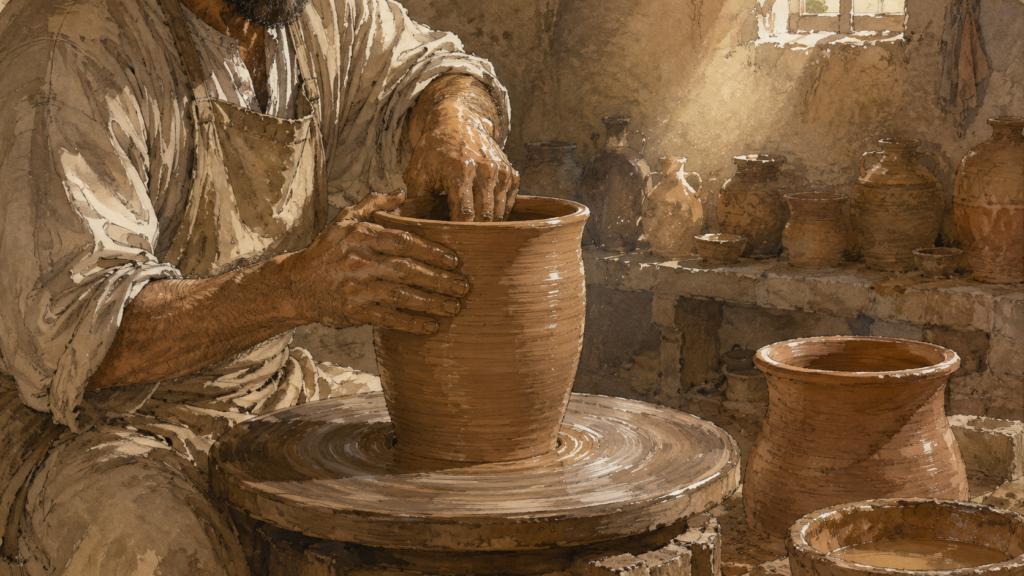
Romans 9:19-29 is Paul’s answer to a second objection: “Why does he still find fault? For who can resist his will?” (verse 19). His response is the potter image. But the crucial thing I kept noticing is that the image does not end at verse 21. It runs all the way to verse 24, and the destination changes how the whole picture reads. If you stop at verse 21, the potter and the clay sounds like raw sovereignty. If you read to verse 24, it becomes something far warmer.
Where the Image Comes From — A Hand That Reshapes
I wanted to dig into where this metaphor originates, because Paul did not invent it. The potter and the clay appears repeatedly in the Old Testament — Jeremiah 18, Isaiah 29:16, Isaiah 45:9. And these passages share a common setting: each one appears when Israel is resisting God’s shaping and going its own way.
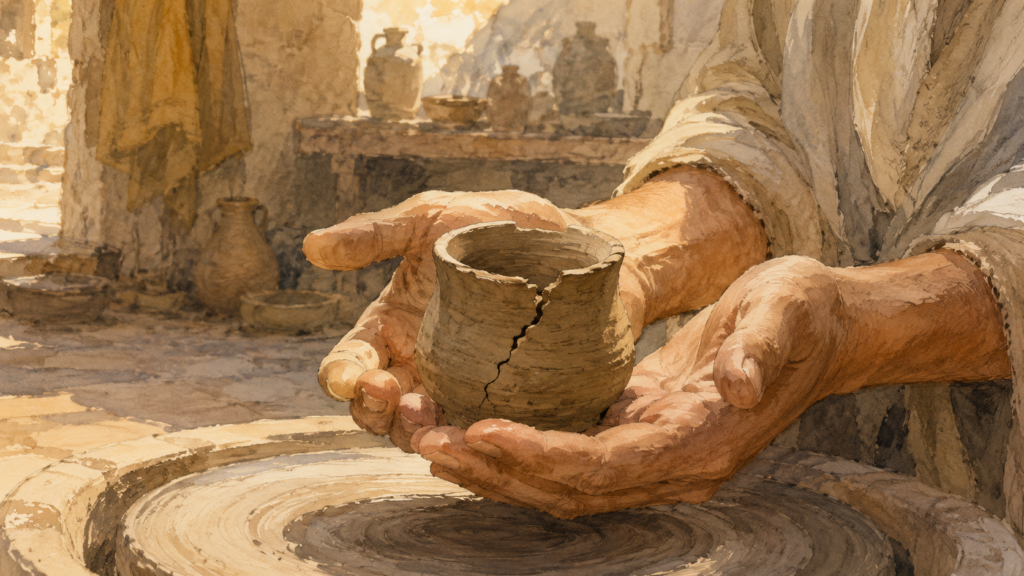
Jeremiah 18 is especially worth revisiting. There, the potter is working a lump of clay, and when the vessel is spoiled in his hand, he reshapes it into another vessel, “as it seemed good to the potter to do” (Jeremiah 18:4). The potter’s hand is not a hand that makes one decision and walks away. It is a hand that reworks broken clay. That is not the image of a cold determinism. It is an image of restoration. (Blue Letter Bible traces the Hebrew potter language across these texts.)
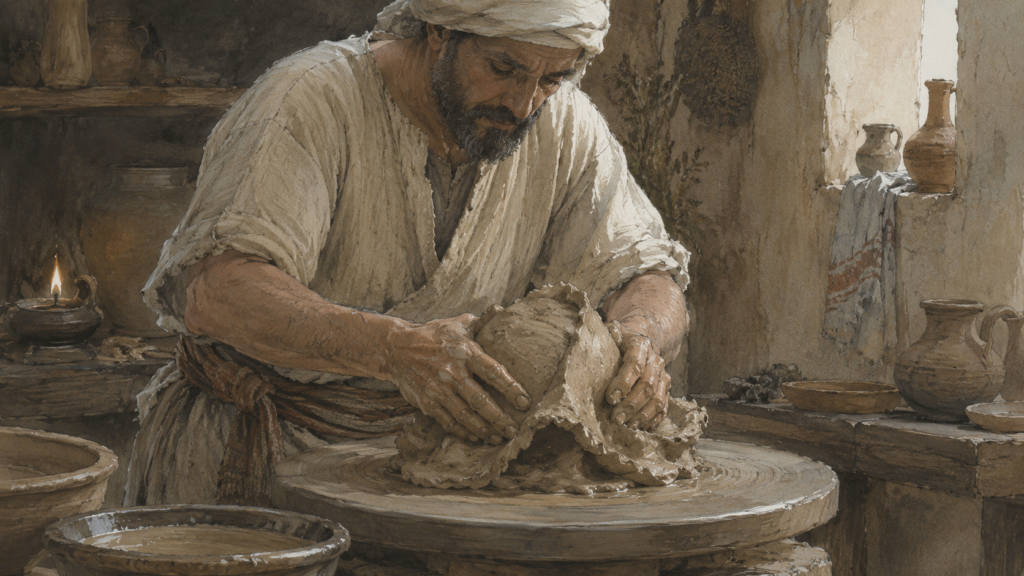
Reading verse 21 with that background, “Has the potter no right over the clay?” stops sounding cold. The hand that holds the clay is not a hand that fires and discards; it is a hand that reshapes what has broken. The frightening thing was never that I am clay in someone’s hand. The only question that matters is whose hand it is.
Vessels of Wrath, and the Patience That Holds Them
Following verses 22 through 24 slowly, I noticed something I had skimmed past for years. In verse 22 Paul names “vessels of wrath prepared for destruction.” And then comes the unexpected phrase: God “has endured with much patience” even these.
The Greek behind “patience” is μακροθυμία (makrothymia) — from makros (long) and thymos (temper, passion). Literally, a “long temper,” a long-suffering of heart. Toward the vessels of wrath, God stretches His own heart out long. He does not detonate immediately. He does not destroy at once. He gives time.
That one word colors the entire potter-and-clay image. If the potter were only a hand of cold decision, the vessels of wrath would shatter the moment they were formed. But the potter Paul describes holds even the vessels of wrath with a long patience. I thought of 2 Peter 3:9 — that God is “patient toward you, not wishing that any should perish, but that all should reach repentance.” The same makrothymia runs through both.
Vessels of Mercy — and the Gentiles Inside Them
Verse 23 shifts the weight. God acts “in order to make known the riches of his glory for vessels of mercy.” The Greek here is σκεύη ἐλέους (skeuē eleous), vessels of mercy — and that noun ἔλεος (eleos) is the very same root I sat with in the Romans 9 devotional on the God who has mercy. The true exit of the potter-and-clay image is mercy. The potter is long-patient toward the vessels of wrath and pours out the riches of glory upon the vessels of mercy. Both vessels stand under the shadow of the same mercy.
And then verse 24 lands the point I had missed: “even us whom he has called, not from the Jews only but also from the Gentiles.” Look at where the potter image travels. It moves toward the formation of a new people that crosses the boundary of bloodline. Verse 21 was never merely about a hand that fixes fates; it was about a hand shaping Jews and Gentiles together out of one lump of clay.
This connected back to the question the whole chapter is asking — why did Israel, the people of promise, largely refuse, while Gentiles outside the promise received? The answer was hidden inside the potter image all along. The potter shapes across the boundary of lineage, forming the vessels He chooses to form. The potter and the clay, read all the way to its end, turns out to be a picture of inclusion rather than exclusion. The same theme of belonging by promise rather than by birth runs through the Romans 9 devotional on the children of the promise, where bloodline never produced the family in the first place.
Surrendering to the Hand vs. Falling Silent Before It
If the potter and the clay is read in a purely deterministic way, one danger creeps in: it can slide into a theology of resignation — “I am clay, so I must fall silent.” But read in the light of verses 22 through 24, the message is not resignation but trust — “I am clay, so I entrust myself to His hand.” Falling silent and opening your hands are not the same gesture. One is surrender as defeat; the other is surrender as entrustment.
This distinction shapes the ordinary texture of faith. The person who only falls silent carries faith as a weight, bowing before an unknown fate. The person who opens their hands carries faith more lightly, entrusting themselves to One who knows them better than they know themselves. The very same passage produces opposite outcomes depending on which posture reads it.
I would not want this to be misheard as passivity. Entrusting myself to the potter is not doing nothing. It is the active, daily choice to bring what is broken in me back to the hand that reshapes, rather than hiding it or trying to fire it hard myself.
So perhaps that is the practice for today. If there is something broken in me this morning, I want to set it back on the potter’s wheel rather than conceal it — remembering that the hand holding the clay is the hand that reworks what has broken into something it was always meant to be.
Frequently Asked Questions
Q: What does the potter and the clay mean in Romans 9:21? A: The potter and the clay is an Old Testament image (Jeremiah 18; Isaiah 29:16; 45:9) that Paul uses to describe God’s right to shape His people. Read alongside Romans 9:22-24, the image is not primarily about cold determinism but about a hand that reshapes broken clay and forms vessels of mercy — including both Jews and Gentiles.
Q: Who are the “vessels of mercy” in Romans 9:23? A: The vessels of mercy (skeuē eleous) are those on whom God makes known the riches of His glory. Verse 24 identifies them as “us whom he has called, not from the Jews only but also from the Gentiles” — a new people formed across the boundary of bloodline, shaped by the potter’s mercy rather than by lineage.
Q: Does Romans 9 teach that God has no patience toward the “vessels of wrath”? A: The opposite. Romans 9:22 says God “endured with much patience” the vessels of wrath. The Greek makrothymia means a long-suffering, a stretching-out of heart. Even within this difficult passage, the potter is shown holding the vessels of wrath with patience rather than destroying them at once.
A Prayer to Close This Romans 9 Devotional
Lord, I confess I have often read the image of the potter and the clay with fear, as if Your hand were only a hand of cold decision. But this morning You showed me a hand that is long-patient even with the vessels of wrath, a hand that reshapes what has broken, a hand that formed vessels of mercy out of both Jew and Gentile and somehow included one like me. Teach me to entrust myself to that hand — not to fall silent in defeat but to open my hands in trust. Where something in me is broken today, let me set it back on Your wheel rather than hide it. In the name of our Lord Jesus Christ I pray. Amen.
About the Author
Each morning I read one chapter of Scripture and reflect on its resonance in daily life. Writing from the perspective of a layperson rather than a trained theologian, I trace how the ancient text still meets us today.
📖 Learn more: About the Author