This morning I sat down for my Acts 6&7 devotional and read the story of Stephen. The whole time, something heavy settled in my chest — and yet, at the same time, a strange clarity. I underlined several verses, and as I sat with them, I realized they were all telling the same story.
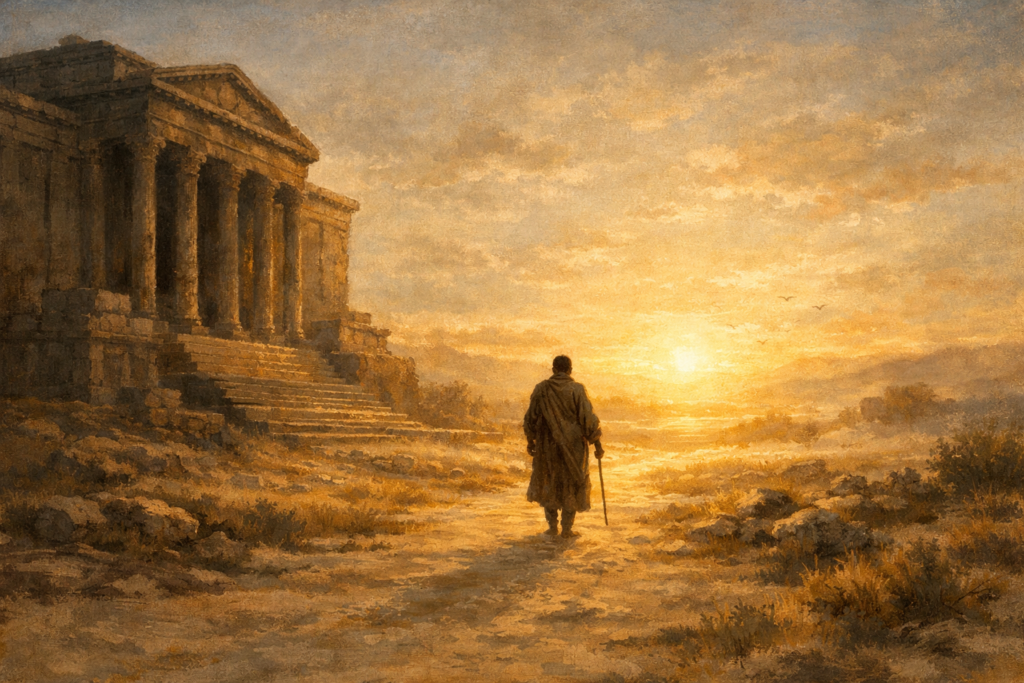
Why the Word Cannot Be Set Aside
Chapter 6 opens with a problem in the early church. The Hellenistic widows were being overlooked in the daily distribution of food. Complaints were rising. Tension was building. It seemed obvious — the apostles should step in and fix it.
But their response surprised me.
“It is not right that we should give up preaching the word of God to serve tables… We will devote ourselves to prayer and to the ministry of the word.” (Acts 6:2–4)
At first glance, this could feel cold. People are going hungry, and you’re prioritizing sermons? But the more I thought about it, the more the logic came into focus. The sharing that defined the early church — described back in Acts 2:42–45 — wasn’t a social program. It was the overflow of people who had been transformed by the word. If the root dries up, the fruit disappears.
What also caught my eye was that the apostles didn’t try to do everything themselves. They appointed seven people full of the Spirit and wisdom to handle the practical work. They stayed in their own lane — prayer and the word — and trusted God to work through the whole community. It’s a picture of what Korean author Lee Kang-rak calls taryeok (他力) — relying not on your own capacity, but on God’s power. Not doing more, but abiding where you’ve been placed.
If you’re following along with this Acts series, this connects to what we explored in Acts 5 — the idea that God’s work cannot be overthrown by human effort, and our job is to stay faithful in our given role rather than trying to control outcomes.
The God Who Does Not Dwell in What We Build
Chapter 7 is Stephen’s sermon. He traces Israel’s history from Abraham to Moses to David to Solomon — a long, winding journey through the Old Testament. At first I wondered why he was giving a history lecture in front of a hostile court. Then I reached the end, and the point hit me like a thunderbolt.
“The Most High does not dwell in houses made by human hands.” (Acts 7:48)
I felt a shiver reading this. Stephen said this standing before the Sanhedrin — people whose entire identity was built around the temple. And he told them, plainly, that God is not contained within it.
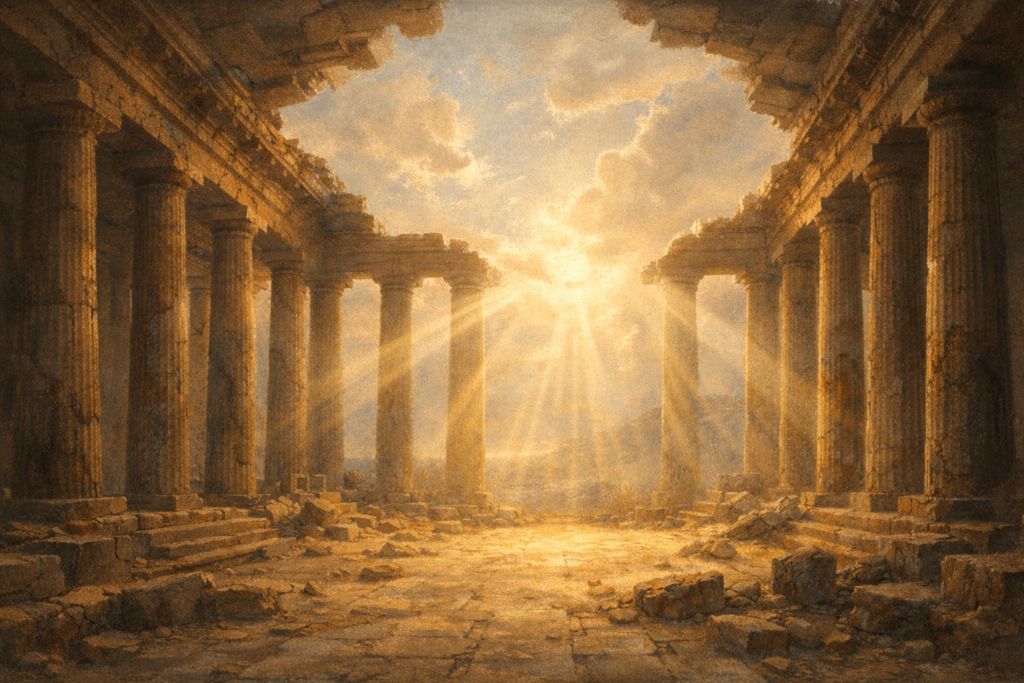
That’s why he walked through all that history. God kept moving, kept coming, kept speaking — but the people kept trying to pin Him down. The tabernacle in the wilderness became the temple. The temple became a symbol of power. And the form that was meant to honor God became the cage that confined Him.
This is what struck me most deeply in today’s Acts 6&7 devotional. We try to contain God within our own forms and methods, but that impulse — however sincere at the start — is ultimately a human desire. And over time, we become captive to the form itself. The form becomes the point. Keeping the form makes us righteous. This is exactly what Tim Keller calls moralism — the inversion where “I have done enough, so God must accept me.”
It’s the same thing Jesus confronted throughout the Gospel of John. The Pharisees who valued Sabbath rules over a healed man. The merchants who turned the temple into a marketplace. In every case, a form that was meant to point toward God became a form emptied of God.
The direction, I realized, is reversed. We don’t house God — God calls us to dwell in Him. When Jesus said “Abide in me” (μένω, menō — to remain, to dwell) in John 15, He was saying the same thing. Stop trying to fit God into the structures you build. Instead, take your place in the dwelling He has prepared. That is the direction of faith.
This recalls what we saw in the early chapters of Acts — how the apostles in Acts 4 discovered that the stone the builders rejected became the cornerstone. The builders tried to construct on their own terms; God’s foundation was something else entirely.
A Prayer Under the Stones
Stephen’s sermon enraged the Sanhedrin. They dragged him out and stoned him. But his final words stopped me cold.
“Lord, do not hold this sin against them.” (Acts 7:60)
The same man who had just called them “stiff-necked people, uncircumcised in heart and ears” — that man, as stones crushed him, prayed for the forgiveness of his killers. It’s almost identical to Jesus on the cross: “Father, forgive them” (Luke 23:34).
How can uncompromising truth and dying forgiveness exist in the same person, in the same breath? I think there’s only one answer. It wasn’t because Stephen was an extraordinary man. It was because he was abiding in Christ. The μένω (menō, abiding) of John 15 — Stephen showed what it looks like in real life, right up to his last breath.
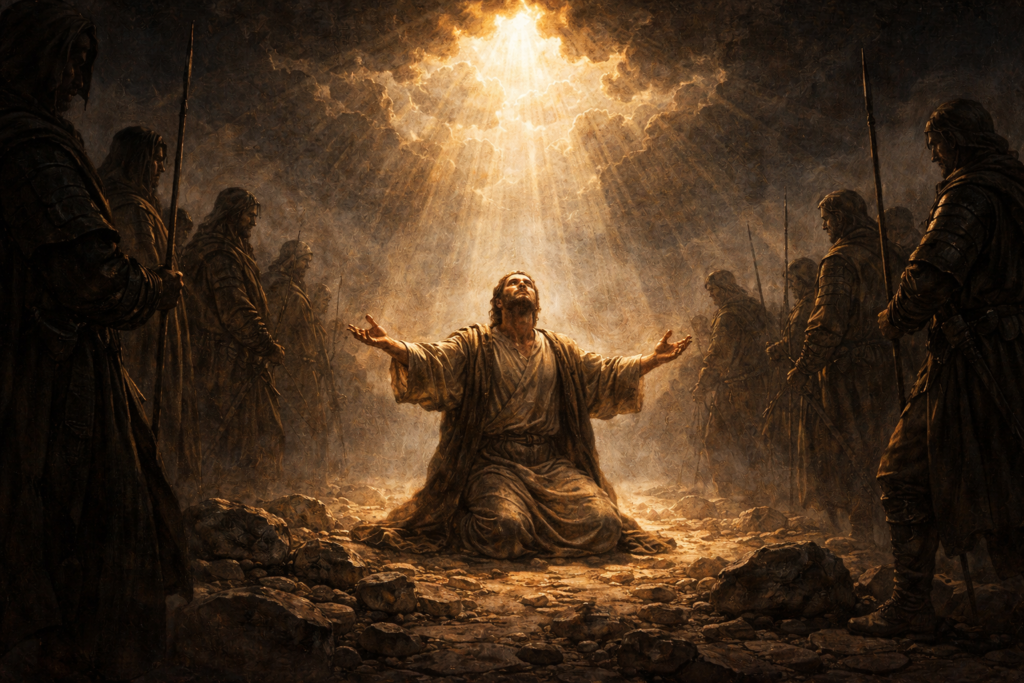
Before the very people who tried to lock God inside a building, Stephen testified with his death to what it means to dwell inside God. From that abiding came his boldness. From that abiding came his forgiveness.
Today, I
Since this post was written last Sunday, it includes a prayer that is no longer relevant at the time of publication. I appreciate your understanding.
Today is Sunday. I’m going to church. I’ll sing, listen to a sermon, and pray.
But after reading Stephen’s story, I find myself asking: Am I trying to contain God within my own forms, or am I dwelling in Him? Has the form of worship become the goal itself? In my work, too — am I trying to bring God into the framework of my plans and strategies, or am I stepping into the place where He is already at work?
I need to turn the direction around. Stop trying to fit God into what I build. Start abiding in the place He has already made. That is taryeok. That is menō. That is the faith Stephen demonstrated with his life.
Lord, I confess that so many times I have tried to contain You within things I have built — my plans, my forms, my methods. I thought that was faith. But today, through Stephen, I see it clearly: You do not dwell in what I construct. Rather, You call me to dwell in You. I turn the direction around. Let today’s worship, and this week’s work, flow not from my own strength but from abiding in You. Let me grow, even a little, toward the fruit that Stephen bore to his very last breath — boldness and forgiveness, both flowing from that abiding. In the name of Jesus Christ I pray. Amen.
Pingback: Acts 9 Devotional — Unfathomable Calling & Change
Pingback: Acts 17 Devotional — The Hidden God Who Is Already Near
Pingback: Acts 19 Devotional — The Hidden Mirror of Demetrius