This Acts 3 meditation explores one of the most vivid healing stories in the New Testament — and the extraordinary Greek word hidden inside it. At the Beautiful Gate of the temple, a man who had never walked receives far more than he asked for, and Peter reveals that even the faith behind the miracle was not his own.
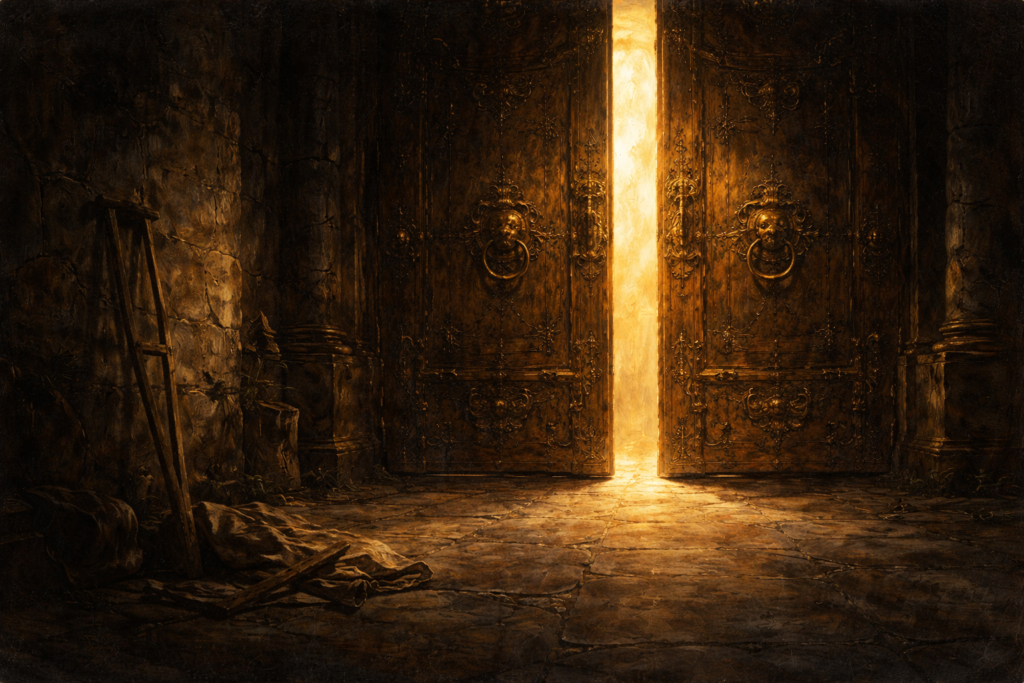
“Silver and gold I do not have, but what I have I give you. In the name of Jesus Christ of Nazareth, rise up and walk.” (Acts 3:6)
“By faith in his name, his name has made this man strong whom you see and know, and the faith that is through him has given him this perfect health in the presence of you all.” (Acts 3:16)
The Most Unbeautiful Seat Before the Beautiful Gate
The Beautiful Gate. The name says it all. And every day, a man was laid at its entrance. He had been unable to walk since birth. Someone carried him there each morning, set him down, and he begged from those entering the temple.
The irony of this scene is easy to miss. He was at the closest possible distance to the house of God. Every single day. Yet he had never once entered. The Beautiful Gate was not beautiful to him. It was a boundary he could not cross.
A man sitting at the threshold of God’s presence but unable to step inside. Placed in the same spot each day, asking for the same thing. Right next to the sacred, yet permanently excluded from it.
Is this only the story of a man who could not walk?
“Silver and Gold I Do Not Have” — What Peter Actually Gave
Peter and John go up to the temple. The man begs from them, as he does from everyone. To him, they are just two more faces in the passing crowd.
But Peter stops. “Look at us” (v. 4). And then:
“Silver and gold I do not have, but what I have I give you.”
What the man expected was a few coins. What the world could offer. What he asked for every day. But Peter gives him something he never thought to ask for.
The phrase “what I have” deserves attention. Peter does not stand here as a man commanding from his own power. He stands as someone passing along what he has received. The power promised in Acts 1:8, the Spirit that came at Pentecost in Acts 2 — that power now flows into the life of one man at a gate.
“In the name of Jesus Christ of Nazareth, rise up and walk.”
And he rose.
Walking, Leaping, Praising, Entering
The description in verse 8 is striking. “Walking and leaping and praising God, he entered the temple with them.”
Luke records four movements in rapid succession. Walking — leaping — praising — entering. This is not simply a healed man’s excitement. This is a man who spent his entire life outside the temple stepping inside for the very first time.
The Beautiful Gate is no longer a boundary. He passes through it and stands in the presence of God. Beyond physical healing, a restoration of his entire being has taken place.
Acts 3 Meditation on Holokleria — Made Perfectly Whole
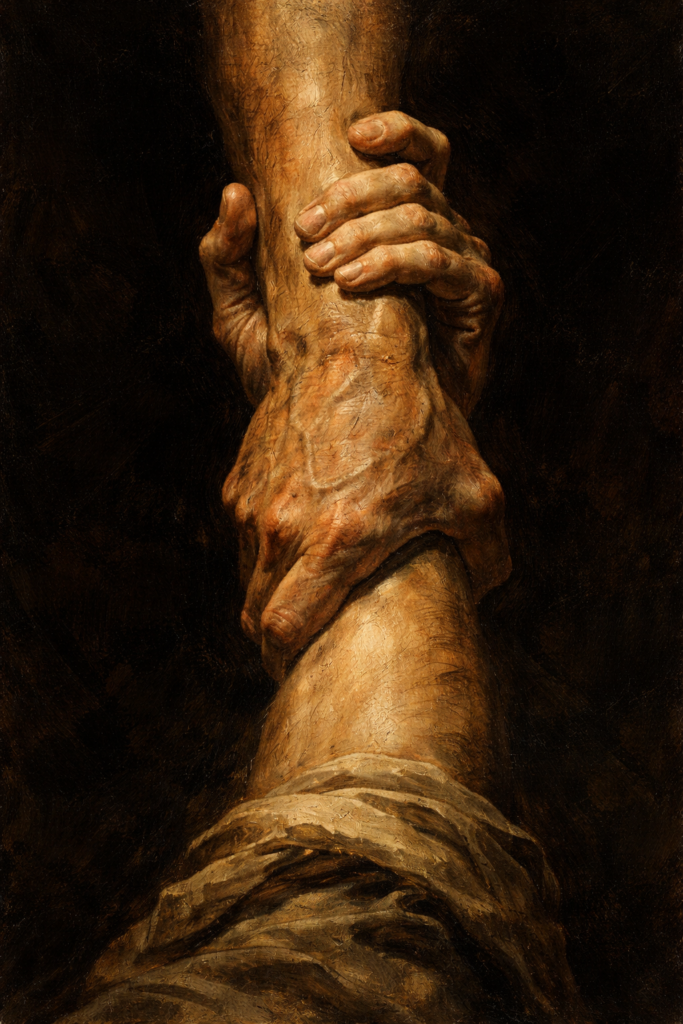
After the miracle, a crowd gathers in astonishment. They stare at Peter and John. Peter immediately redirects their gaze.
“Why do you stare at us, as though by our own power or piety we have made him walk?” (v. 12)
Then in verse 16, he reveals the true cause of the healing.
“By faith in his name, his name has made this man strong … and the faith that is through him has given him this perfect health in the presence of you all.”
The phrase “perfect health” translates ὁλοκληρία (holoklēria). This word appears only once in the entire New Testament — right here in this Acts 3 meditation passage. It is formed from ὅλος (holos, whole/entire) and κλῆρος (klēros, portion/part). It means “a state in which every part is in its proper place.” Nothing missing. Nothing incomplete. That is holoklēria.
This man did not simply have his legs repaired. He became whole. The missing piece was restored. For a deeper study of this Greek term, Thayer’s Greek Lexicon provides helpful background on its usage in biblical and classical contexts.
Whole in Body, but Not Whole
Reading this passage, a thought surfaced that I could not shake.
I can walk. I can leap. I am not laid at a gate to beg. But am I truly whole?
Perhaps I am simply not physically limited. That does not mean I am complete.
There are areas where I cannot stand on my own. Patterns where I find myself placed in the same spot day after day, asking for the same things. Moments when I am right at the threshold of God’s presence but somehow cannot step inside. Missing pieces that I cannot even name.
The distance between me and the man at the Beautiful Gate may not be as great as I assumed.
Even the Faith Is Not My Own — Acts 3:16 Explained
The most remarkable part of verse 16 is its final clause. “The faith that is through him (ἡ πίστις ἡ δι’ αὐτοῦ / hē pistis hē di’ autou) has given him this perfect health.”
Faith appears twice in this verse, and the second time its origin is revealed. This is not faith manufactured by human effort. It is faith given through Jesus.
Peter strips away his own merit in three layers. The power is not mine (v. 12). The piety is not mine (v. 12). Even the faith is not mine (v. 16). Everything that makes whole comes from Him.
This is the same place Peter arrived at in John 21:15–17, by the charcoal fire. “Lord, You know everything.” No longer “I am strong enough,” but “You know.” Only someone whose self-confidence has been thoroughly broken can confess this way.
And that same Peter now becomes the channel through which another person is made whole. The man broken by the charcoal fire becomes the vessel of holoklēria at the Beautiful Gate.
Reflection on This Acts 3 Meditation
Holoklēria — a wholeness in which every part is in its proper place.
I may not know exactly which piece is missing in me. But He knows. And that wholeness does not come through my own striving. It comes through “the faith that is through him.”
The man at the Beautiful Gate asked for coins. What he received was holoklēria. What the Lord intends to give is always greater than what we think to ask for.
Walking, leaping, praising, entering. That is what a life made whole looks like.
“The faith that is through him has given him this perfect health.”
This post is part of the Peter Restoration Series, tracing Peter’s journey from the charcoal fire in John 21 through his Spirit-empowered mission in Acts. Read the previous meditations: John 21:15–17 — By the Charcoal Fire | Acts 1:8 — The Power to Be a Witness
Pingback: Acts 11 Devotional — Eyes That Recognize Grace