Acts 1:8 meaning explored — why did Jesus answer the disciples’ question about restoring Israel with a call to be witnesses? Discover the true meaning of dynamis, martyres, and the expanding circles from Jerusalem to the ends of the earth.
“But you will receive power when the Holy Spirit has come upon you, and you will be my witnesses in Jerusalem and in all Judea and Samaria, and to the end of the earth.”
Acts 1:8
The Last Question the Disciples Ever Asked
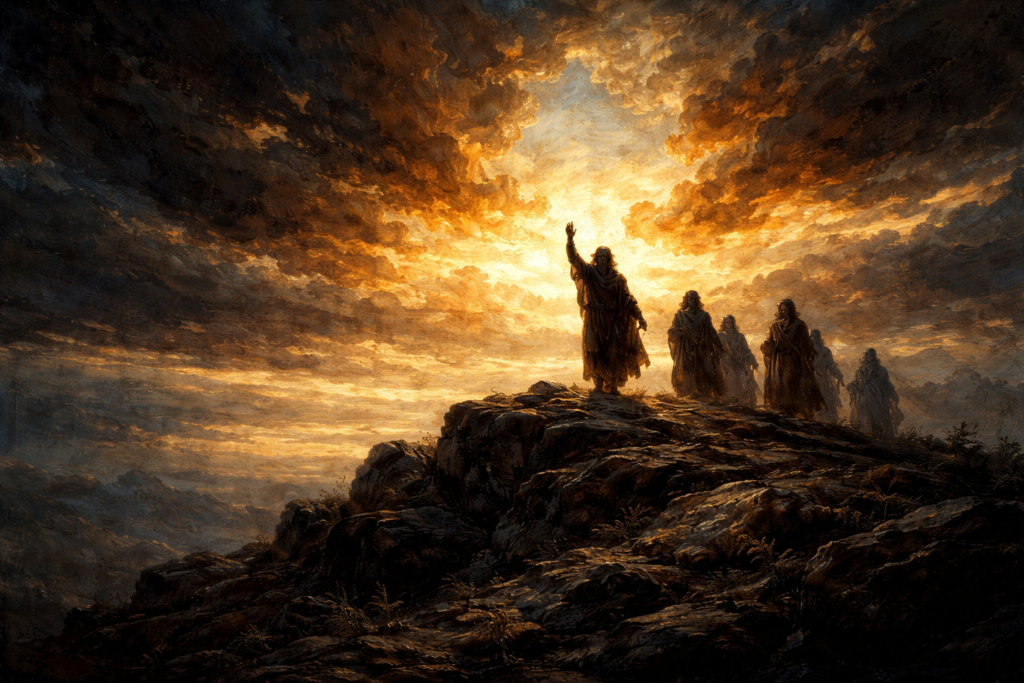
Just before His ascension, the risen Jesus stood with His disciples for one final conversation. After forty days together since the resurrection, the disciples asked their question:
“Lord, will you at this time restore the kingdom to Israel?” (Act 1:6)
It was an honest question. For them, the Messiah was the one who would overthrow Rome and rebuild the throne of David. He had risen from the dead — surely this was the moment. Three years of expectation compressed into a single sentence.
Jesus did not answer their question directly. Instead, He pointed in an entirely different direction.
“You Will Receive Power” — What Dynamis Really Means
The word Jesus used is δύναμις (dynamis) — power, ability, strength. It is the root of the English word “dynamite.” Because of this, it is easy to picture explosive, miraculous force — healings, signs, supernatural experiences.
But look at the structure of Jesus’ sentence. Dynamis is not the destination. It is the means. The sentence does not end at “you will receive power.” It continues: “you will receive power → and you will be my witnesses.” Power is given for the purpose of witness.
Reversing this order distorts the faith. If power itself becomes the goal, we are simply repeating the disciples’ question from verse 6 — “When will you give us power?” — in spiritual language. Jesus refused that direction. He opened an entirely different path.
“My Witnesses” — What It Means to Be a Martyr
The word μάρτυρες (martyres) means witnesses — people who testify in court about what they have personally seen and experienced.
This word later became the root of “martyr.” In the history of the early church, being a witness literally came to mean laying down one’s life. Stephen was stoned to death (Acts 7). James was executed by Herod (Acts 12). Tradition holds that Peter himself was crucified upside down in Rome.
Yet the heart of the word is not death itself. It is telling what you have seen. A witness does not invent new theories. A witness reports what they personally encountered — the death and resurrection of Jesus.
There is a distinctive humility in witness. A witness does not tell their own story. They tell the story of the One they saw. In John 21, Peter laid down his self-confidence and said, “Lord, You know.” That same posture now becomes the posture of a witness.
“Jerusalem, Judea, Samaria, the End of the Earth” — Expanding Circles
These four names are not a casual list of places. They are the blueprint for the entire book of Acts.
Jerusalem (Act 1 ~ Act 7) is the most familiar ground — the place where you already stand. Judea (chapters 8–12) extends a little further — the same culture, but beyond the comfort zone. Samaria (chapter 8) is the land of those whom the Jews refused to associate with. And the end of the earth (chapters 13–28) is an entirely different world — the Gentile world.

This structure reveals that the gospel does not stay where it is comfortable. The circles keep expanding outward. And the driving force is not human strategy — it is the Holy Spirit. When you read Acts closely, the church did not leave Jerusalem voluntarily. Acts 8:1 records that a great persecution broke out, and the believers “were scattered.” Painful circumstances became the very channel through which the gospel spread.
Between the Question and the Answer
The disciples asked: “When will you restore the kingdom?”
Jesus answered: “You will be my witnesses.”
Between these two sentences lies a massive shift.
The disciples asked for a result. Jesus gave them an identity. They wanted to know when. Jesus told them who — “You are witnesses. This is your reason for being.”
Results belong to God. The timetable belongs to God (verse 7: “It is not for you to know times or seasons that the Father has fixed by his own authority”). What is given to us is not a guarantee of outcomes, but a calling — to live as witnesses in the power of the Holy Spirit.
Reflection
Standing before this verse, I find myself asking:
What kind of power am I seeking right now? What is it for? Am I living as a witness, or am I still lingering inside the question — “When will you restore the kingdom?”
The life of a witness is not grandiose. It is simply telling what you have seen. Sharing the grace you have received. Carrying the conversation that restored you by the charcoal fire into your own Jerusalem — the place where you already stand.
The Holy Spirit comes for exactly that kind of life.
“But you will receive power when the Holy Spirit has come upon you, and you will be my witnesses.”
Pingback: Acts 4 Devotional — The Stone the Builders Rejected
Pingback: Acts 5 Devotional — Discovering the Bold Truth of God