John 21:15-17 meaning explained — why did Jesus shift from agapaō to phileō when asking Peter “Do you love me?” Discover the charcoal fire parallel and how restoration leads to mission.
“Simon, do you love me?”
The Return of the Charcoal Fire
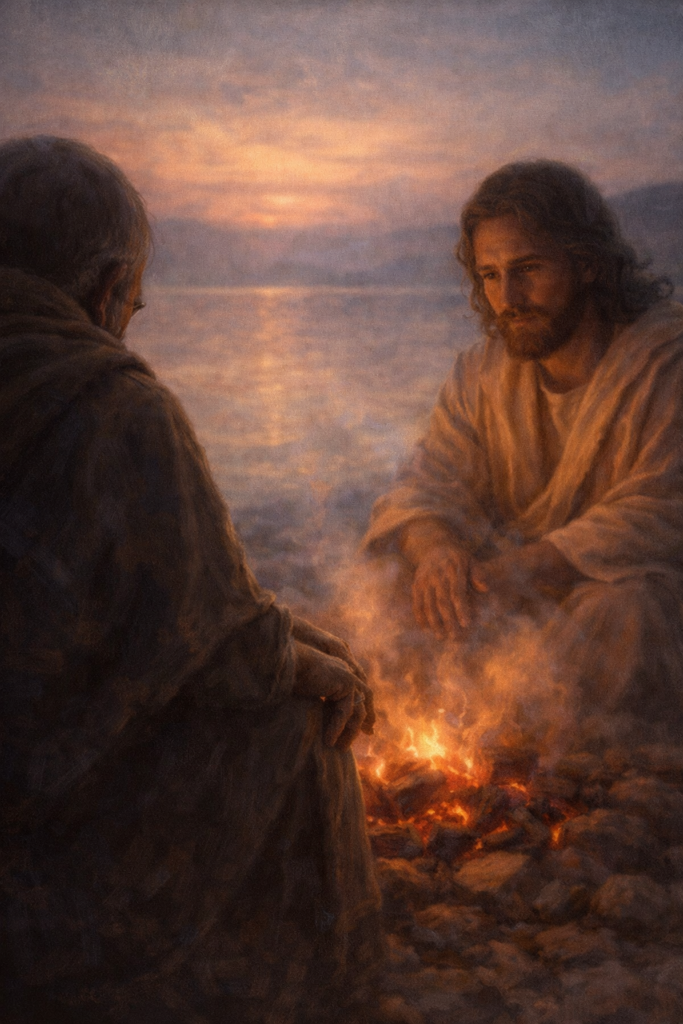
The risen Jesus waits for His disciples on the shore of the Sea of Tiberias. They have fished all night and caught nothing. When they arrive, Jesus has already prepared breakfast — fish and bread laid over a charcoal fire.
Here lies a detail that is easy to miss. The word for “charcoal fire” is ἀνθρακιά (anthrakia).
In the entire Gospel of John, this word appears exactly twice. Once in chapter 18, beside the fire where Peter denied Jesus three times. And once here, in chapter 21, at this breakfast on the shore.
This is no coincidence. Jesus is deliberately recreating the sensory landscape of Peter’s deepest shame. He is turning the scene of failure into a scene of restoration.

Three Questions, a Downward Movement
The First Question (v. 15)
“Simon, son of John, do you love me more than these?”
Jesus uses the word ἀγαπάω (agapaō) — a love that is volitional, self-giving, covenantal. And He adds a comparison: “more than these.” This is a direct reference to Peter’s declaration at the Last Supper: “Even if everyone else falls away, I will not.”
Peter’s response is striking. He does not answer with ἀγαπάω. Instead, he uses φιλέω (phileō) — the love of friendship, of warm personal affection. He also drops the comparison entirely. “Lord, you know that I love you.”
This is the answer of a man who has been broken. He can no longer make grand declarations. What remains is a humbled, honest confession.
The Second Question (v. 16)
“Simon, son of John, do you love me?”
Jesus still uses ἀγαπάω (agapaō), but this time removes the comparison — “more than these” is gone. He lowers the bar by one step.
Peter answers again with φιλέω (phileō).
The Third Question (v. 17) — The Turning Point
“Simon, son of John, do you love me?”
Something remarkable happens. Jesus sets aside His own word, ἀγαπάω (agapaō), and takes up Peter’s word, φιλέω (phileō).
Jesus descends to where Peter stands.
The text says Peter was ἐλυπήθη (elypēthē, “grieved”). This grief is not simply because Jesus asked three times. It is because Jesus entered even Peter’s lowest confession and asked, “Is even this real?”
Peter’s final answer is beautiful:
“Lord, you know everything (σὺ πάντα οἶδας / sy panta oidas). You know that I love you.”
This is no longer a confession built on self-confidence. It is not “I am strong enough.” It is “You know.” Peter places himself entirely in the hands of the One who sees all things. This is a confession that only someone who has passed through failure can reach.
Restoration Ends in Commission
After each question, Jesus gives Peter a mission:
- βόσκε (boske) — “Feed my lambs”
- ποίμαινε (poimaine) — “Tend (shepherd) my sheep”
- βόσκε (boske) — “Feed my sheep”
Restoration does not end in emotional comfort. Jesus does not ask, “Are you feeling better now?” He says, “Feed my sheep.”
This connects directly to the Good Shepherd discourse in John 10, where Jesus Himself is the shepherd who lays down His life for the sheep. Now He entrusts that very mission to Peter.
Those who have received grace become those who carry it forward.
Reflection
Jesus does not ignore our failures. He does not sweep them aside. He relights the charcoal fire. He asks the question three times. He lowers His words to meet ours. He enters the very center of our shame — not to condemn, but to restore in love.
And after restoring us, He does not leave us to rest. He gives us a calling again.
Even our smallest confession, our most timid love — the Lord receives it. And from that very place, He raises us up once more.
“Feed my sheep.”

Pingback: Acts 3 Meditation - Holokleria & the Faith That Makes Whole